Archives November 2023

Escorted by Dolphins, Hello New Orleans!

Day 189 – 193; 11/24 – 11/28: Friday, 11/24 (day after Thanksgiving) we were off on a 2 day trek to New Orleans with Coda, leaving Lil Sudden and SAGA to take a few extra days stopping at some of the ports along the way while we planned to hit them on the way back to FL. Why the different plan you may ask? We’ve been having trouble with our house batteries so new ones will be delivered in New Orleans. With our failing batteries, we only had power while running the engines, running the generator or in a marina plugged into shore power. Heading straight to New Orleans would get us to marina power and the new batteries the quickest.

Steve’s girlfriend Toni arrived from Seattle on Thanksgiving day, way after our bed time, so we decided we’d all sleep in Friday morning (with our bellies full of turkey) and planned an 11:00 am departure. We left in glorious sunshine but crisp temperatures, headed to an anchorage off of Horn Island, south west of Pascagoula, MS.

We knew it would be a fairly long run, around 6 hours, but knew we had Thanksgiving Round 2 waiting for us when we arrived. We had our eyes peeled for dolphins and they did not disappoint. We saw them off in the distance jumping and playing as well as feeding with the birds. The best was when they decided to be our escort and 4 or 5 of them rode in our bow wave (see videos below).

We anchored in about 20’ of water and rafted up with Coda. It was great to just sit and relax with Steve and Toni after such a beautiful ride, and of course Looper Midnight came early (around 8:30 pm) and we all turned in. We had the benefit of the protection of Horn Island to the south, but when the winds shifted after we had gone to bed, we found ourselves in about 7-8’ of water and winds too strong for us to stay tied together. Coda pulled off and set their own anchor around 11:00 pm. We also pulled anchor and reset further away from the island, back in about 20’ of water. Now on our own anchors, we bounced around a lot less and got a few hours sleep before setting off around 7:00 am for the final leg of our trip to New Orleans, a 9.5 hour run.

It was another beautiful crisp day navigating some narrow channels where depth outside of the channel had only 4-5’ of water. The last stretch was a man made canal with plenty of depth, only a few tows with barges to pass and a railroad bridge where we had to wait for a train to pass and request an opening. Settled into our slips, we were all exhausted from the lack of sleep the night before, ate at the local restaurant at the marina (which was quite good) and turned in early. Our prize of touring New Orleans in the morning was ahead of us and we all slept like babies!

Sunday morning, 11/26 we ubered into downtown NOLA in search of beignets – a New Orleans delicacy which is basically fried dough covered in powdered sugar! We found them at Cafe Du Monde in the French Quarter, right near Jackson Square. With a little (okay a lot) of sugar and some caffeine from the lattes, we were off to explore New Orleans with the help of the Hop-On-Hop-Off bus.

Street Music – 10:30 am!

New Orleans history goes back to its founding by the French in 1718, who ruled it until 1763. Following Britain’s victory in the 7 year war, the French colony west of the Mississippi River including New Orlean was ceded to the Spanish as a secret provision of the 1762 Treaty of Fontainebleau. According to our tour guide, King Louis XV of France transferred ownership of the region to his cousin, King Charles III of Spain to avoid having to give up the region to Great Britain as one of the settlements of the war…. If you don’t own it, you can’t give it up! Quite brilliant and sly.

No Spanish governor came to take control until 1766. French and German settlers, hoping to restore New Orleans to French control, forced the Spanish governor to flee to Spain in the bloodless rebellion of 1768. A year later, the Spanish reasserted control, executing five ringleaders and sending five plotters to a prison in Cuba, formally instituting Spanish law. Other members of the rebellion were forgiven as long as they pledged loyalty to Spain. Although a Spanish governor was in New Orleans, it was under the jurisdiction of the Spanish garrison in Cuba.

In 1800, Spain and France signed the secret Treaty of San Ildefonso stipulating that Spain give Louisiana back to France, although it had to remain under Spanish control as long as France wished to postpone the transfer of power.

In April 1803, Napoleon sold Louisiana (New France) (which then included portions of more than a dozen present-day states) to the U.S. in the Louisiana Purchase for $15M. At first, Napoleon, planned to build a huge North American empire based in Haiti, but a slave rebellion on the island ended this plan. Embroiled in a war in Europe, Napoleon accepted defeat in Haiti and decided to sell the Louisiana Territory to the United States in 1803 to help finance his war with Britian. Louisiana was admitted to the union in 1812 as the 18th state.

New Orleans culture is truly a mix of French, Spanish, African and Caribbean influence. One fascinating thing we learned was the number of free, well educated and professional blacks in this area of the Deep South at the time. In 1805, a census showed a heterogeneous population of 8,500, comprising 3,551 whites, 1,556 free blacks, and 3,105 slaves. The free blacks had slaves themselves and were mostly from Haiti. Interracial marriage was common and life under French and Spanish rule was quite good…. That would all change under US rule with its views on slavery and reinforcement of the caste system built to keep the black population as slaves. More on that another time!

Our tours took us through the French Quarter, down Bourbon Street (Oh My!) and through the Garden District. We ended our first couple days in NOLA on Frenchman Street enjoying some live jazz in various styles.

Lil Sudden and SAGA arrived in NOLA on late Monday, joining us on Frenchman Street. Nice to have the Flotilla together again. Watch out NOLA! Frenchman Street is known for its local live jazz bars. We hung out and listened on Monday night, grabbed dinner but didn’t stay out of late since Toni had to leave very early in the morning to catch a flight.

Tomorrow was another day and we expected to receive and install the new house batteries – YAY! We are here almost a week… so plenty of time for touring.
Goodbye River System; Hello Mobile Bay and DOLPHINS; onto Fairhope, AL for Thanksgiving

Days 184 – 189; Nov 20 – 24: November 19th (Sunday) had taken us further down the river system, where we celebrated our last lock until we hit North Carolina. That called for a little champagne toast as we enjoyed Sunflower East Anchorage!

The morning of November 20th (Monday), brought us some challenges. Having left the last lock behind, we were now in tidal waters and under estimated the power of the tide. Over night we swung around and now had 3 anchors tangled around each other….ugh! With a lot of team work and patience, we got them all sorted out and were on our way around 8:30 am. Monday would be about a 5 hour run with our next anchorage in the Tensaw River, just where it branches off of the Mobile River; It was a twisty turny, yet uneventful run…. Let’s just say more of the same! We did pass Bobby’s Fish Camp on the way that was previously a must stop for loopers. With rates at $2.75/foot with no power or services, we decided to pass and anchor out further down river.

Arriving at the anchorage in Tensaw River, it was cloudy with rain arriving in the afternoon. We had 2 anchors down and a stern tie for 3 of the boats; Saga decided to anchor on their own, but joined us for dinner. The stronger winds and rain came after dinner, intensifying overnight. We pulled anchor around 8:00 am on 11/21 (Tuesday) where it was raining on and off. There were cows on the beach…. What?

Legacy’s anchor was up first, just before the skies opened up; Coda was not so lucky and Steve got drenched! We ran from the pilot house the entire day due to the rain, dodging tons of debris from (we are guessing) all the rain raising the water level which re-floated all the junk from the beaches. We aren’t talking just a few sticks or clumps of grass…. We’re talking full size trees and logs! We were happy to reach the end of the river and Mobile Bay/Gulf of Mexico and clear water.

Not being able to secure slips in Mobile, we made the run across Mobile Bay to Fairhope Yacht Club, who could accomodate all 4 boats for our 3 day stay over Thanksgiving.

Mobile was very industrial with tows, container ships, military ships, ship building and oil rigs. We were excited to be out of the river system and into Mobile Bay, but were surprised as to how shallow it was (8-12 feet) with some dangerously shallow spots we needed to avoid.

Check out the video below of our last day on the river.

The shallow made for warmer waters and DOLPHINS! They were super hard to catch on video or photo, but great fun to keep an eye out for. We did get a short shot of them riding in our bow wave and playing ahead us. You might wonder why they ride in the bow wave of a boat. First of all they are very curious animals and want to check out the boats. Second, it’s an energy efficient way to travel with the flow of the water assisting them – faster and farther with less effort. Being playful and curious animals, though, it’s mostly for fun. We sure thought it was!

Thanks to reciprocity with AYC, we stayed at lovely Fairhope Yacht Club and enjoyed a cocktail at their bar where we found our AYC burgee on display with all the other reciprocal clubs, then it was back to the boats for dinner.

Fairhope was a lovely town with a very nice Main Street filled with a variety of shops and restaurants. We particularly enjoyed Panini Pete’s (a Diners, Drive-ins and Dives location) for lunch and Gambino’s for dinner (Italian if you didn’t already guess!). Fairhope also boasts a beautiful waterfront, scenic bluffs & parks, flower filled streets and colorful sunsets on the Mobile Bay. With a couple rental cars, we re-provisioned all of the boats including for our Thanksgiving Dinner. Thanksgiving festivities started at 1:00 pm with ‘’Appetizers in the Adirondacks’ on the yacht club grounds including a tasting of 6 differernt Cabernet Sauvignons chosen by Boris. Dinner was at 3:00 pm aboard Legacy with delicious contributions by all including 2 turkeys, 2 hams, 3 kinds of stuffing and all the other fixings. We were creative with our seating of 12, but no one left hungry and everyone had their favorite things! We all know what happens when turkey and red wine comes together…… tryptophan overdose which enduces sleepiness!

Do you remember the now infamous 1997 Seinfeld episode when Jerry and George scheme to make as woman fall asleep so they can play with her antique toy collection? They feed her a big turkey dinner with lots of gravy and a box of red wine. Tryptophan was specifically mentioned as “that stuff in the turkey that makes you sleepy.” The rest, they say, is history regarding the birth of the tryptophan myth….. It’s just a myth! Of course dinner was followed by football and dessert along with the massive clean up effort.

After 3 days in Fairhope, we are off (11/24) to New Orleans with Coda. We will anchor half way and arrive the evening of 11/25 (our 6 month mark on the Loop). Saga and Lil Sudden will take a couple extra days to get to New Orleans, arriving 11/28.

2 months from Chicago to the Gulf of Mexico
Legacy and Coda departing Fairhope, AL

3 Flemings, 2 SeaRays and an American Tug; Last lock on the Tenn-Tom!

Days 182 – 183; Nov 18 – 19: After a lovely night at anchor with the reunited 4 musketeers (do you remember their names? D’Artagnan, Porthos, Aramis and Athos), we were anchors up at 9:00 am headed to Okatuppa Creek – a 54 mile run that took us about 6 hours. Scenery was more of the same as we wound our way down river, following a path that looked like a ribbon thrown on the ground. The Tombigbee River twists and turns, folding back on itself in sharp curves, passing itself going in the opposite direction.

The riverbanks are mostly a tangled mess of fallen trees due to erosion, exposing sandy beaches and shallow flats on some of the sharp curves. We were thankful for the uploaded route with hundreds of waypoints and the autopilot making each little turn every few minutes. It’s a lot of beeping, as the autopilot beeps every time it makes a turn, but a huge help not having to make each turn manually. Of course we never leave the helm and can take autopilot off with a single button.

We arrived at Okatuppa Creek around 3:00 pm and proceeded cautiously with Lil Sudden in the lead, knowing they drew the least amount of water. Always smart to be cautious, but water depth wasn’t an issue as we saw no less than 8-9 feet and at times 30 feet. About a half of a mile in, we zigged around Mona Lisa who was already anchored in the middle of the creek and found a nice wide part at a sharp turn that would allow us to anchor, raft all 4 boats and tie off the stern to a couple trees preventing us from swinging. This would also keep the passage open for other boat traffic, should there be any. Mission accomplished around 3:15 pm. This was not our first rodeo!

Around 4:15, what did we see coming around the corner, but 2 more Flemings! Blue Moon (58-032) and Blessed Again (55-053), who we had seen several times on the loop but not yet spent any time together, asked to join our raft. Of course we said yes. We already had 2 anchors down and there was literally no current or wind, so they just came along side. Within a few minutes, we were 6 across and truly ready for a safe arrival drink as Boris and Mayli worked on dinner – a home made fish stew made from Boris and Michael’s previous fishing efforts! It was lovely to finally meet Steve and Judy on Blue Moon and re-meet Perry and Vicki on Blessed Again. We had first met Perry and Vicki at anchor in Cape May, day 2 of our trip! Blue Moon is Legacy’s younger sister, having been delivered June of 2021 whereas Legacy was June of 2020. Fleming produces 2 58’ boats per year. Okay, truth be told, we have been semi-stalking both boats on NEBO for some time (as they have been doing the same with us), but just hadn’t managed to cross paths. Well now the gang was all here!

Sunday morning, 11/19 was CHILLY!! We awoke to 36 degree temperatures, but a forecast to reach 70 degrees. We broke up the raft around 7:00 am to get to the Coffeeville lock before 8:00 since the lockmaster agreed to lock us through before shutting down for some maintenance.

Last lock on the Tenn-Tom

All 6 boats locked through with ease – our last lock on the Tenn-Tom which took us down 34 feet. Hooray for our last lock in a while! Check out the video below of Legacy leaving the last lock.

The rest of the river was more of the same with a bit of barge traffic to navigate. Check out the video below of a slight traffic jam with 2 barges and our fleet all passing each other.

Scenery was still lots of erosion, downed trees and exposed beaches; a bald eagle, a few floating logs but no alligators yet, although other boats have reported seeing some. We did see varying depths of water, but nothing that gave us great pause.

Our next stop: Sunflower East Anchorage; should arrive around 1:00 pm. Tonia and Matt are making dinner: Risotto! We may pull out some jalapeño poppers and see how they come out in the new air fryer. One more anchorage on Monday then we are in Mobile, AL for Thanksgiving. Much to be thankful for!

Onto Columbus, MS where Carol is off to Boston for a few days and “the village” lends a hand; Beautiful White Cliffs of Epes in Alabama

Days 177 – 181; Nov 13 – 17: Monday, 11/13 we were up around 7:00 am, giving our weary friends a glimpse of the anchorage they entered after dark. After calling the lock, we pulled anchor and were off a little before 8:00 am to get through Aberdeen lock, about an hour away, before a tow got there before us. The lockmaster agreed to lock us through before the tow, saving us about an hour of wait time. Check out the below for what it’s like cruising the Tenn-Tom.

Tenn-Tom cruising

We arrived at the marina in Columbus, MS around noon; Steve, the owner, did an awesome job calling us in one at a time and getting us docked.

We were pleased to run into Kim Russo (director of the AGLCA) and her partner Michael Martin aboard ‘The Perch’ as well as Brent and Sarah Bowlin and their children Mary Grace and Miller aboard ‘Light and Salty.’ Both families are liveaboards. Side story – why is the boat named The Perch?….. because their boat is also home to Mike’s cockatoo Margo! Kim is not as much of a fan….her boat (a runabout in Charleston) is called Freebird! Relative to “Light and Salty,” this is a reference to the Bible and book of Matthew, chapter 5 verses 13 and 14 that reference the “salt of the earth” and the “light of the world.” There is always a great story behind a name!

Carol had a couple meetings in the afternoon and Gary was pleased that his shipment of 25 gallons of oil and oil filters arrived – he’d use that to change the oil (11 gallons per engine) in Demopolis, AL on Wednesday. Monday nights dinner was at Harvey’s, the top recommendation by Steve, with the crews of The Perch, Light and Salty, Saga, Lil Sudden and of course, Legacy.

Table for 14! 5 looper boats!

Tuesday morning the alarm bell went off at 3:45 am for Carol to be up and out by 5:00 am to get a car to the airport for a flight at 6:15 am to Boston for 2 days of meetings. Gary and our flotilla left Columbus around 9:00 am with Mayli on board Legacy to help with the locks, arriving at Upper Cooks Bend Anchorage around 4:30 pm. Great job by Annette and Michael on Saga helping out with the locks! This was the day we crossed into Alabama from Mississippi. Mayli and Boris made Bratwurst for dinner while Gary made old bay fries.

Temperatures dropped overnight and the rain came down. Wednesday was up and out by 6:00 am, before the sun was up, again to beat a tow to the lock and get through. Mayli again helped on Legacy, Saga rafted to Legacy in the lock and Mayli jumped back on her own boat after the lock. It was another long run (60+ miles) to Kingfisher Bay Marina in Demopolis, AL, arriving around 1:15.

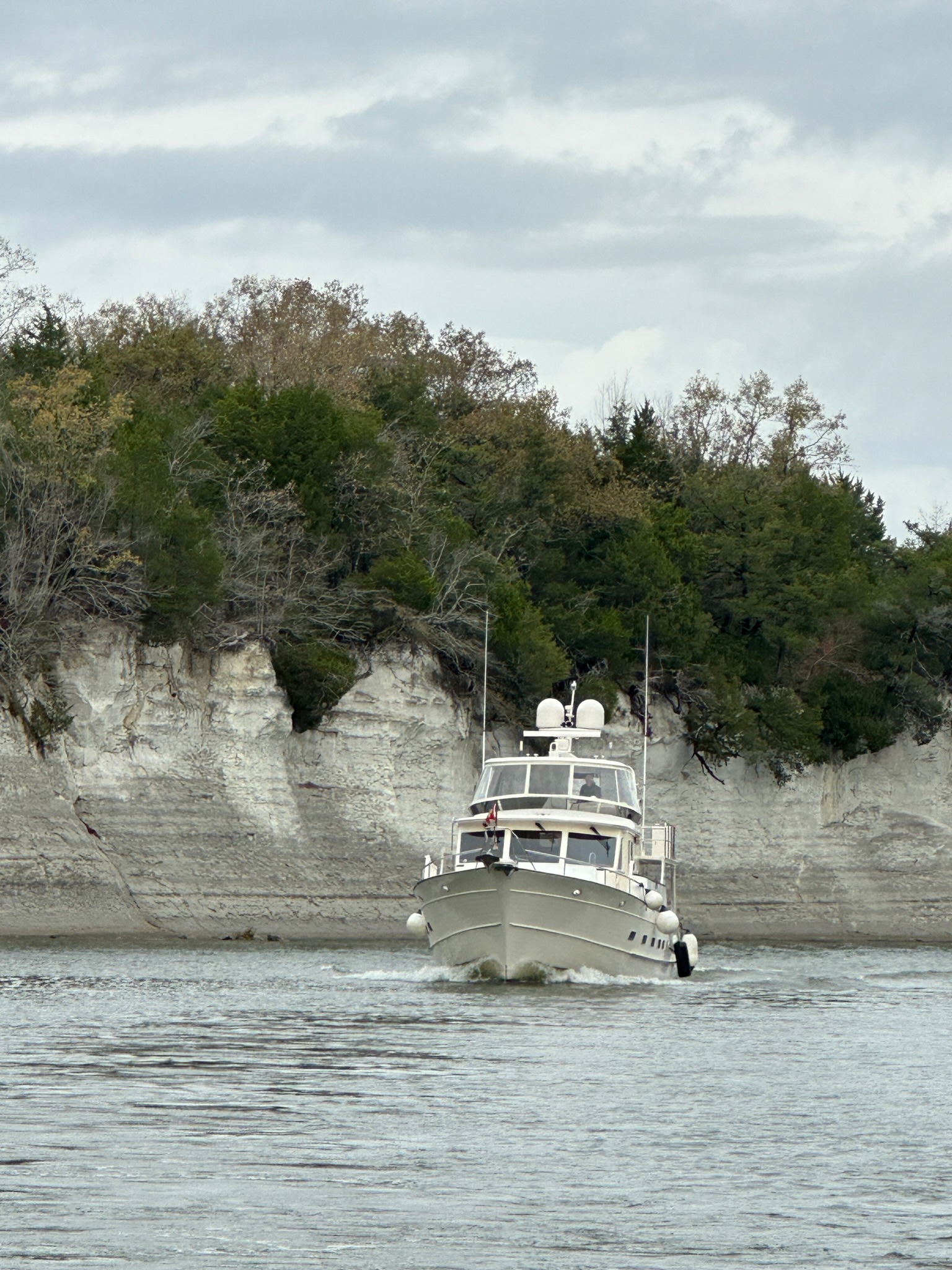
This was one of the more scenic days on the Tenn-Tom passing through the White Cliffs of Epes. The White Cliffs of Epes proved to be a beautiful break from the somewhat monotony of the river. Weather was overcast making the cliffs a bit gray versus bright white. This striking mile of white cliffs provides a window into what Alabama was like during the time of the dinosaurs. Similar to the chalk that makes up England’s famous White Cliffs of Dover, the Alabama version hasn’t earned nearly as much renown.

The chalk began forming in the Cretaceous Period, which began about 145 million years ago. At that time, Alabama would have finally drifted north of the Equator to around the same latitude you find it today. The supercontinent Pangea was in the later stages of breaking apart, creating the Gulf of Mexico and covering most of Alabama with water.

The chalk is a form of limestone, a sedimentary rock deposited when this part of Alabama was still underwater. The rock itself is made up of the remains of single-celled marine organisms and lime-producing algae, which collected in a shallow sea along with the runoff from Alabama’s fast eroding mountains to the east. The tiny shells and plates of the chalk-forming plankton rained down upon the sea floor for many millions of years. Geological studies estimate that every foot of chalk deposit represents about 18,000 years of buildup of those organisms. The exposed cliff face in Epes stands about 80 feet high, meaning about 1.4 million years of marine sediment can now be seen above the Tombigbee water line. The rest is buried underground. Some Alabama chalk formations are more than 500 feet thick, representing at least 9 million years of dead algae and plankton building up on the seafloor.

Back then, the shoreline would have been somewhere around Montgomery, give or take, but would have moved around as global temperatures increased and sea levels rose. Evidence shows Alabama’s so-called “Goat Hill,” where the state capitol building sits, was actually a barrier island in the young Gulf.

Dinosaurs like Appalachiosaurus would have roamed tropical jungles in between the beaches and the mountains. The chalk here also has the distinctive quality that it doesn’t let water through. Water in the Black Belt still tends to pool at the surface rather than filtering through to the deep groundwater beneath the bedrock.

That meant the development of dark, rich soil atop the chalk during the thousands of years after the land dried out. Tall grasses grew on the site for millions of years, and their decomposition created a dark, rich humus that would later prove ideal for cotton farmers.  This soil, built over millions of years, drew European settlers. The area became the heart of the South’s cotton plantations, and the forced import of enslaved African people to work the plantations. Alabama’s Black Belt was among the most valuable in the world during that time.  Much of the fertile dark soil that gave the area its name has weathered away to the chalk bedrock beneath.

The area is still good for growing grasses to support cattle and other livestock, but the massive cotton farms are largely relics of the past. The Black Belt today is instead ideal for catfish farming, with some of the largest operations in the country springing up among the old cotton fields. But the chalk has also made the area ground zero for concerns over environmental racism. Populations in many parts of the Black Belt are among the poorest in the state, and in some cases 90 percent Black. That same impermeable bedrock that made for rich cotton farming until the soil got used up is now attractive for developers of landfills, turning the area into a convenient dumping ground for the rest of the country.

Isn’t if fascinating to look behind the scenes of natural beauty as to its history/roots and ramifications? I’ll stop here leaving you with the image of these beautiful cliffs, but one off the largest landfills in the country right behind it.

Okay end of history lesson and back to the trip….After arriving at the marina in Demopolis, Gary changed the oil in both engines and everyone got their pizza craving satisfied by Dominoes! It was more rain overnight, but atleast a little warmer.

Thursday, 11/16 was another work day for Gary – fixed the TV mount that was stuck down, changed the oil in the generator, reset the nav system in the pilot house that thought we were in FL, got a haircut, got rid of the old oil, figured out how to upload routes from Navionics (navigation app) to Legacy’s Furuno system and figured out how to get local channels on the TV. Wow that was a lot of stuff, but the best was the Navionics to Furuno interface. The first route uploaded to the autopilot included 286 waypoints, meaning 286 turns that would have had to have been programmed or steered manually! YAY!! Lunch was at the Bistro, which was large enough and late enough that no dinner was needed! Carol arrived after 12 hours of travel around 10:00 pm, happy to reunite with the flotilla.

Friday, 11/17 would be the day we also reunited with Coda, after their side trip to Louisville. Steve and Barbara arrived around 9:00 am, filled the fuel tanks and the ‘four musketeers’ we were off again around 10:00 am, right when Carol’s meeting started! We are so thankful for Mayli again helping with the lock while Carol was on the call….. yes there have been a lot of calls in the last couple weeks, but you do what you gotta do!

We dropped anchor in the Edna Bend Anchorage around 2:45 pm after a twisty turny day on the river. The anchorage was literally a bend in the river where you could tuck in and stay out of the way of the tows….barely!

Dinner was Carol and Gary’s version of ‘Marry Me Chicken’ over pasta – yummy white cream sauce with garlic, parmesan cheese, sun dried tomatoes and spinach. So great to see Steve and Barbara again so we celebrated with some Kentucky Bourbon Steve and Barbara picked up in Louisville and light sticks. We also planned our Thanksgiving dinner menu, dividing up the tasks and making sure everyone’s favorites are covered.

Saturday, 11/18 we were treated to Steve’s amazing custom brewed coffees and lattes as well as a fabulous breakfast on Steve’s new grill – homemade hash browns, cheesy omelets and bacon!

It was anchors up at 9:00 am and we are off to Okatuppa Creek – about a 50 mile, 7 hour run. We are all getting a little weary of the boredom of the rivers (we have 3 more nights of anchorages) and looking forward to civilization in Mobile, AL.

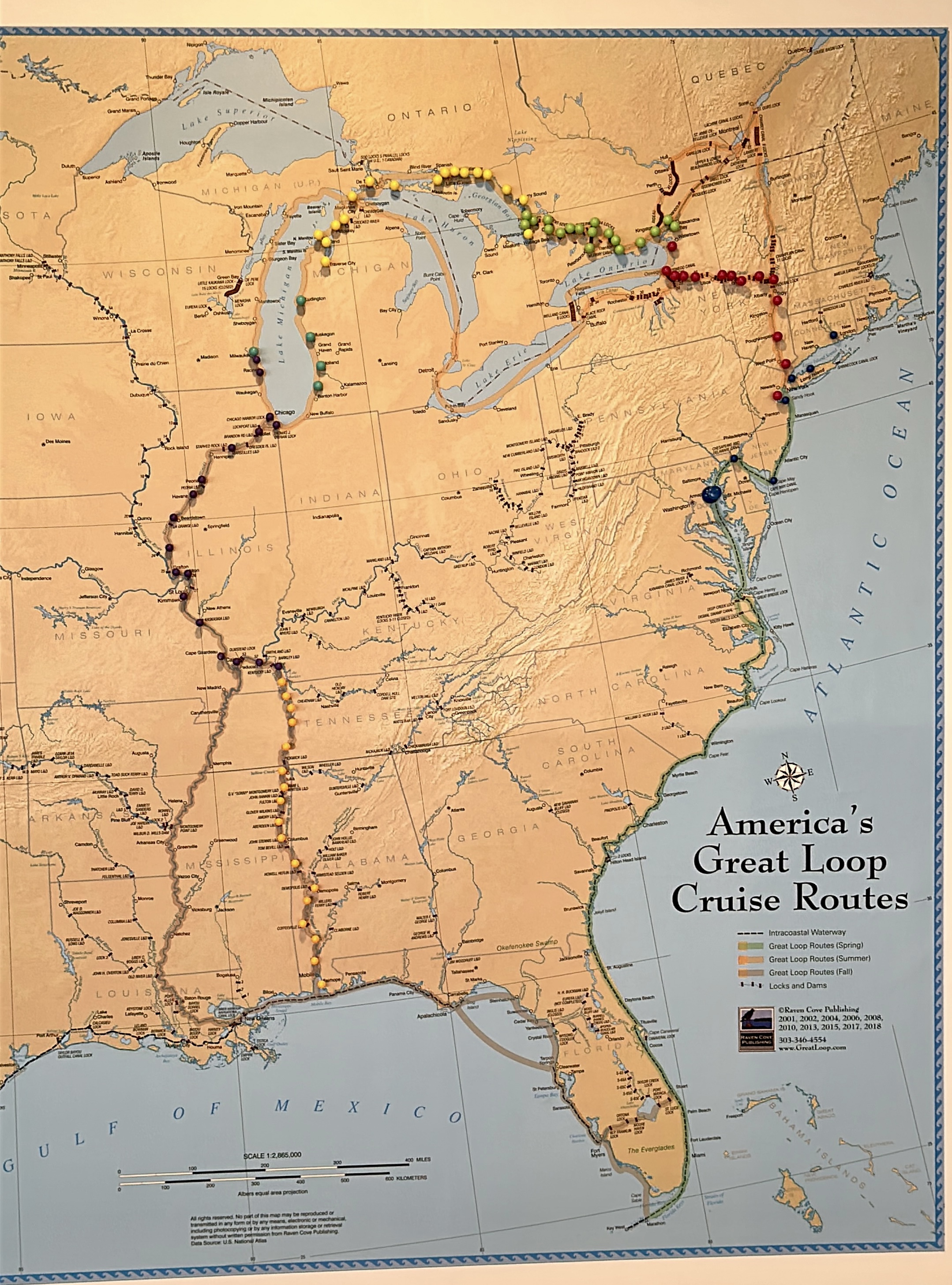
We’ve covered lots of ground in November! Orange/mustard color pins represent our travel in November.

Hello Tombigbee Waterway (Tenn-Tom)! Check out the lock with 84’ drop, gorgeous sunsets and story of lost anchor/found dog!

Days 174 – 176; Nov 10 – 12: After 2 days in a marina with full power, water, pump out, courtesy car, marine store and more….. all 3 boats were fully re-provisioned, so we were off! It was lines off at 9:00 am headed down the Tennessee River onto the Tennessee-Tombigbee Waterway to an anchorage at Bay Springs, MS.

The Tombigbee waterway is an interesting fellow, connecting the Tennessee River to the Tombigbee River.

Popularly known as the Tenn-Tom, it is a 234-mile man-made waterway completed in 1984 at a cost of nearly $2 billion USD. It links commercial navigation from the nation’s midsection to the Gulf of Mexico, providing an alternative to the Mississippi. The Tenn-Tom features 10 locks and dams, each 110’ wide by 600’ long with a total lift of 341 feet. It took 12 years to complete. We’ve heard that compared to the Panama canal’s cost of $375M and 10 years to build, but that was in 1904 – 1913. 5600 people died during that construction project, mostly from malaria. I couldn’t find any safety information on the Tenn-Tom.

So why build this? From Chattanooga, TN it is 1800 miles to New Orleans via the Tennessee, Ohio, and Mississippi Rivers. Shipping costs were high. The Rivers and Harbor Act of 1946 authorized the Corps of Engineers to plan for a canal between the Tennessee and Tombigbee Rivers that could cut that distance by 1000 miles, saving businesses millions of dollars in just a few years. In 1958 Alabama and Mississippi established the Tennessee-Tombigbee Waterway Development Authority. After receiving favorable economic reports, Congress accepted the plans in 1961 but appropriated no funds for another decade.

President Nixon turned the first official spade of earth in May 1971, but the Corps of Engineers had yet to set long-term construction schedules or complete the required environmental studies. The Corps spent more than a decade conducting those studies and refining construction designs.

As planned, the Tennessee-Tombigbee has become a preferred route for transporting large and heavy finished products and raw materials between the Gulf of Mexico and the American heartland. Using the waterway instead of the Mississippi-Ohio River system reduces fuel consumption and lowers shipping costs. But most important (atleast to us) – it made the Great Loop possible!

Our plan over the period of 11/10 – 11/13 was to travel a reasonable amount each day, anchor out (there are very few marinas) and end up in Columbus. MS on 10/13 since Carol needs to fly out on 11/14 for a BOD meeting. First night (Friday, 11/10) was Bay Springs and we found a great anchorage around 1:45 pm. Mayli put out an amazing charcuterie board while looking ‘very yachty’ and later served up corned beef and cabbage for dinner.

Saturday, 11/11 was anchors up at 8:00 am with 3 locks to get through to our targeted destination just north of the Fulton lock. Our first lock (the Jamie Whitten lock) was the tallest on the Tenn-Tom with a drop of 84 feet. Check out the pics below and the time lapsed video of huge doors opening on the Jamie Whitten lock as well as our full descent in the Montgomery lock (only 30’)…. Can you tell I’m playing with a new toy?

Doors opening after 84’ drop
Experience a lock – going down!

After 3 locks, we found another great anchorage. We were rafted up by 12:30 and watched college football. That called for some fun appetizers and Tonia made an Iowa comfort-food chicken casserole that her Mom used to make for dinner. Most impressive was the amazing colors of the sunset!

11/12 (Sunday) started off as any other day…. We were up and lines off at 7:30 am. Legacy and Lil Sudden separated from Saga, who was the anchor boat, and started down river. Saga called back that as they had the anchor almost all the way up, it separated from the chain….. as in…it just fell off! WHAT?!?! We all turned back, Saga marked where they thought it fell, re-anchored tied to Lil Sudden and we all tried to find the needle in the haystack. Boris got out his diving gear and both Matt from Lil Sudden in Saga’s dinghy and Gary and I in Legacy’s dinghy tried to drag a smaller anchor hoping to snag it. By 10:00 am, Legacy needed to start down river because Carol needs to be on that plane out of Columbus on Tuesday morning. Lil Sudden and Saga stayed behind to search, without success, for several more hours giving up around 2:00 pm…. But that wasn’t until after they had a German Shepard mix puppy swim up to their boat out of no where! Did she fall off a passing boat? Did she swim from land? With no collar…don’t know. They pulled her out of the water, dried her off and gave her some food and water, then took her to the nearby marina hoping they would help to find her owner.

Legacy passed through 3 locks and looked for a safe place to anchor and await the arrival of Saga and Lil Sudden, who would now arrive in the dark, likely around 7:00 pm; it gets dark here around 5:00 pm. Our charts indicated a safe anchorage fairly close to the Aberdeen lock, but with water levels so low, that was a no-go. We ended up backtracking 7 or 8 miles to a safe spot which made the journey a little shorter for our weary friends. All ended well with Gary’s pot roast dinner complete with roasted potatoes, carrots, onions and homemade gravy. They said they could smell it as the entered the cove where we were anchored. We had every light on the boat turned on so they could safely find us and all went well. No pics as they came in, although they looked beautiful all lit up; we were too busy catching lines!

Tomorrow (Monday, 11/13) we will pass through 2 locks on our way to a marina in Columbus, MS…. first marina in 4 days. Carol has a flight out on Tuesday morning at some ungodly hour and Gary will continue with the flotilla arriving in Demopolis on 11/16 where Carol will rejoin them. Then it’s onward down the Tenn-Tom to Mobile, AL where we will all spend a few days celebrating a friends Thanksgiving. At dinner last night, we shared all of our different traditions and favorite dishes….. this is going to be quite the varied smorgasbord!

Below is our progress to date. The yellowish color is November; still a ways to go to get to Mobile and some turkey!

Journey so far…also of 11/11/2023

Tennessee River to Grand Harbor/Pickwick, TN and the Tombigbee Waterway; Amazing visit to Shiloh National Park – site of the bloodiest battle in US History as of that date.

Days 171 – 173; Nov 7 – 9: It was anchors up 10:00 am as we headed up river on the Tennessee River to an anchorage behind Wolf Island, TN arriving round 1:30 pm. We passed many homes up on stilts (Gary says they are properly called piers) of various heights to protect them when the river rises. The rock formations with their striations and layers were interesting in that they weren’t level. We wondered if this was the result of earthquakes in this area in 1811/1812 (magnitude 7.2 – 8.2 with aftershocks up to 7.4)

Water levels seemed low by about 6 feet “from datum” meaning low from the benchmark for measurements for charts and bridge clearances. That’s good for us to get under bridges but bad for the risk of hitting bottom!

It was alarming to see some of the damage from tornados including one that looked very recent – we saw one house where the roof was ripped off and the bedroom furniture still in place. We saw quite a few homes under repair, some just a pile of rubble and others new rebuilds.

Since we were anchored by 1:30 we decided on some work and some play. Mayli and the kids finished up their schoolwork for the day, Carol got some board work done and we had a “sip and paint” afternoon! A great time was had by all as we took our varying degrees of talent and expertise and attempted to recreate a sunset with 3 palm trees! We topped off the night with Mayli and Boris’ beef stroganoff for dinner and Carol’s pineapple upside down cake for dessert!

11/8 (Wednesday) we hauled anchor and were underway by 6:00 am since we had about a 2 hour trip, one lock to go through (the Pickwick Lock and Dam with a vertical lift of 63 feet) and Carol had a meeting she needed to attend from 10:00 am – 12:30. This would be our last lock that we’d travel UP, all the rest will take us back DOWN to the level of the Gulf of Mexico.

We arrived around 9:30 am giving us time to get settled into the marina in Grand Harbor (Pickwick), get the meeting done then we were off with Bill and Mary Routt, who live in Memphis but have a place on Lake Pickwick at the mouth of the Tennessee-Tombigbee waterway.

Bill and Mary were super gracious hosts and we enjoyed 2 days wtih them including lunch at the Catfish Hotel, a tour of the Civil War battlefields at Shiloh and Corinth, dinner at The Outpost and lunch at the old Borrum Drug Store and Soda Fountain – the oldest drug store in continuous operations started at the end of the Civil War. Bill taught us how to eat catfish and we learned these small edible catfish are called “fiddlers.” When he ordered a whole catfish, we envisioned some monstrous thing being brought to the table but learned those huge catfish (+30 lbs) people post pics of that they caught are just released – not edible! Can‘t thank Bill and Mary enough for such a great couple days! Their southern hospitality was off the charts and we are forever grateful!

Shilo (and the next day visiting Corinth) gave us some amazing Civil War history…. First, we had not realized the armies of the north (US) and south (Confederacy) were organized by state; so each state sent their armies and Generals then coordinated them…. So know that you know that, here is some history:

The American Civil War (April 12, 1861 – May 26, 1865; was fought between the Union (“the North” or “Federals”) and the Confederacy (“the South”). The Confederacy was formed by states that had seceded from the Union. The cause of the war was the dispute over whether slavery would be permitted to expand into the western territories, leading to more slave states or be prevented from doing so, which many believed would place slavery on a course of ultimate extinction.

Decades of political controversy over slavery was brought to a head by the election of Abraham Lincoln to the US Presidency in 1860. Lincoln opposed slavery’s expansion into the western territories. Seven southern states responded to Lincoln’s victory by seceding from the United States and forming the Confederacy. The Confederacy seized U.S. forts and other federal assets within their borders. Four more southern states seceded after the war began. Led by Confederate President Jefferson Davis, the Confederacy asserted control over about a third of the U.S. population in eleven states. Four years of intense combat, mostly in the South, ensued.

By mid-February 1862, United States (Northern/Federal) forces had won decisive victories in the West at Mill Springs, Kentucky, and Forts Henry and Donelson in Tennessee. These successes opened the way for invasion up the Tennessee River to sever Confederate rail communications along the Memphis & Charleston and Mobile & Ohio railroads. Forced to abandon Kentucky and Middle Tennessee, Gen. Albert Sidney Johnston, supreme Confederate commander in the West, moved to protect his rail communications by concentrating his forces around the small town of Corinth in northeast Mississippi – the strategic crossroads of the Memphis & Charleston and the Mobile & Ohio rails.

In March, armies under Maj. Gens. Ulysses S. Grant and Don Carlos Buell moved southward to sever the Southern railroads. Grant ascended the Tennessee River by steamboat, disembarking his army at Pittsburg Landing in Shiloh, 22 miles northeast of Corinth. There he established a base of operations on a plateau west of the river, with his forward camps posted two miles inland around a log church called Shiloh Meeting House. Grant was ordered NOT to engage the Confederates until he had been reinforced by Buell’s Army of the Ohio, then marching overland from Nashville. Once combined, the two armies would advance on Corinth and permanently break western Confederate railroad communications.

General Johnston (Confederacy), looking to defend the southern states control of Corinth, planned to smash Grant’s army at Pittsburg Landing before Buell arrived. He placed his troops in motion on April 3, but heavy rain and difficulties encountered by marching large columns of men, artillery, and heavy wagons over muddy roads, delayed the attack. By nightfall, April 5, his Army of the Mississippi, nearly 44,000 men present for duty, was finally deployed for battle four miles southwest of Pittsburg Landing.

At daybreak, Sunday, April 6, the Confederates stormed out of the woods and assailed the forward Federal camps around Shiloh Church. Grant and his nearly 40,000 men were surprised by the onslaught. The Federals soon rallied, however, and bitter fighting consumed “Shiloh Hill.” Throughout the morning, Confederate brigades slowly gained ground, forcing Grant’s troops to give way, grudgingly, to fight a succession of defensive stands at Shiloh Church, the Peach Orchard, Water Oaks Pond, and within an impenetrable oak thicket battle survivors named the Hornets’ Nest.

Despite having achieved surprise, Johnston’s troops soon became disorganized. The Southern attack lost coordination as corps, divisions, and brigades became entangled. Then, at mid-afternoon, as he supervised an assault on the Union left, Johnston was struck in the right leg by a stray bullet and bled to death, leaving Gen. P.G.T. Beauregard in command of the Confederate army. Grant’s battered divisions retired to a strong position extending west from Pittsburg Landing where massed artillery and rugged ravines protected their front and flanks. Fighting ended at nightfall.

Overnight, reinforcements from Buell’s army reached Pittsburg Landing. Beauregard, unaware that Buell had arrived, planned to finish the destruction of Grant the next day. At dawn, April 7, however, it was Grant with fresh troops who attacked. Throughout the day, the combined Union armies, numbering over 54,500 men, hammered Beauregard’s depleted ranks, now mustering barely 34,000 troops. Despite mounting desperate counterattacks, the exhausted Confederates could not stem the stronger Federal tide. Forced back to Shiloh Church, Beauregard withdrew his outnumbered command and returned to Corinth. The battered Federals did not pursue the retreating Confederates. The battle of Shiloh, or Pittsburg Landing, was over. It had cost both sides a combined total of 23,746 men killed, wounded, or missing, and ultimate control of Corinth’s railroad junction remained in doubt.

Union leadership, recognizing Corinth’s military value, considered its capture more important than the destruction of Confederate armies. Reinforced by another army under Gen. John Pope, Union armies advanced southward from Tennessee and, by late May, entrenched three armies within cannon range of Confederate fortifications defending the strategic crossroads. Despite being reinforced by Maj. Gen. Earl Van Dorn’s Trans-Mississippi Army, Beauregard withdrew south to Tupelo, abandoning the most viable line of east-west rail communications in the western Confederacy.

Federal efforts to recover the Mississippi Valley stalled in the late summer of 1862, and Confederate leaders launched counteroffensives in every theater. Armies led by Gens. Braxton Bragg and Edmund Kirby Smith invaded Kentucky, while troops under Van Dorn boldly attacked the heavily fortified Union garrison at Corinth, “linchpin” of Federal control in northern Mississippi. In one of the more bitterly contested battles of the war, Van Dorn was decisively repulsed, following two days of carnage (October 3-4) that claimed nearly 7,000 more Confederate and Union casualties.

Although overshadowed by the failure of Robert E. Lee’s Confederate invasion in Maryland, Van Dorn’s defeat, coupled with Bragg’s retreat from Kentucky after the battle of Perryville (October 8), caused discouragement in Richmond and relief in Washington. More significantly, Van Dorn’s defeat at Corinth—the last Confederate offensive in Mississippi—seriously weakened the only mobile Southern army defending the Mississippi Valley. This permitted Ulysses S. Grant to launch a relentless nine-month campaign to capture “the fortress city” of Vicksburg and recover the Mississippi River.

The civil war would continue for over 3 more years finally ending in May of 1865. By the end of the war, much of the South’s infrastructure was destroyed, especially its railroads. The Confederacy collapsed, slavery was abolished, and four million enslaved black people were freed. The war-torn nation then entered the Reconstruction era in an attempt to rebuild the country, bring the former Confederate states back into the United States, and grant civil rights to freed slaves…. Of course there’s more history to share beyond 1865, but we won’t do that today.

Southbound on Kentucky Lake and the Tennessee River; Glad the weather is warming and enjoying several anchorages

Days 168 – 170; Nov 4 – 6: We left our anchorage in Standing Rock Creek, TN as planned around 10:00 am headed to an anchorage just outside of Birdsong Marina in Camden, TN. Birdsong is a very small marina that didn’t have room for all 3 of us, so we anchored out. It was a tricky entrance to the creek, making a large circle around a shallow area that to the naked eye looked fine, but the charts said otherwise! Lil Sudden only draws 3’ and made it across, seeing as little as 5 feet of water. We took the longer, deeper, more conservative route (as did Saga) since we draw 5 feet. We rafted the 3 boats around 4:30 pm and enjoyed Mayli’s “marry me chicken” over rice.

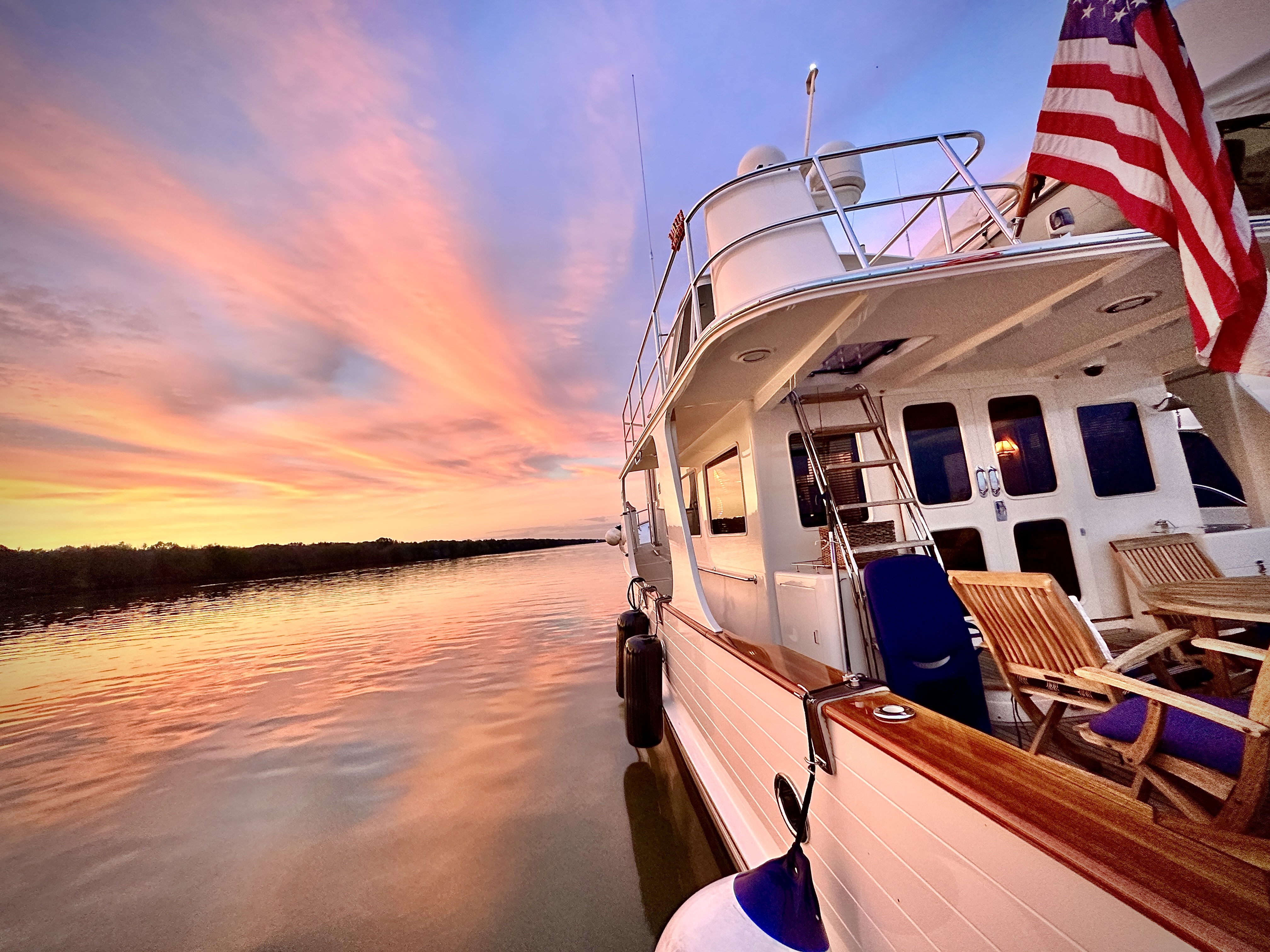
We had finally found some reasonably warmer weather and shed our layers and jackets, eating outside in the cockpit of Legacy. All the fishing poles came out but alas the fish were elusive and they remained fishing poles vs. catching poles. We enjoyed watching the wild life and were treated to a beautiful sunset.

Sunday, 11/5 we were up and out around 9:00 am. As we enjoyed our coffee and breakfast, we saw 2 loopers go by who had stayed at the Marina and were headed out early. It ended up being a bad day for one of them having decided to go straight across that shallow area instead of around the long way. Hopscotch, a 36’ Grand Banks, was hard aground and working to get back into deeper water using their dinghy, anchor and windlass. They would take the dinghy and drop the anchor in deeper water, then pull the boat with the windlass toward the anchor. They were making progress slowly but surely as we went by. Not much we could do to help without endangering ourselves. Despite losing several hours getting “unstuck,” they seemed to have no damage from the ordeal and arrived at the same anchorage as us that night, a little more tired and a little more wise.

Back to our trip….we ran for a few hours and checked out several creeks along the way that should have been good anchorages, but with the water so low (we are now on the Tennessee River) they were a “no-go” so we continued on. It made for a longer day than we had planned, finally anchoring around 3:00/3:30 pm when we thought it would closer to noon. Not a big deal – it just brought us closer to Clifton which was our planned destination for Monday, 11/6.

Dinner was a team effort inspired by a facebook cooking video Carol had seen on calzones. We made 4 large calzones (1 glutton free for Annette) that included decorating them with dough and veggies that made them quite unique….food art! They were pretty and tasty at the same time filled with tomato sauce, ground beef, Italian sausage, mozzarella cheese, spinach, basil and mushrooms! They were lots of fun and yummy too! Credit for video below to Mayli on Saga!

11/6 (Monday) we were up and out around 8:00 am, headed to Clifton which we expected to be a 2-3 hour run. Carol had meetings all afternoon (2:00 – 6:30) so we were thankful Tonia was making dinner. We arrived around 10:30 am finding a beautiful and spacious anchorage, eager for some leftover Calzones!

Although we continued to observe low water levels (atleast 5 feet below normal) our ride here was pretty uneventful. The threat of rising water and power of the river was clear in the height of the supports under the houses/structures to keep them from flooding when the river rises. The edges of the river were very interesting layers of rock and WOW on the number of stairs to the waters edge!

Tomorrow we are off to Wolf Island, about a 3.5 hour run where we will anchor again…. Then onto Grand Harbor/Pickwick where we have a reservation for 2 days in a marina. We will reprovision there.

Green Turtle Bay Resort (Grand Rivers, KY) to Kentucky Lake and Standing Rock Creek, TN

Days 162 – 168 ; Oct 29 – Nov 4: We arrived at Green Turtle Bay (GTB) Resort in Grand Rivers, KY on 10/29 around 3:15 pm and were grateful to get plugged into power and the heat on, after about a 7 hour run in the cold and rain. Green Turtle Bay is a very nice facility with restaurant, gift shop, bar, spa and courtesy car on site. We stayed 4 nights in GTB, mostly due to a bunch of meetings Carol needed to attend, but it also gave us time for a big provisioning trip to Sam’s Club (first time been in one since we left Annapolis) and Kroger (grocery store) leveraging the courtesy car and rental car that Boris and Mayli rented (SAGA). We go to dog sit for Flash (SAGA) while they took a side trip to Nashville and Gary caught up on tons of paper work and other stuff.

Flash!

Of course Carol made time for a manicure, pedicure, massage and facial – we all have our priorities! Now don’t imagine a 5 star spa like the Ritz or Waldorf Astoria….. imagine a 2 star converted building that gets and “A” for effort with some amazing ladies with southern charm.

The big attraction in Grand Rivers is the Patti’s 1880 Settlement – a destination built around a restaurant that features a 2” thick pork chop and mile high meringue pies, amongst many other things! Okay, so we ate their twice! First time was with the crews of Beachside, Sea No Evil, Into the Mystic, Sundancer, Red Pearl and Coconuts (below); second was with Saga and Lil Sudden. The place is already decked out for Christmas.

Patti’s looks like a rustic 1800’s town but offers modern conveniences – hotel rooms, mini golf, gardens, moonshine shop, other boutiques, ice cream parlor, panning for “precious gems” and more.

A little history: In 1975, Bill and Patti Tullar stopped in Grand Rivers, fell in love with the little town and purchased the Grand Rivers Motel. In 1977, Bill, Patti, Chip and Michael Lee, started Hamburger Patti’s Ice Cream Parlor. The restaurant was part of the building that was the 6-unit motel, but the motel units quickly gave way to becoming dining rooms. The upstairs rooms were the Tullar’s personal living space. Patti’s 1880’s Restaurant was on it’s way.

Bill got tired of being called Mr. Patti, so built a second restaurant in 1990. Mr. Bill’s was designed with added entertainment to accomodate bus tours including Honky Tonk piano players and the hostess and servers dressed in period costumes. Today Mr. Bill’s and Patti’s have the same food, servers, etc, creating quite the compound. The two restaurants, in a tiny town of 350 people, serve over 350,000 people each year with 25% of that happening in November and December due to the extensive Christmas display. We slipped in before the craziness of Christmas kicked in…. We just wished for warmer jackets as the weather hovered in the high 30’s to low 40’s and the town was about a mile walk away. Patti’s will drive you back and forth, which we did take some advantage of, but we also wanted the exercise of the walk after indulging in their offerings.

On 11/1, we celebrated 3 boats crossing their wakes (finishing their loops) with about 30 other loopers. This is also known as “going gold” since you exchange your white burgee for a gold one. Congratulations to Red Pearl, Cavalier and Ottysey. A round of little beers was highlighted by the looper toast, adopted from an old Irish proverb: “There are good ships and wood ships and ships that sail the sea; but the best ships are friendships and may they always be.”

11/3 (Friday) we left GTB on Kentucky Lake around 9:15/9:30 am after all 3 boats pumped out. We were headed to an anchorage in Standing Rock Creek, TN where Matt and Tonia were making chili for dinner and some spirited board games were planned. It was a beautiful, yet chilly evening capped by a pretty sunset. The morning of 11/4 was a leisurely morning with a planned 9:30/10:00 am departure with an approximate 4 hour cruise to an anchorage near Birdsong Marina in Camden, TN. The only excitement came as we untangled the anchors of SAGA and Legacy that had crossed over night as we swung with the wind and current.

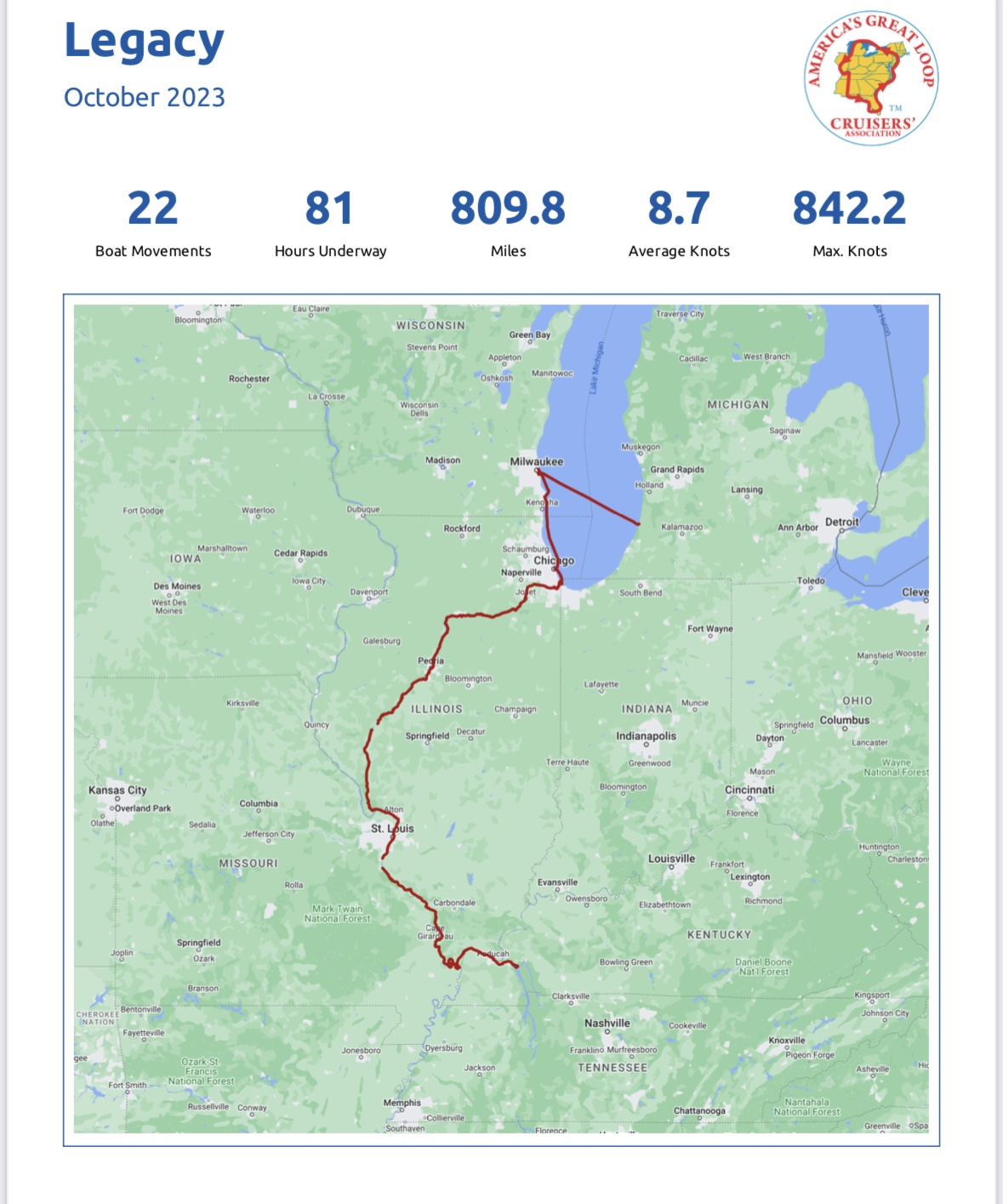
Having crossed into Tennessee, that makes 12 states, 1 Canadian province and 1 foreign country we’ve visited so far. October was a big month of travel, covering a lot of ground (over 800 miles) including crossing Lake Michigan, spending some tourist time in Chicago and finally starting down the river system once the locks were re-opened (see below).

Month of October
October is represented by the purple pins

We are looking forward to getting south to warmer weather. It looks like Thanksgiving will be in New Orleans, but neither Sarah (and Richard) or Michael (and Kylie) can really get away from their responsibilities to join us. We will need to figure something out for Christmas, but didn’t think ahead to bring warm clothes needed for a trip north; all of that is in storage…..Hoping they may be able to come south. Miss them all and would like to share some of this adventure with them.