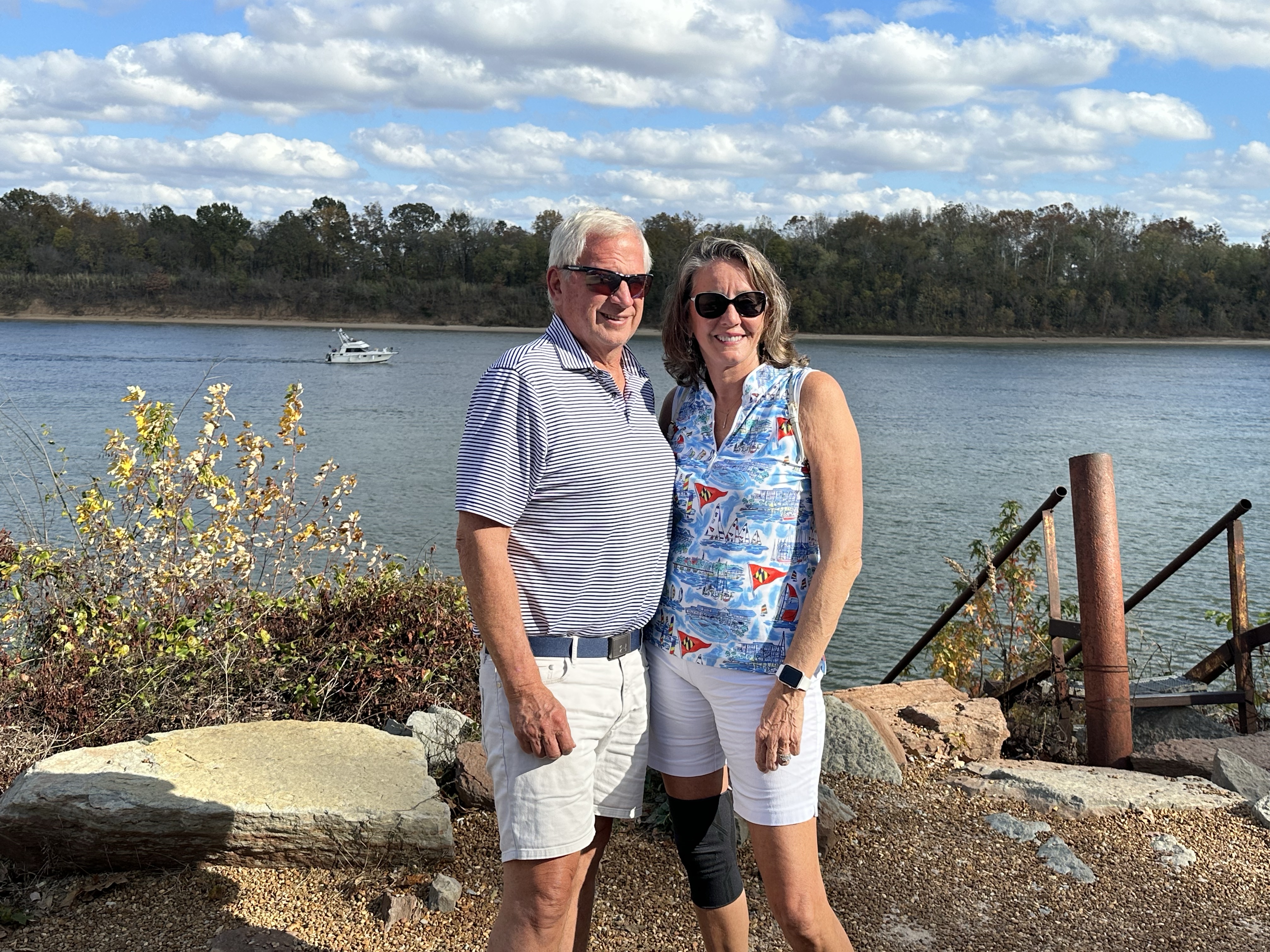
Days 171 – 173; Nov 7 – 9: It was anchors up 10:00 am as we headed up river on the Tennessee River to an anchorage behind Wolf Island, TN arriving round 1:30 pm. We passed many homes up on stilts (Gary says they are properly called piers) of various heights to protect them when the river rises. The rock formations with their striations and layers were interesting in that they weren’t level. We wondered if this was the result of earthquakes in this area in 1811/1812 (magnitude 7.2 – 8.2 with aftershocks up to 7.4)


Water levels seemed low by about 6 feet “from datum” meaning low from the benchmark for measurements for charts and bridge clearances. That’s good for us to get under bridges but bad for the risk of hitting bottom!
It was alarming to see some of the damage from tornados including one that looked very recent – we saw one house where the roof was ripped off and the bedroom furniture still in place. We saw quite a few homes under repair, some just a pile of rubble and others new rebuilds.


Since we were anchored by 1:30 we decided on some work and some play. Mayli and the kids finished up their schoolwork for the day, Carol got some board work done and we had a “sip and paint” afternoon! A great time was had by all as we took our varying degrees of talent and expertise and attempted to recreate a sunset with 3 palm trees! We topped off the night with Mayli and Boris’ beef stroganoff for dinner and Carol’s pineapple upside down cake for dessert!


11/8 (Wednesday) we hauled anchor and were underway by 6:00 am since we had about a 2 hour trip, one lock to go through (the Pickwick Lock and Dam with a vertical lift of 63 feet) and Carol had a meeting she needed to attend from 10:00 am – 12:30. This would be our last lock that we’d travel UP, all the rest will take us back DOWN to the level of the Gulf of Mexico.


We arrived around 9:30 am giving us time to get settled into the marina in Grand Harbor (Pickwick), get the meeting done then we were off with Bill and Mary Routt, who live in Memphis but have a place on Lake Pickwick at the mouth of the Tennessee-Tombigbee waterway.
Bill and Mary were super gracious hosts and we enjoyed 2 days wtih them including lunch at the Catfish Hotel, a tour of the Civil War battlefields at Shiloh and Corinth, dinner at The Outpost and lunch at the old Borrum Drug Store and Soda Fountain – the oldest drug store in continuous operations started at the end of the Civil War. Bill taught us how to eat catfish and we learned these small edible catfish are called “fiddlers.” When he ordered a whole catfish, we envisioned some monstrous thing being brought to the table but learned those huge catfish (+30 lbs) people post pics of that they caught are just released – not edible! Can‘t thank Bill and Mary enough for such a great couple days! Their southern hospitality was off the charts and we are forever grateful!


Shilo (and the next day visiting Corinth) gave us some amazing Civil War history…. First, we had not realized the armies of the north (US) and south (Confederacy) were organized by state; so each state sent their armies and Generals then coordinated them…. So know that you know that, here is some history:
The American Civil War (April 12, 1861 – May 26, 1865; was fought between the Union (“the North” or “Federals”) and the Confederacy (“the South”). The Confederacy was formed by states that had seceded from the Union. The cause of the war was the dispute over whether slavery would be permitted to expand into the western territories, leading to more slave states or be prevented from doing so, which many believed would place slavery on a course of ultimate extinction.
Decades of political controversy over slavery was brought to a head by the election of Abraham Lincoln to the US Presidency in 1860. Lincoln opposed slavery’s expansion into the western territories. Seven southern states responded to Lincoln’s victory by seceding from the United States and forming the Confederacy. The Confederacy seized U.S. forts and other federal assets within their borders. Four more southern states seceded after the war began. Led by Confederate President Jefferson Davis, the Confederacy asserted control over about a third of the U.S. population in eleven states. Four years of intense combat, mostly in the South, ensued.
By mid-February 1862, United States (Northern/Federal) forces had won decisive victories in the West at Mill Springs, Kentucky, and Forts Henry and Donelson in Tennessee. These successes opened the way for invasion up the Tennessee River to sever Confederate rail communications along the Memphis & Charleston and Mobile & Ohio railroads. Forced to abandon Kentucky and Middle Tennessee, Gen. Albert Sidney Johnston, supreme Confederate commander in the West, moved to protect his rail communications by concentrating his forces around the small town of Corinth in northeast Mississippi – the strategic crossroads of the Memphis & Charleston and the Mobile & Ohio rails.
In March, armies under Maj. Gens. Ulysses S. Grant and Don Carlos Buell moved southward to sever the Southern railroads. Grant ascended the Tennessee River by steamboat, disembarking his army at Pittsburg Landing in Shiloh, 22 miles northeast of Corinth. There he established a base of operations on a plateau west of the river, with his forward camps posted two miles inland around a log church called Shiloh Meeting House. Grant was ordered NOT to engage the Confederates until he had been reinforced by Buell’s Army of the Ohio, then marching overland from Nashville. Once combined, the two armies would advance on Corinth and permanently break western Confederate railroad communications.
General Johnston (Confederacy), looking to defend the southern states control of Corinth, planned to smash Grant’s army at Pittsburg Landing before Buell arrived. He placed his troops in motion on April 3, but heavy rain and difficulties encountered by marching large columns of men, artillery, and heavy wagons over muddy roads, delayed the attack. By nightfall, April 5, his Army of the Mississippi, nearly 44,000 men present for duty, was finally deployed for battle four miles southwest of Pittsburg Landing.
At daybreak, Sunday, April 6, the Confederates stormed out of the woods and assailed the forward Federal camps around Shiloh Church. Grant and his nearly 40,000 men were surprised by the onslaught. The Federals soon rallied, however, and bitter fighting consumed “Shiloh Hill.” Throughout the morning, Confederate brigades slowly gained ground, forcing Grant’s troops to give way, grudgingly, to fight a succession of defensive stands at Shiloh Church, the Peach Orchard, Water Oaks Pond, and within an impenetrable oak thicket battle survivors named the Hornets’ Nest.
Despite having achieved surprise, Johnston’s troops soon became disorganized. The Southern attack lost coordination as corps, divisions, and brigades became entangled. Then, at mid-afternoon, as he supervised an assault on the Union left, Johnston was struck in the right leg by a stray bullet and bled to death, leaving Gen. P.G.T. Beauregard in command of the Confederate army. Grant’s battered divisions retired to a strong position extending west from Pittsburg Landing where massed artillery and rugged ravines protected their front and flanks. Fighting ended at nightfall.
Overnight, reinforcements from Buell’s army reached Pittsburg Landing. Beauregard, unaware that Buell had arrived, planned to finish the destruction of Grant the next day. At dawn, April 7, however, it was Grant with fresh troops who attacked. Throughout the day, the combined Union armies, numbering over 54,500 men, hammered Beauregard’s depleted ranks, now mustering barely 34,000 troops. Despite mounting desperate counterattacks, the exhausted Confederates could not stem the stronger Federal tide. Forced back to Shiloh Church, Beauregard withdrew his outnumbered command and returned to Corinth. The battered Federals did not pursue the retreating Confederates. The battle of Shiloh, or Pittsburg Landing, was over. It had cost both sides a combined total of 23,746 men killed, wounded, or missing, and ultimate control of Corinth’s railroad junction remained in doubt.


Union leadership, recognizing Corinth’s military value, considered its capture more important than the destruction of Confederate armies. Reinforced by another army under Gen. John Pope, Union armies advanced southward from Tennessee and, by late May, entrenched three armies within cannon range of Confederate fortifications defending the strategic crossroads. Despite being reinforced by Maj. Gen. Earl Van Dorn’s Trans-Mississippi Army, Beauregard withdrew south to Tupelo, abandoning the most viable line of east-west rail communications in the western Confederacy.
Federal efforts to recover the Mississippi Valley stalled in the late summer of 1862, and Confederate leaders launched counteroffensives in every theater. Armies led by Gens. Braxton Bragg and Edmund Kirby Smith invaded Kentucky, while troops under Van Dorn boldly attacked the heavily fortified Union garrison at Corinth, “linchpin” of Federal control in northern Mississippi. In one of the more bitterly contested battles of the war, Van Dorn was decisively repulsed, following two days of carnage (October 3-4) that claimed nearly 7,000 more Confederate and Union casualties.
Although overshadowed by the failure of Robert E. Lee’s Confederate invasion in Maryland, Van Dorn’s defeat, coupled with Bragg’s retreat from Kentucky after the battle of Perryville (October 8), caused discouragement in Richmond and relief in Washington. More significantly, Van Dorn’s defeat at Corinth—the last Confederate offensive in Mississippi—seriously weakened the only mobile Southern army defending the Mississippi Valley. This permitted Ulysses S. Grant to launch a relentless nine-month campaign to capture “the fortress city” of Vicksburg and recover the Mississippi River.
The civil war would continue for over 3 more years finally ending in May of 1865. By the end of the war, much of the South’s infrastructure was destroyed, especially its railroads. The Confederacy collapsed, slavery was abolished, and four million enslaved black people were freed. The war-torn nation then entered the Reconstruction era in an attempt to rebuild the country, bring the former Confederate states back into the United States, and grant civil rights to freed slaves…. Of course there’s more history to share beyond 1865, but we won’t do that today.


chashurley
Great sunrises on the Tenn. River and extraordinary Civil War history! And I thought the TennTom would be boring!