Days 177 – 181; Nov 13 – 17: Monday, 11/13 we were up around 7:00 am, giving our weary friends a glimpse of the anchorage they entered after dark. After calling the lock, we pulled anchor and were off a little before 8:00 am to get through Aberdeen lock, about an hour away, before a tow got there before us. The lockmaster agreed to lock us through before the tow, saving us about an hour of wait time. Check out the below for what it’s like cruising the Tenn-Tom.
We arrived at the marina in Columbus, MS around noon; Steve, the owner, did an awesome job calling us in one at a time and getting us docked.
We were pleased to run into Kim Russo (director of the AGLCA) and her partner Michael Martin aboard ‘The Perch’ as well as Brent and Sarah Bowlin and their children Mary Grace and Miller aboard ‘Light and Salty.’ Both families are liveaboards. Side story – why is the boat named The Perch?….. because their boat is also home to Mike’s cockatoo Margo! Kim is not as much of a fan….her boat (a runabout in Charleston) is called Freebird! Relative to “Light and Salty,” this is a reference to the Bible and book of Matthew, chapter 5 verses 13 and 14 that reference the “salt of the earth” and the “light of the world.” There is always a great story behind a name!
Carol had a couple meetings in the afternoon and Gary was pleased that his shipment of 25 gallons of oil and oil filters arrived – he’d use that to change the oil (11 gallons per engine) in Demopolis, AL on Wednesday. Monday nights dinner was at Harvey’s, the top recommendation by Steve, with the crews of The Perch, Light and Salty, Saga, Lil Sudden and of course, Legacy.

Tuesday morning the alarm bell went off at 3:45 am for Carol to be up and out by 5:00 am to get a car to the airport for a flight at 6:15 am to Boston for 2 days of meetings. Gary and our flotilla left Columbus around 9:00 am with Mayli on board Legacy to help with the locks, arriving at Upper Cooks Bend Anchorage around 4:30 pm. Great job by Annette and Michael on Saga helping out with the locks! This was the day we crossed into Alabama from Mississippi. Mayli and Boris made Bratwurst for dinner while Gary made old bay fries.


Temperatures dropped overnight and the rain came down. Wednesday was up and out by 6:00 am, before the sun was up, again to beat a tow to the lock and get through. Mayli again helped on Legacy, Saga rafted to Legacy in the lock and Mayli jumped back on her own boat after the lock. It was another long run (60+ miles) to Kingfisher Bay Marina in Demopolis, AL, arriving around 1:15.


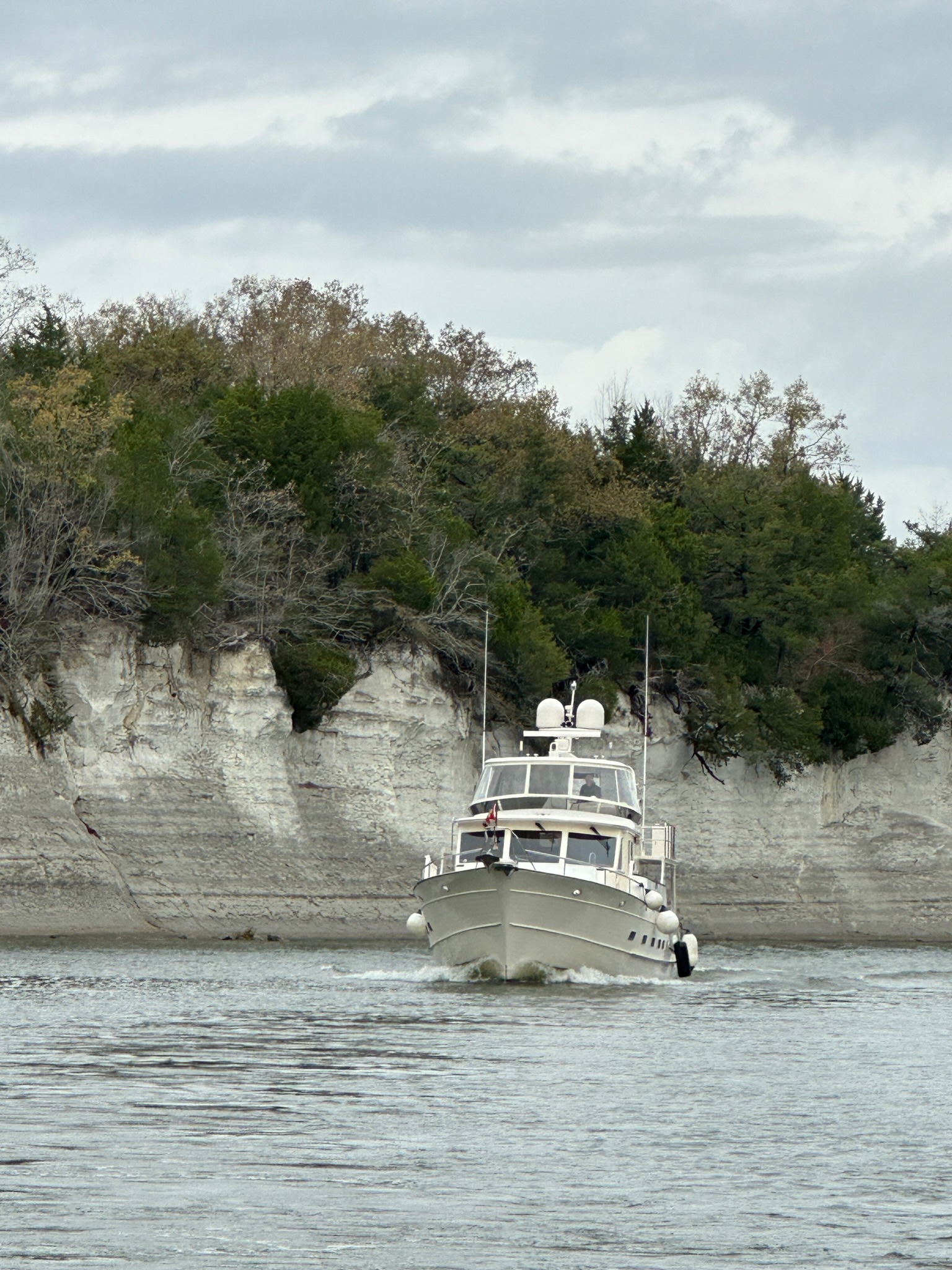
This was one of the more scenic days on the Tenn-Tom passing through the White Cliffs of Epes. The White Cliffs of Epes proved to be a beautiful break from the somewhat monotony of the river. Weather was overcast making the cliffs a bit gray versus bright white. This striking mile of white cliffs provides a window into what Alabama was like during the time of the dinosaurs. Similar to the chalk that makes up England’s famous White Cliffs of Dover, the Alabama version hasn’t earned nearly as much renown.


The chalk began forming in the Cretaceous Period, which began about 145 million years ago. At that time, Alabama would have finally drifted north of the Equator to around the same latitude you find it today. The supercontinent Pangea was in the later stages of breaking apart, creating the Gulf of Mexico and covering most of Alabama with water.
The chalk is a form of limestone, a sedimentary rock deposited when this part of Alabama was still underwater. The rock itself is made up of the remains of single-celled marine organisms and lime-producing algae, which collected in a shallow sea along with the runoff from Alabama’s fast eroding mountains to the east. The tiny shells and plates of the chalk-forming plankton rained down upon the sea floor for many millions of years. Geological studies estimate that every foot of chalk deposit represents about 18,000 years of buildup of those organisms. The exposed cliff face in Epes stands about 80 feet high, meaning about 1.4 million years of marine sediment can now be seen above the Tombigbee water line. The rest is buried underground. Some Alabama chalk formations are more than 500 feet thick, representing at least 9 million years of dead algae and plankton building up on the seafloor.
Back then, the shoreline would have been somewhere around Montgomery, give or take, but would have moved around as global temperatures increased and sea levels rose. Evidence shows Alabama’s so-called “Goat Hill,” where the state capitol building sits, was actually a barrier island in the young Gulf.
Dinosaurs like Appalachiosaurus would have roamed tropical jungles in between the beaches and the mountains. The chalk here also has the distinctive quality that it doesn’t let water through. Water in the Black Belt still tends to pool at the surface rather than filtering through to the deep groundwater beneath the bedrock.
That meant the development of dark, rich soil atop the chalk during the thousands of years after the land dried out. Tall grasses grew on the site for millions of years, and their decomposition created a dark, rich humus that would later prove ideal for cotton farmers. This soil, built over millions of years, drew European settlers. The area became the heart of the South’s cotton plantations, and the forced import of enslaved African people to work the plantations. Alabama’s Black Belt was among the most valuable in the world during that time. Much of the fertile dark soil that gave the area its name has weathered away to the chalk bedrock beneath.
The area is still good for growing grasses to support cattle and other livestock, but the massive cotton farms are largely relics of the past. The Black Belt today is instead ideal for catfish farming, with some of the largest operations in the country springing up among the old cotton fields. But the chalk has also made the area ground zero for concerns over environmental racism. Populations in many parts of the Black Belt are among the poorest in the state, and in some cases 90 percent Black. That same impermeable bedrock that made for rich cotton farming until the soil got used up is now attractive for developers of landfills, turning the area into a convenient dumping ground for the rest of the country.
Isn’t if fascinating to look behind the scenes of natural beauty as to its history/roots and ramifications? I’ll stop here leaving you with the image of these beautiful cliffs, but one off the largest landfills in the country right behind it.
Okay end of history lesson and back to the trip….After arriving at the marina in Demopolis, Gary changed the oil in both engines and everyone got their pizza craving satisfied by Dominoes! It was more rain overnight, but atleast a little warmer.
Thursday, 11/16 was another work day for Gary – fixed the TV mount that was stuck down, changed the oil in the generator, reset the nav system in the pilot house that thought we were in FL, got a haircut, got rid of the old oil, figured out how to upload routes from Navionics (navigation app) to Legacy’s Furuno system and figured out how to get local channels on the TV. Wow that was a lot of stuff, but the best was the Navionics to Furuno interface. The first route uploaded to the autopilot included 286 waypoints, meaning 286 turns that would have had to have been programmed or steered manually! YAY!! Lunch was at the Bistro, which was large enough and late enough that no dinner was needed! Carol arrived after 12 hours of travel around 10:00 pm, happy to reunite with the flotilla.
Friday, 11/17 would be the day we also reunited with Coda, after their side trip to Louisville. Steve and Barbara arrived around 9:00 am, filled the fuel tanks and the ‘four musketeers’ we were off again around 10:00 am, right when Carol’s meeting started! We are so thankful for Mayli again helping with the lock while Carol was on the call….. yes there have been a lot of calls in the last couple weeks, but you do what you gotta do!
We dropped anchor in the Edna Bend Anchorage around 2:45 pm after a twisty turny day on the river. The anchorage was literally a bend in the river where you could tuck in and stay out of the way of the tows….barely!
Dinner was Carol and Gary’s version of ‘Marry Me Chicken’ over pasta – yummy white cream sauce with garlic, parmesan cheese, sun dried tomatoes and spinach. So great to see Steve and Barbara again so we celebrated with some Kentucky Bourbon Steve and Barbara picked up in Louisville and light sticks. We also planned our Thanksgiving dinner menu, dividing up the tasks and making sure everyone’s favorites are covered.


Saturday, 11/18 we were treated to Steve’s amazing custom brewed coffees and lattes as well as a fabulous breakfast on Steve’s new grill – homemade hash browns, cheesy omelets and bacon!


It was anchors up at 9:00 am and we are off to Okatuppa Creek – about a 50 mile, 7 hour run. We are all getting a little weary of the boredom of the rivers (we have 3 more nights of anchorages) and looking forward to civilization in Mobile, AL.
We’ve covered lots of ground in November! Orange/mustard color pins represent our travel in November.


chashurley
Quite a history lesson! And friendships (literally) to overcome the monotony.