Day 152 – 157 Oct 20 – 24: Left Grafton headed to Alton a bit after 10:00 am on Friday, 10/20. Lines off that late made it a bit of a leisurely morning since our trip was short (2 hours) and stay in Alton would be 4 days. It was evident fall has arrived as we took in the changing colors and granite cliffs.


Arrived in time for a quick lunch and Boris and Matt were off to get rental cars and pick up friends at the airport. We hung out for the afternoon and headed into St. Louis for dinner at Hodak’s, a restaurant Boris’ great uncle started back 1962. Famous for it’s fried chicken and a bit of an icon in St. Louis, the food was fabulous! Where else can you get a half of a fried chicken (it’s signature dish) including french fries and cole slaw for $14.99! Matt and Tonia arrived first and secured a table. We arrived with the Hodak’s a few minutes later and were warmly greeted by the owner, since a little birdie told him the founders grand nephew was coming. A great time was had by all and of course the Hodaks purchased a few Hodak t-shirts!
While at Hodak’s we saw these curious statues of a fox dressed in traditional Lederhosen drinking a beer and eating a chicken bone. How odd, so I knew I needed to research that.


Saturday we were up early and wanted to be first in line at the National Great Rivers Museum, which included a tour of the Melvin Price lock and dam. Early was better since tour times and number of visitors was limited and Coda was planning on heading out after the tour with a deadline to be in Louisville for a family event. One of the highlights of the museum was a simulator that allowed you to drive the tow (tug boat) and push a raft of barges under a bridge or into a lock. While there were a few successes, no one successfully got the barges into the lock in the allotted time, but had fun trying!


We learned a lot about river lingo, barges, Samuel Clemens’ (Mark Twain’s) birthplace and early life as a steamboat captain, Did you know that 60% of US grain and oilseed exports, 22% of all domestic petroleum products and 20% of US coal used for electricity generation are moved by barge on inland waterways? How about the origin of Samuel Clemens pen name “Mark Twain”? Back in his days (1860’s), crewman would call out the depth of the river in fathoms. A yell of “Mark” meant 6 feet and “Mark Twain” with Twain meaning “twice that” meant 12 feet of water (2 fathoms). River boat life was dangerous with multiple groundings, hitting snags (underwater trees or logs) and coal fires. I was interesting to see some river-speak that is now part of everyday language: “Their project hit a snag”, “Let’s let off some steam”, “She’s working full steam ahead”, They got sold down the river” (a reference to slave auctions on levees), “It’s touch and go”, “They are riffraff” (after steamboats, only paupers traveled by riff (paddle) rafts).


So back to the foxes…..It turns out the foxes have an interesting history that we learned about touring the Anheuser-Busch (A-B) factory with Rick and Heidi. The foxes date back to A-B’s survival strategy during Prohibition, when A-B first brewed Bevo (its nonalcoholic near-beer) in 1916 after alcohol was banned in the military. By the time Prohibition rolled around in 1919, it ramped up production, and by the early 20s, A-B was selling 5 million cases of Bevo every year. It was so ever-present, it eventually became part of popular culture: Irving Berlin mentioned it in two songs, including “How Dry I Am.” The brewing building—the Bevo bottling facility—was named after the Bevo brand of “beer”.
The mascot for Bevo was a playful character named Reynard the Fox. Reynard (Dutch: Reinaert, French: Renard, German: Reineke) is a popular character from allegorical Dutch, French, German and English fables and fairy tales. While other heroes in the stories had brute strength, Reynard was sly and witty.
Reynard in the story was always funny whenever he was around, and he knew great places to find eats and drinks. That’s why the fox is shown on the corners with food and drink in his hand.


When the A-B building was constructed, four fox statues were carved on each corner. Each statue is about 10 feet tall; the foxes are dressed in traditional Lederhosen, and are shown eating and drinking. The traditional German outfits were chosen because Eberhard Anheuser and Adolphus Busch were from Germany. Foxes are familiar, yet overlooked to many St. Louis natives. The statues, like the bottling facility, have a rich history that is integrated with St. Louis, so it’s no coincidence that we found them at both Hodak’s and the A-B factory. By the way — other things A-B did to survive prohibition (1920 – 1933): built truck bodies, diesel engines and refrigerated cabinets, manufactured barley malt syrup, ice cream and infant formula, they also entered the bakers yeast business. Fun fact – do you know why prohibition was enacted? It was a response to social issues like domestic violence and child abandonment, whose presumed cause was alcohol. Some say it was a big backfire as criminal groups took advantage creating a large black market for booze.


Back to the A-B factory and our visit with Rick and Heidi – had a great time with Rick and Heidi on Sunday, 10/22 first with a tour of the A-B factory, followed by a visit to Forest Park – a huge public park complete with museums, a science center, zoo, an amphitheater, paddle boats and 30 miles of walking trails. Forest Park, officially opened to the public on June 24, 1876, is one of the largest urban parks in the United States. At around 1,300 acres, it is bigger than Central Park in New York. We capped off the night with a fabulous dinner at one of their favorite places – Polite Society in the Lafayette Square neighborhood of St. Louis.


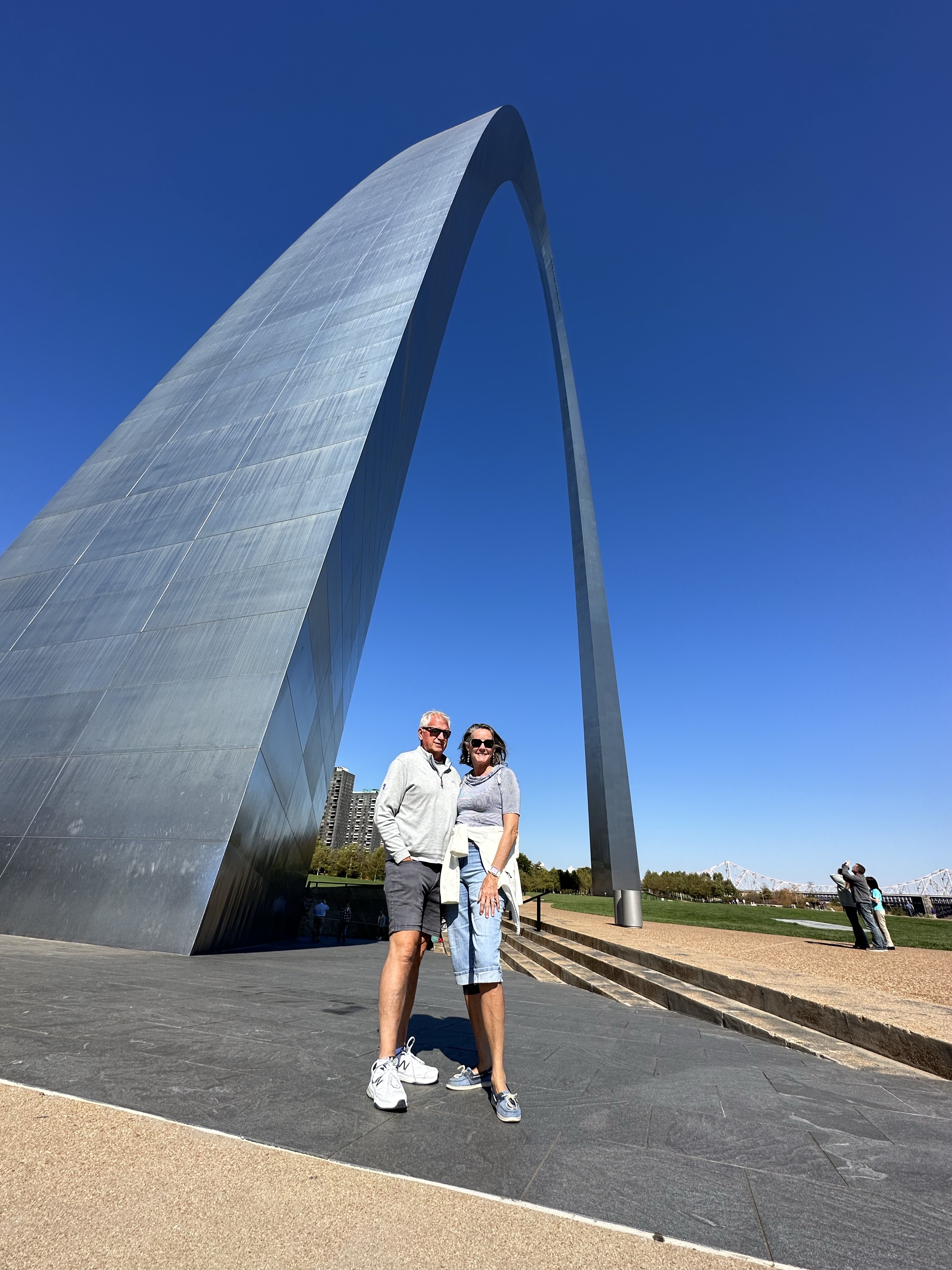
Alas, Rick had to work on Monday but Heidi was kind enough to return to the marina and pick us up for a driving tour of St. Louis (actually fairly sad as to the abandonment and decline of the city) – the gateway to the west that supplied the covered wagons and all the settlers needed for their journey into the Louisiana purchase. We ventured, of course, to the Gateway Arch and made the journey to the top in the 5 person miniature cars – an amazing system built inside of the arch inspired by elevators and ferris wheels. Going up was very cool, and the view quite impressive, but we have to say the highlight was the 30 minutes film in the Arch museum that chronicled the construction of the arch from February 1963 until its opening on October 28, 1965. 630 feet tall and 630 feet wide, it is designed to withstand earthquakes, lightning strikes and sways 18” in 150 mph winds. There are 1076 steps in each arch leg (thankful we didn’t have to walk them!) and a little known construction fact – despite what looked like zero OSHA rules and not a single worker tied off with a safety harness as they worked at great heights with cigarettes hanging out of their mouths, there was not a single fatality in the construction process.
The arch uses an “orthotropic design” that only became possible with advances in engineering in the late 50’s. If the arch had been built in 1948, the walls would have been 3 feet thick and would not have been able to accommodate a tram to the top. With an orthotropic design, the arch has no real structural skeleton. It’s inner and outer steel skins, joined together, form a composite load bearing structure that give it its strength.


After our amazing tour of the arch, it was back to the boat for a BOD meeting followed by a Captain’s meeting with the 13 boats who are planning to depart Alton for Hoppies in the morning. We have 2 locks to navigate and only half the boats have reservations at Hoppies – a small “marina” in Kimswick, MI run by the same family for generations. Hoppies is literally a few barges strapped together on the Mississippi; a must stop for loopers.
It was a very full 4 days and great to spend some time with Rick and Heidi seeing their adopted city of St. Louis. We were grateful for their generous hosting of us, doing touristy things they’ve done sooooo many times! Tomorrow we are off to brave the Mississippi and it’s huge barges again. We’ve traveled far in October trying to get south before the marinas close. The one we are in will shut down power and water next week. There are hundreds of loopers still behind us, so Godspeed to them!

Leave a Reply