Archives October 2023

Little Diversion Canal Anchorage to Paducah (a walled city) onto Green Turtle Bay, KY

Days 159 – 162; Oct 26 – 29: Thursday, 10/26 was anchors up from Kimmswick a little after 8:00 am headed to an anchorage in the Little Diversion Canal, Missouri – about a 7 hour run. It was a cold windy day with white caps on the river. Waves were about a foot with some nearing 2 feet, but nothing worrisome, just cold! We passed Cape Girardeau noting some of the wall built at the banks of the Mississippi as a defense for the rising of the river. It reminded us of the massive flooding of this area in 1993. You could also see how low the water is right now, with the wing dams and embankments quite exposed. See video below; sorry hard to hear me narrate.

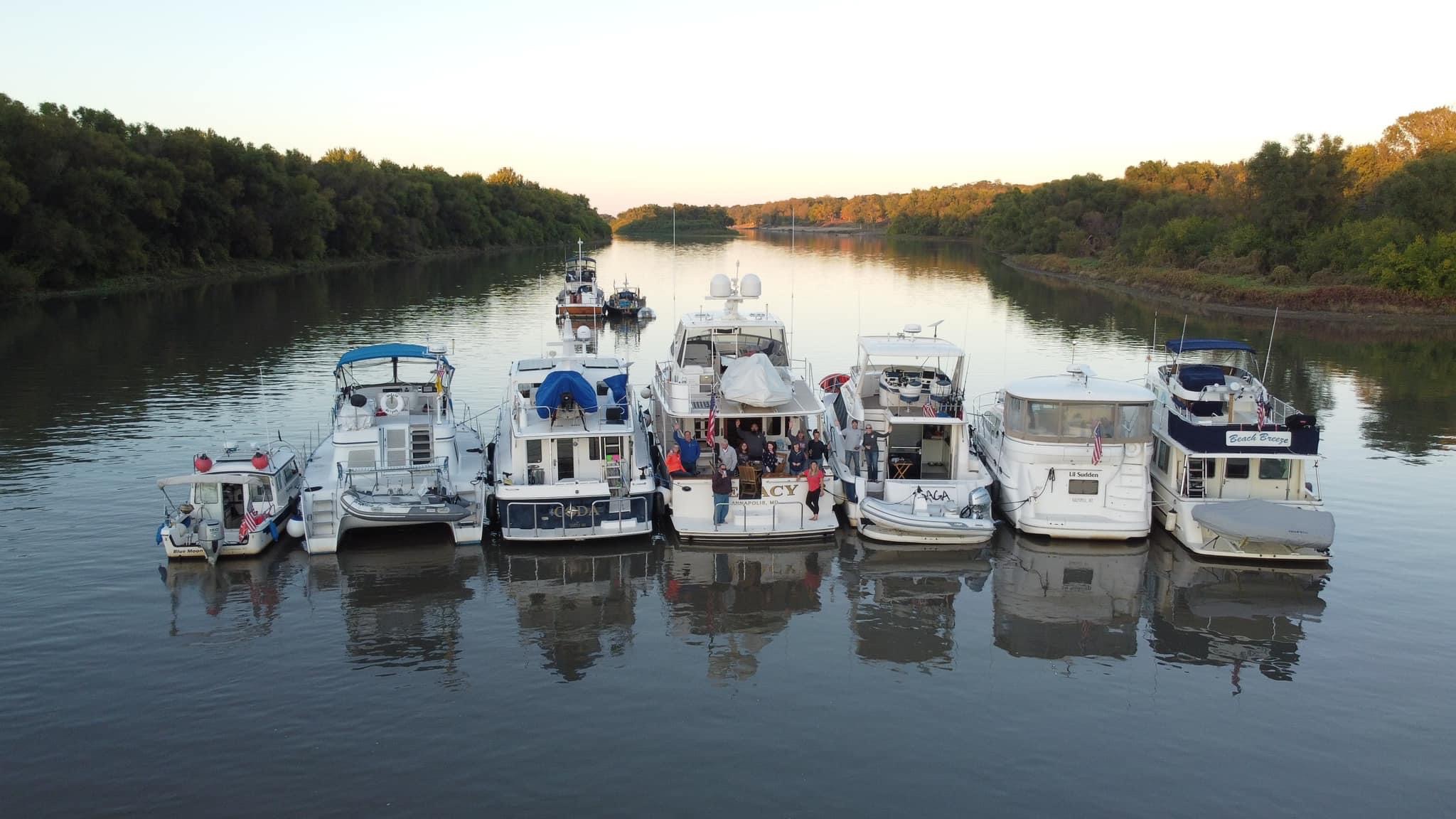
We arrived at the Little Diversion Canal around 5:00 pm, in time for dinner and ice cream cake celebrating Mayli’s birthday! The water was super calm although there was a strong current. We rafted the 3 boats with 2 anchors down and set out a stern anchor to keep us in the middle of the channel. There were 2 raft-ups in front of us and one that came in later; total of 12 boats and room for more.

10/27 we left the Little Diversion Canal around 9:00 am headed to the Olmstead lock, where we planned to anchor just north of the lock and go through the lock first thing in the morning. This would be another fairly long day with a 6+ hour run and a transition from the Mississippi River to the Ohio river at a town called Cairo (pronounced Kay-Row). (See video below).

We switched from gaining some speed and fuel efficiency riding the current south to going against the current on the Ohio River; we also had to shift our brains to keep the red markers on the starboard as opposed to on the port when we were on the Mississippi. “Red on Right Returning” is the saying to remember, but you have to know if you are coming or going! Our anchorage was safe but windy, so all 3 boats had anchors out and drag alarms set.

Boris got up early on Saturday (6:30 am) to speak with the lock master as to when our little flotilla of 10-12 boats could pass through the lock. An inquiry at 6:30 ended up in “go time” at 6:31 so we were all hands on deck getting coffee made (priorities!) lines off, anchors up and everyone in the lock. This lock called Olmstead Lock and Dam, took us up 20-25 feet. This is a new lock, only about 5 years old, that replaced 2 aging locks built in 1929.

It was cool to watch a tow come into the lock next to us as we exited. Such a huge set of barges to push. You might wonder why it’s called a “Tow” when they push, not pull the barges. Back in the day they did pull them bury later changed to pushing, but the name “tow” stuck. See below.

Fortunately, this would be a short run to Paducah where we had reservations at the public dock. We arrived in Paducah around lunch time and found it to be an interesting and fun city; It’s a walled city (a rising river defense built after the massive flood of 1937) with beautiful murals on the inside of the Great Wall. The wall did it’s job with no damage to the city in the flood of 1993. In Paducah, we toured the National Quilt Museum, the Paducah Railroad Museum and walked the cute downtown shops finding a great bakery, coffee shop and some great choices for dinner. Check out the details of the quilts below…. These are all totally made of fabric! True works of art!

A little history: Paducah, Kentucky, was named after the Paducah Indians – the largest nation of Native Americans in North America.

The Ohio River, which flows through Paducah, has been both a source of sustenance and a force to be reckoned with. Historically, the town has faced severe flooding, which led to the construction of a flood wall in the 1930s. Paducah’s flood wall is not just a practical measure but also a canvas for art. The city has transformed it into a mural gallery, making it one of the most unique and picturesque flood walls in the United States depicting the town’s history and resilience in the face of nature’s challenges.

Paducah’s history is intertwined with the Clarks. In 1781, George Rogers Clark, the older brother of William Clark of the Lewis and Clark expedition, was granted a tract of land as part of his compensation for his role in the Revolutionary War. This land acquisition was known as the “Clark Grant.” Although George Rogers Clark had rights to the land, over the years he lacked the funds to develop and hang on to them. In 1803, Captain Meriwether Lewis, while on his way to meet William Clark in St. Louis, stopped in Paducah to recruit local volunteers and prepare for their historic journey westward. In 1827, William Clark purchased 37,000 acres from George for $5.00 which became the Pudacah we know today. Why so little money? George had fallen on hard times and as he tried to evade creditors, he transferred ownership of his properties to friends and family members. He died poor, in ill health and frequently intoxicated.

We stayed just one day in Paducah and were off again Sunday (10/29) morning around 8:30 am in the cold and the rain…. I’m not saying just chilly – it’s downright cold! High 30’s/low 40’s!! Very quickly, we left the Ohio River and turned onto the Tennessee River. Not a very pleasant day of travel, we anchored on the north side of the dam for about 1.5 hours waiting our turn to go through the lock. It worked out well since the captains and crew of Saga and Lil Sudden huddled on Legacy to plan out the next several weeks, including the airports Carol needed to fly out of in mid November for board meetings. We also peered into our refrigerators and pantries and came up with all the needed ingredients for dinner – cottage pie to be assembled on Saga and served on Legacy. It takes a village! We transited the Lock at the Kentucky Lock and Dam around 1:30 pm, in the rain. This lock was a big one and took us up 35-40 feet. Upon exiting the lock, we entered the Cumberland River arriving at Green Turtle Bay Resort around 3:15, very cold and very wet.

It was nice to get plugged into power, get the heaters on, take a nice hot shower and settle in with some football and dinner. We will spend 4 nights here while the Seattle crew takes a car trip to Nashville. We’ve been to Nashville several times so will stay behind, dog sit and enjoy the spa and heated pool here. Forecast is cold! High 30’s/low 40’s…..Brrrrrr! We are also excited that loopers we met and hung out with back in Clayton, NY will be arriving tomorrow (Monday) so will catch up with them….We’ve not seen them in a while since they got stuck on the wrong side of the huge storm and waves on Lake Michigan and had to hunker down in Hammond, Indiana for an extra week. Looking forward to hearing of their travels. Friday we are on to Paris Landing/Buchanan, TN.

Good bye St. Louis…. Onward on the Mississippi

Day 157 – 159 Oct 24 – 26: Left Alton as the sun came up, just before 7:00 am; headed down the Mississippi River to Hoppies, a small family run marina which is actually a couple rusty old barges strapped together and secured to land….but they do have power, so that was a pleasant surprise!

Up with the sun!

On the way we passed through 2 locks. The first was the Mel Price lock, named after Illinois Congressman Charles Melvin Price. The lock was newly rebuilt between 1990 and 1994 with a vertical drop of about 15 feet. This is the lock we toured at the National Great Rivers Museum a few days ago. It’s main chamber is 1200 feet long and 110 feet wide with a miter gate down river (in front of us) and a vertical lift gate up river (behind us). What the heck does that mean, you might ask! The miter gate is 2 huge doors and the vertical lift gate is essentially a wall that rises/falls from the bottom of the lock. See the video below for the noises of the lock and how the bollard “sings” and another video below of the vertical lift gate and miter gate in the next lock (the Chain of Rocks Lock).

As we approached the Chain of Rocks canal, an 8.4 mile canal that precedes the Chain of Rocks lock, you can’t miss the big sign that warns you to go to the left for the lock and canal, or you will enter very shallow waters complete with rocks (ergo the name), rapids and other hazards. How can you miss this?

Well some might remember the sailboat that made that mistake in October of 2021. That was a very bad day for them. While the 2 people on the boat were rescued, the boat was lost in a storm over the next couple days as they tried to salvage it. It was never found.

Oct, 2021 Chain of Rocks…. He missed the sign to stay left!

See below for the vertical lift gate in the Chain of Rocks lock. This lock took us down some 8-10 feet.

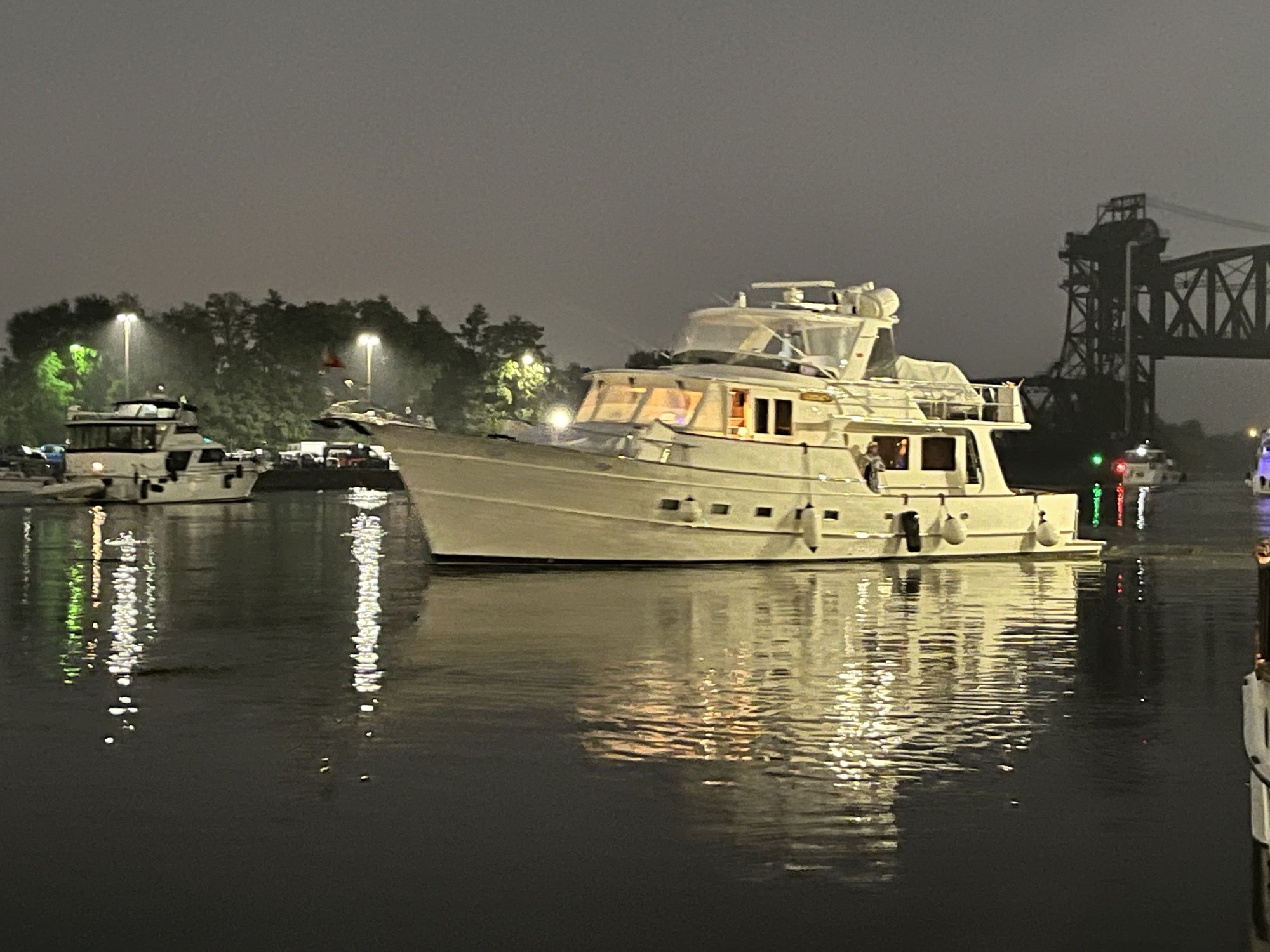
Just a few miles south of the Chain of Rocks lock, we came upon the long awaited Looper picture opportunity – the boat in front of the Gateway Arch!

Looper Classic shot! Thank you Mayli!

I’d be remiss if I didn’t provide a little history of St. Louis, since I didn’t do that in our last post. St. Louis, often referred to as the “Gateway to the West,” played a pivotal role in American history, serving as a launching point for westward expansion during the 19th century. The city was founded in 1764 by French fur traders and named after King Louis IX of France. It became a major trading post and gateway for explorers, trappers, and settlers heading west.

In the 19th century, St. Louis became a hub for westward migration, with the Lewis and Clark Expedition departing from the city in 1804 to explore the newly acquired Louisiana Purchase. Purchased in 1803, this new land doubled the size of the US adding 530 million acres. This vast tract of land was purchased from France for $15 million USD (Napoleon was running out of money battling Great Britain).

The city’s role as a transportation and trade center was further solidified when the Gateway Arch, an iconic symbol of the city, was completed in the 1960s, commemorating the westward expansion of the United States. However, like many industrial cities, St. Louis faced economic challenges and population decline in the latter half of the 20th century. The city struggled with deindustrialization, suburbanization, and racial tensions, resulting in the decline of its population and urban infrastructure. Today, St. Louis remains a city of historical significance and cultural heritage, but it grapples with issues of urban blight, crime, and economic disparities. Despite these challenges, St. Louis still embodies its historic role as a symbol of America’s westward expansion and retains its cultural and historical significance in the heartland of the United States.

After the Arch, it was onward to Hoppies and a little town, we were very pleasantly surprised by, called Kimmswick. In Kimmswick, we found some very cute shops (I got a sweater) and a fabulous restaurant and bakery called the Blue Owl. Unfortunately we got there at 2:50 pm and they close at 3:00, so no restaurant for us but the bakery was open. There we found the “Levee-High Apple Pie” inspired by the Great flood of 1993 when the Blue Owl had to be evacuated and the gallant sandbagging efforts of thousands of volunteers and National Guard saved the town and restaurant. An earthen levee built outside the Blue Owls’ back door withstood the 50 foot crest of the Mighty Mississippi. Mary, Owner and baker at the Blue Owl created this special Levee-High Apple Pie weighing in at 8 lbs standing 8” tall containing 18 hand peeled, sliced and stacked apples! Who can resist that!?!

After Hoppies, on 10/25 (a day marking the end of our 5th month on the loop) we headed south about 38 miles trying to get part of the way to Little River Diversion Canal, which in one go would have been about an 11 hour run. We found a safe anchorage south of Kaskaskia Lock and Dam on the right descending bank. With a 3+ knot current, Legacy anchored first and Saga and Lil Sudden tied on each side of us, also dropping their own anchors – more is better in this current and wind. We set our ‘anchor drag alarms’ and set out some cheers and crackers. As we got ready for dinner, Tonia crossed over from Lil Sudden to Legacy and saw, out of the corner of her eye, something amiss on their anchor chain. Low and behold it was a huge log laying perfectly across their chain with the chain acting as a fulcrum and the current keeping the log in place. We were thankful it didn’t hit one of the boats, but now how to get it loose?

It was all hands on deck to figure out how to get this log off of the anchor chain and beyond the boats safely. After lots of pushing and pulling, a few bad words and the help of Legacy’s anchor winch, we were able to break the fulcrum and current with a 50’ line to pull it off the chain. We were able to safely guide its passage between the two boats (Lil Sudden’s starboard and Legacy’s port) after failing to be able to get any leverage on it to go around Lil Sudden on her port side. With 4 boats anchored behind us, we didn’t want to just unleash the log, so the guys brought the dinghy around and towed it to shore. Crisis averted and it was time for dinner! We’d find out later that another log found the boats behind us later in the night (around 11 pm). We had already retired but heard their story in the morning. You never know what will happen on the Mississippi!

Up to see the glorious colors of the morning, we enjoyed the other half of the pie for breakfast and were ‘anchors up’ around 8:30 am for our 7 hour journey to Little Diversion Canal where we will anchor and celebrate Mayli’s birthday!

Today is Day 1 of month 6 on the loop…… 10 states and 1 Canadian province. Onward to warmer weather!

Alton, IL and touring St. Louis, MI

Day 152 – 157 Oct 20 – 24: Left Grafton headed to Alton a bit after 10:00 am on Friday, 10/20. Lines off that late made it a bit of a leisurely morning since our trip was short (2 hours) and stay in Alton would be 4 days. It was evident fall has arrived as we took in the changing colors and granite cliffs.

Arrived in time for a quick lunch and Boris and Matt were off to get rental cars and pick up friends at the airport. We hung out for the afternoon and headed into St. Louis for dinner at Hodak’s, a restaurant Boris’ great uncle started back 1962. Famous for it’s fried chicken and a bit of an icon in St. Louis, the food was fabulous! Where else can you get a half of a fried chicken (it’s signature dish) including french fries and cole slaw for $14.99! Matt and Tonia arrived first and secured a table. We arrived with the Hodak’s a few minutes later and were warmly greeted by the owner, since a little birdie told him the founders grand nephew was coming. A great time was had by all and of course the Hodaks purchased a few Hodak t-shirts!

While at Hodak’s we saw these curious statues of a fox dressed in traditional Lederhosen drinking a beer and eating a chicken bone. How odd, so I knew I needed to research that.

Saturday we were up early and wanted to be first in line at the National Great Rivers Museum, which included a tour of the Melvin Price lock and dam. Early was better since tour times and number of visitors was limited and Coda was planning on heading out after the tour with a deadline to be in Louisville for a family event. One of the highlights of the museum was a simulator that allowed you to drive the tow (tug boat) and push a raft of barges under a bridge or into a lock. While there were a few successes, no one successfully got the barges into the lock in the allotted time, but had fun trying!

We learned a lot about river lingo, barges, Samuel Clemens’ (Mark Twain’s) birthplace and early life as a steamboat captain, Did you know that 60% of US grain and oilseed exports, 22% of all domestic petroleum products and 20% of US coal used for electricity generation are moved by barge on inland waterways? How about the origin of Samuel Clemens pen name “Mark Twain”? Back in his days (1860’s), crewman would call out the depth of the river in fathoms. A yell of “Mark” meant 6 feet and “Mark Twain” with Twain meaning “twice that” meant 12 feet of water (2 fathoms). River boat life was dangerous with multiple groundings, hitting snags (underwater trees or logs) and coal fires. I was interesting to see some river-speak that is now part of everyday language: “Their project hit a snag”, “Let’s let off some steam”, “She’s working full steam ahead”, They got sold down the river” (a reference to slave auctions on levees), “It’s touch and go”, “They are riffraff” (after steamboats, only paupers traveled by riff (paddle) rafts).

So back to the foxes…..It turns out the foxes have an interesting history that we learned about touring the Anheuser-Busch (A-B) factory with Rick and Heidi. The foxes date back to A-B’s survival strategy during Prohibition, when A-B first brewed Bevo (its nonalcoholic near-beer) in 1916 after alcohol was banned in the military. By the time Prohibition rolled around in 1919, it ramped up production, and by the early 20s, A-B was selling 5 million cases of Bevo every year. It was so ever-present, it eventually became part of popular culture: Irving Berlin mentioned it in two songs, including “How Dry I Am.” The brewing building—the Bevo bottling facility—was named after the Bevo brand of “beer”.

The mascot for Bevo was a playful character named Reynard the Fox. Reynard (Dutch: Reinaert, French: Renard, German: Reineke) is a popular character from allegorical Dutch, French, German and English fables and fairy tales. While other heroes in the stories had brute strength, Reynard was sly and witty.

Reynard in the story was always funny whenever he was around, and he knew great places to find eats and drinks. That’s why the fox is shown on the corners with food and drink in his hand.

When the A-B building was constructed, four fox statues were carved on each corner. Each statue is about 10 feet tall; the foxes are dressed in traditional Lederhosen, and are shown eating and drinking. The traditional German outfits were chosen because Eberhard Anheuser and Adolphus Busch were from Germany. Foxes are familiar, yet overlooked to many St. Louis natives. The statues, like the bottling facility, have a rich history that is integrated with St. Louis, so it’s no coincidence that we found them at both Hodak’s and the A-B factory. By the way — other things A-B did to survive prohibition (1920 – 1933): built truck bodies, diesel engines and refrigerated cabinets, manufactured barley malt syrup, ice cream and infant formula, they also entered the bakers yeast business. Fun fact – do you know why prohibition was enacted? It was a response to social issues like domestic violence and child abandonment, whose presumed cause was alcohol. Some say it was a big backfire as criminal groups took advantage creating a large black market for booze.

Back to the A-B factory and our visit with Rick and Heidi – had a great time with Rick and Heidi on Sunday, 10/22 first with a tour of the A-B factory, followed by a visit to Forest Park – a huge public park complete with museums, a science center, zoo, an amphitheater, paddle boats and 30 miles of walking trails. Forest Park, officially opened to the public on June 24, 1876, is one of the largest urban parks in the United States. At around 1,300 acres, it is bigger than Central Park in New York. We capped off the night with a fabulous dinner at one of their favorite places – Polite Society in the Lafayette Square neighborhood of St. Louis.

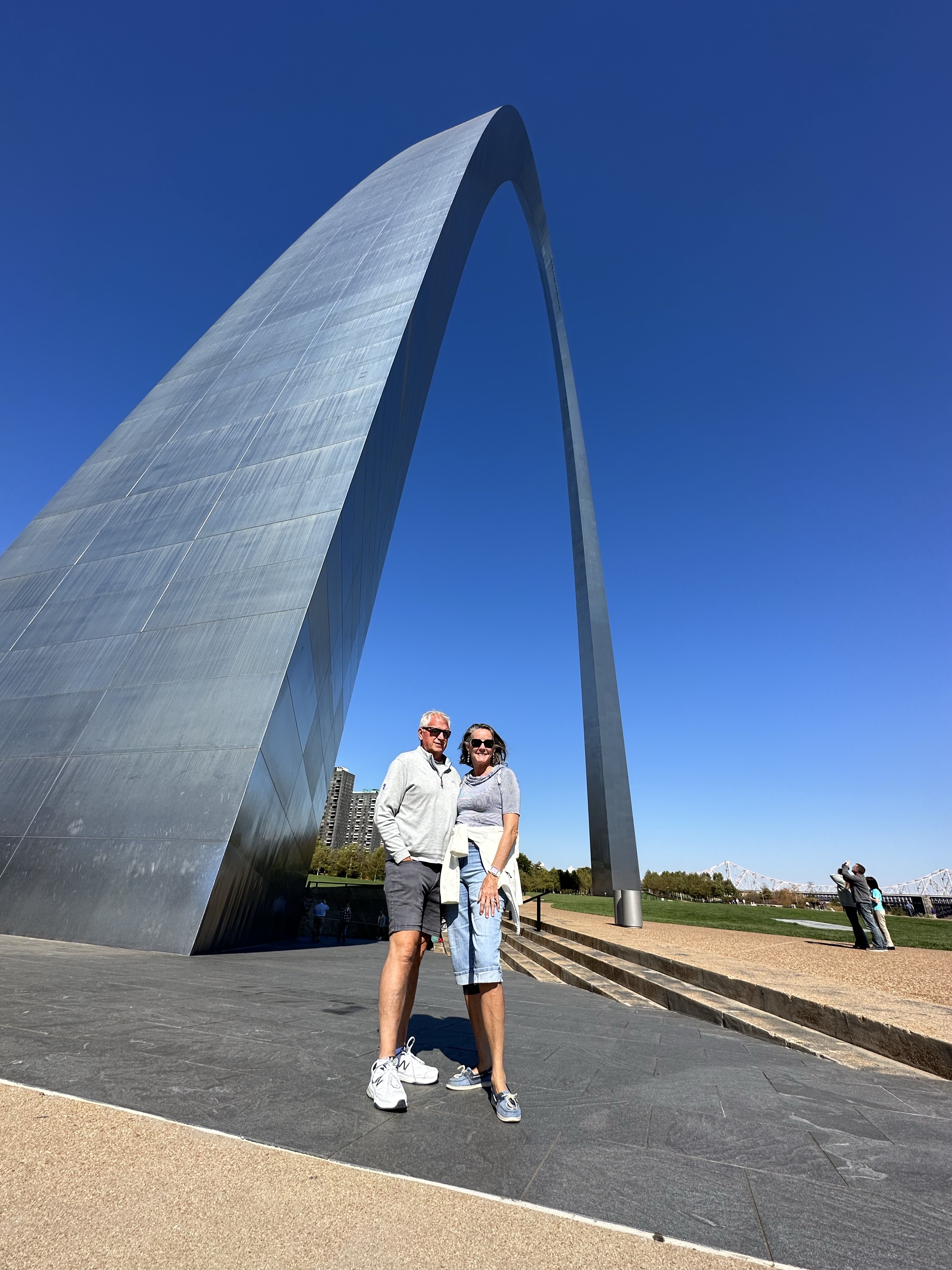
Alas, Rick had to work on Monday but Heidi was kind enough to return to the marina and pick us up for a driving tour of St. Louis (actually fairly sad as to the abandonment and decline of the city) – the gateway to the west that supplied the covered wagons and all the settlers needed for their journey into the Louisiana purchase. We ventured, of course, to the Gateway Arch and made the journey to the top in the 5 person miniature cars – an amazing system built inside of the arch inspired by elevators and ferris wheels. Going up was very cool, and the view quite impressive, but we have to say the highlight was the 30 minutes film in the Arch museum that chronicled the construction of the arch from February 1963 until its opening on October 28, 1965. 630 feet tall and 630 feet wide, it is designed to withstand earthquakes, lightning strikes and sways 18” in 150 mph winds. There are 1076 steps in each arch leg (thankful we didn’t have to walk them!) and a little known construction fact – despite what looked like zero OSHA rules and not a single worker tied off with a safety harness as they worked at great heights with cigarettes hanging out of their mouths, there was not a single fatality in the construction process.

The arch uses an “orthotropic design” that only became possible with advances in engineering in the late 50’s. If the arch had been built in 1948, the walls would have been 3 feet thick and would not have been able to accommodate a tram to the top. With an orthotropic design, the arch has no real structural skeleton. It’s inner and outer steel skins, joined together, form a composite load bearing structure that give it its strength.

After our amazing tour of the arch, it was back to the boat for a BOD meeting followed by a Captain’s meeting with the 13 boats who are planning to depart Alton for Hoppies in the morning. We have 2 locks to navigate and only half the boats have reservations at Hoppies – a small “marina” in Kimswick, MI run by the same family for generations. Hoppies is literally a few barges strapped together on the Mississippi; a must stop for loopers.

It was a very full 4 days and great to spend some time with Rick and Heidi seeing their adopted city of St. Louis. We were grateful for their generous hosting of us, doing touristy things they’ve done sooooo many times! Tomorrow we are off to brave the Mississippi and it’s huge barges again. We’ve traveled far in October trying to get south before the marinas close. The one we are in will shut down power and water next week. There are hundreds of loopers still behind us, so Godspeed to them!

Willow Island to Grafton where the Illinois River meets the mighty Mississippi

Day 150 – 152; Oct 18 – 20: We left our anchorage behind Quiver Island around 11:00 am, having waited to get started since there were tugs with barges in the locks. Carol had already been on her zoom call since 7:00 am, so Tonia joined Gary to handle the lines, fenders and anchoring. We proceeded to the La Grange lock where we anchored for about 30 minutes, waiting our turn. Gary and Tonia managed Legacy in to the lock, where we went down 8 feet. Carol’s break was timed perfectly so she was able to help get us off the wall of the lock and Tonia went back to her own boat. All worked out and then it was back to the Zoom call until 3:15 pm while Gary navigated on his own for a few hours. We arrived at our next anchorage behind Willow Island around 5:30 where magically, dinner was ready! Mayli and Boris made pork and chicken filled fried rice while Barb made a carrot and raisin salad as well as amazing white chocolate and macadamia nut cookies! Starship and Surprise joined as well with grilled chicken fingers and a salad.

This brought together 4 boys all between 11 and 12 years old who had a blast rowing a dinghy around with 2 dogs. What could possibly go wrong there? Well how about not tying up the dinghy when you take the dogs on shore? No worries – it was one of the Moms to the rescue on a kayak! Later, they had a blast chasing flies and little gnats in Legacy with the zapping tennis racket bug killing thingies…. We were quite grateful for their “work” and they had a blast….just little Huck Finn trick!

Willow Island Anchorage

Thursday, 10/19 was another early start for Carol (on Zoom by 7:30 am). Shortly after coffee and on a zoom break, we broke up the raft around 9:30 and headed to Grafton, arriving a little after 1:00, right when Carol’s call ended. Perfect timing! After everyone got settled and had a quick lunch, we were off to the Grafton Sky tour, a ski lift that takes you to the top of a hill where you can ride the Alpine coaster, do a zip line adventure or enjoy a full service restaurant with a big deck and view of the valley. We all enjoyed the Alpine Coaster that reaches speeds of 28 miles per hour while screaming around tight corners…. Or was that Carol screaming?…… anyway. We passed on the zip line being a 1.5 hour commitment with a hike between 4 different zip lines; that cold beer was calling very loudly at this point! Around 5:00 it was back down the ski lift while some headed to the restaurant and bar at the marina (Grafton Oyster Bar) and some took the marina courtesy car to the grocery store, but all ended up at the Oyster Bar later. Food was fabulous – highly recommend the seafood ravioli or the jambalaya.

We only spent one day in Grafton, which bills itself as the Key West of the Mid West. Kind catchy, but we weren’t so sure about that, although we did see lots of restaurants, bars, wineries and craft breweries.

Leaving Grafton, we crossed onto the mighty Mississippi River where we found the river 2-3 times wider than the Illinois with a lot more maneuvering room for both us and the tugs. We’ve been warned the barge configurations will be much larger and the traffic will be greater on the Mississippi.

Illinois meets mighty Mississippi

As we progress southward, the leaves are beginning to turn and we enjoyed the views of the quarries which provided 1000’s of jobs back in the day. Grafton stone was used to construct many buildings and homes in Grafton, but was also transported to St. Louis for use in structures like the Old Cathedral and the Eads Bridge.

Next stop Alton where we will spend a few day and use that as our home base to tour St. Louis. Hoping to visit with Rick and Heidi Vierstra (cousin) while we are here and of course get the obligatory picture of the boat in front of the arch.

Ottawa (Heritage Harbor) onto Peoria then to anchorage behind Quiver Island, North of Havana…. Still in Illinois!

Day 147 – 149; Oct 15 – 17: We were up early on Sunday morning before the sun with lines off at 6:45 am with 8 boats (members of flotilla 9 who chose to get up and go early plus remnants of flotilla 8). These were the brave ones who chose to make the 11+ hour 80 mile run to Peoria. We left in chilly weather with spitty rain headed to our first lock (Starved Rock) hoping to pass through the lock around 9:00 am.

Leaving as the sun came up

Upon arrival at the lock, they were locking through a large barge that was 3 barges wide and 5 barges long (a 3 by 5 in river talk!). We were instructed to anchor and await the barges clearing the lock. He was a big one – see below.

We started loading into the lock, per the lock masters instructions, with Legacy in first to tie onto the middle bollard; the next two largest boats came in after us, one in front and one behind. Then everyone else followed, rafting off one of the three boats with largest closest to the wall to smallest furthest out. This lock took us down 18 feet. Fun fact: Starved Rock got it’s name from a legend about a group of Illinois Indians who were trapped on the top of the rock by the Ottawa and Potawatomi tribes. The besieged Illinois were without food and water so were forced to surrender and were subsequently killed by their enemies…. Other versions of the legend say they died of starvation. Either way – gruesome death…let’s name a lock after it! This lock and dam were built between 1926 and 1933, part of the effort to provide a navigable channel between the Great Lakes to the Gulf of Mexico via the Mississippi River.

After passing through the Starved Rock Lock, it was another 7 hours of mostly industrial landscape, arriving in Peoria around 5:00 pm. Legacy arrived first and scoped out the space at the free wall off the Riverwalk in Peoria, just south of I74. Tucking into the municipal marina, we paced off the available slips and determined the rest of the flotilla could in fact fit into the various sized slips. Not the most well maintained marina and the power was not working, but we really didn’t much care. It was free, seemed relatively safe and it ended a long day!

It was also time to put the mast back up since we were done with too low bridges. Thankful for that!

Once everyone was tied up and secure, we headed off in search of a beer and dinner, finding Bill’s West Side Pub was open. Unfortunately, most restaurants and the places we wanted to see (Caterpillar Visitors Center and Riverfront Museum) were closed on Sunday and Monday, so we decided we’d stay just the one night and head out on Monday morning. We did get a walk in after breakfast to find the Richard Pryor statue (he was born in Peoria…who knew!) and the other statues along the statue walk on Washington Street, honoring the indigenous people.

By 10:30/11:00 am we were off again, headed under one railroad bridge then another lock. Peoria L&D lock took us down another 8 feet. Shortly after that lock we caught up with a tug (Ann Elise) pushing a large group of barges into an area known as “The Wiggles” because that section of the river was so curvy the tugs need to “wiggle” through it. We watched the Ann Elise navigate this section of the river and it was quite fascinating to see him turn that massive set of barges. See below!

Jeremy at Heritage Harbor suggested an anchorage behind Quiver Island where we would find atleast 6 feet of water. Legacy was in the lead again (you might ask why….our cruising speed is about 10 knots while the other boats cruise in the 7.5 – 9 knot range)…. Anyway….. we got there first and entered this narrow area very cautiously, since we draw 5 feet and expected only 6 feet of depth. We were pleasantly surprised to find between 8 and 9 feet of water and a sailboat named Starship already anchored there. Jason on Starship called us on the radio and gave us the lay of the land…. So appreciated! We dropped anchor in the center and awaited the arrival of the rest of the flotilla: Coda, Lil Sudden, Saga, Darlyn, Blue Moon and Beachside. We rafted the other 6 boats, 3 on each side, with 3 anchors down while one more boat (Surprise) rafted with Starship. Surprise could have joined us as well, but we later learned they were friends with Starship and planned this rendezvous all along!

It was a super nice night, albeit a little chilly, where we started off with queso, bean dip and chips followed by fish tacos with mango slaw and rice. All activity was in the cockpit and salon of Legacy – party central! Carol had done all of the prep for the tacos on the way, using ingredients from just about every boat in the flotilla. Barb also made the rice and bean dip. At “go time”, Tonia got the slaw ready while Gary manned the skillet. The prep paid off and a meal for 13 came together very quickly and was then topped off by a surprise peach, apple and pear cobbler made by Barb! That brought out the last of the vanilla ice cream the Z’s had in the freezer (an added surprise). No one left hungry!

Tuesday, 10/17 we awoke to a 38 degree morning and mist rising from the water. Coffee was again served on Coda where we talked Steve into using his new fancy gas powered super large griddle to make breakfast for everyone. It was bacon, homemade hash browns and scrambled eggs with cheese. YUM and thank you to Steve and Barb!

After breakfast it was time to head to Beardstown, about a 33 mile run, where we could raft to the Logsdon Tug Service barges for $1.00/foot cash, no power. Sounded great! We were on our way around 10:30 am and arrived in Beardstown a little after 2:00.

The last leg required that we pass under a bridge but a large assembly of barges pushed by a tug was coming through. We waited for them to pass. Check out how large they are and how close we were!

The captain and deck hand at the tug were kind enough to give us a quick tour of the tugs before they were off to help a barge coming through the channel. After that, we were off to find ice cream, dinner at a local Mexican restaurant and provisions. We ended our very busy day on the boats with a beautiful sunset.

Tomorrow we are off to Willow Island and the power of friends has kicked in. Carol has 2 days of all day meetings on Wednesday and Thursday. Tonia from Lil Sudden is going to join us on Legacy to assist with the locks while Annette from Saga (13) will join Matt on Lil Sudden to do the same while Carol is in her meeting. We need to get all 3 boats through the locks with the right eyes on computer screens vs. eyes and hands on lines and locks. Super thankful for the help!!

Joliet to Heritage Harbor; cold and rainy but uneventful as Lake Michigan rages behind us

Day 146; October 14: Up at 6:00 am to check the weather forecast and for our flotilla leader, Steve, to communicate with the locks and destination marina. Wind conditions significantly improved with the forecast now at 10-15 knots vs. 15-20 with gusts to 35. It’s pretty darn cold (low 50’s), spitty rain, but flat water. A little more than half of the flotilla decided to go vs. waiting another day for better conditions. Steve did a great job of laying out the facts so each boat could make their own decision based on their own skills and confidence as well as the ability/performance of their boat. The 10 boats that decided to go were “lines off” at 6:30 am to pass under the drawbridge that only stays open until 7:00 am.

We passed through all 3 locks (Brandon Road, Dresden Island and Marseilles) without incident. We had a very short wait to enter the Brandon Road lock, which took us down 38 feet. A couple hours later we came upon the Dresden Island lock, where he had to anchor for about 30 minutes as barges completed their locking and cleared the lock. Dresden Island took us down 18 feet. While on anchor, handed off a pie plate to Mayli on SAGA as she wanted to make us all a pie for dessert tonight! No one starves on the Great Loop!

It was another couple hours to the Marseilles lock, so we took advantage of the time and Carol jumped in the shower since there was no time for that this morning. We also did 3 loads of laundry, made water and vacuumed throughout the day. You do what you can when you can! The Marseilles lock was empty when we arrived, so we were able to go right in. It was the smoothest ride yet, descending 28 feet while Annette on SAGA blew bubbles from her bubble gun and Mayli danced to “It’s Raining Men.” Always some levity from the SAGA crew!

While Marseilles was the smoothest ride, it was also the loudest. Check out the noise from the bollard below:

Being so chilly, we ran from the warmth of the pilot house the entire day and felt badly for those that had to run from their fly bridges. Brrrrrrr! We usually run from the bridge and think this is only the 3rd time in 3 years we’ve run from inside. It was quite pleasant and toasty!!

We arrived at Heritage Harbor around 2:45 pm, so a little over an 8 hour day. We were greeted by Jeremy Fowler, harbor master and his most amazing staff. We had already been given our slip assignments and the amazing HH team assisted each of us as we came in.

Several of our flotilla members had a quick shower then we assembled at the Red Dog Grill for a few beers, some wings and nachos, dinner and briefing by Jeremy covering the next 550 miles of rivers. To say the least he left us impressed, overwhelmed, but with his cell phone number! Tomorrow we are off again around 6:30 am. Next stop: Peoria and the city wall near I74…. Sounds like the only place deep enough for us about 80 miles away – going to be another long day!

Still praying for the flotillas behind us in Hammond and other Lake Michigan ports. The lamb turned into a lion with +10 foot waves and high winds. Loopers are hunkered down for a few days until things calm down and they can continue on their journeys.

Illinois River System, here we come!

Day 143 – 145. October 11 – 13:

We arrived in Hammond, about 15 miles south of Chicago on Wednesday, 10/11 and enjoyed a day hanging with the crews of Coda and Lil Sudden, making dinner together and meeting other boats in our flotilla scheduled to meet up in Joliet, IL at the free wall on Friday. Saturday our flotilla will travel through the Brandon Road, Dresden Island and Marseilles locks. That was a mouthful and why a flotilla? Let me back up.

Why is passing through these locks such a big deal…and why set up flotillas? The three aforementioned locks were closed for repair and maintenance for over 3 months. WOW! So no way to travel south on the river system out of Chicago. That’s a big deal to commercial traffic PLUS the over 250 loopers looking to continue on their journey to Alabama/Florida. Since these locks serve commercial as well as government traffic, pleasure traffic (like us) is the lowest priority. In normal looping time, boats would transition through these locks as they saw fit and would naturally adjust their timing to the capacity of the locks, capacity of marinas north and south of the locks and tolerance for colder weather.

Imagine the log jam of boats with 3 locks closed and no way to transit south. Conventional wisdom is to be out of Chicago by 9/30. The locks were forecasted to reopen 10/1 (but ended up delayed by 5 days). Even without the delay, that leaves mayhem and hundreds of loopers looking to go through. This is where the Americas Great Loop Cruising Association (AGLCA) stepped in and working with the Army Corps of Engineers (ACE) organized the looping fleet into manageable sized flotillas (16 boats in each) who were given priority by the ACE to pass through the locks in an organized fashion, one flotilla per day, in coordination with the prioritized commercial traffic. We are in flotilla 9 scheduled to lock through as a group on 10/14 (delayed from 10/9). Part of the plan is we need to continue moving forward as a group for the next several days so we don’t clog up the works for the flotillas behind us. It really is a cooperative effort by all!

So back to Hammond….we tried and tried to get a slip at Marine Services (a marina) in Dolton, about a 3 hour run with one lock from Hammond to Dolton. We knew that bad weather was coming in on Friday and the hour run from Hammond (on Lake Michigan) to the mouth of the river system was going to be very dicey with a forecast of 5+ foot waves. We finally got word that slips were available around 3:00 pm so we left asap to get to Dolton before dark. We had a little bounce on Lake Michigan (2-3’ waves) but nothing like what it was going to be in the morning. We arrived just before dark, had a quick dinner, flotilla meeting and turned in for the night.

It was a quick turn around in Dolton; we were up and out at 7:00 am headed to the free wall in Joliet, IL which is about a 5 1/2 hour run including one lock that would drop us 38 feet and passing under the lowest fixed bridge on the loop – the Burlington Northern Santa Fe Rail Road Bridge in Lemont, IL at 19’6”.

To make it under that bridge, we folded down the mast that holds our radar domes and approached with extreme caution….as they say, approach at the speed you are willing to hit it! If you can’t get under this bridge, the “The Great Loop” becomes the “The Great U-turn!” We made sure our fuel tanks and water tanks were full so we sat lower in the water and thankfully made it under with about a foot to spare (we had expected inches!)

Passing under lowest fixed bridge on theLoop. We cleared by about 1 foot.

We arrived at the Joliet wall around 12:30/1:00….. hungry but just fine! We had a quick lunch then were on the look out to help catch the second wave of boat in our flotilla that left from Hammond, endured the 5’ waves and was now arriving in the rain. All good – everyone got here safe and sound!

It ended up being a rainy afternoon with everyone watching the weather for the next few days as we decide whether to stay one more day or go. There aren’t really waves on the river, but the forecast for the winds is all over the place right now – 15-20 knots with gusts up to 35. The next leg is a 38 mile run with the 3 newly opened locks and many bridges, including the first that will only open if you are there before 7 am. This leg will be a long day: 10-12 hours depending on wait time at the locks.

The AGLCA had already called off the next 3 flotillas due to forecasted high seas on Lake Michigan (12-15 foot waves!) so we didn’t have the urgency to leave with the flotillas behind us delayed. We were glad we weren’t them! While we were at the Chicago Yacht Club, it was bouncy with 1-3 foot waves, never mind 12-15. Praying for their safety!

Dinner was a collective effort: Boris and Mayli made beef stew; Tonya and Matt made wild rice, Z’s made a chopped salad and Barb and Steve made homemade bread! All delicious and it was later off to bed to assess the weather in the morning and make a go/no-go decision. Stay tuned for what we decide!

Final Day in Chicago and onto Hammond, awaiting the big transition to start down the Illinois River

Day 140 – 142; Oct 10 – 12: Tuesday we started off with a scare as we woke up, came up for breakfast and saw divers running a search pattern in the water between the Chicago Yacht Club bulkhead and our boat. We watched them for a while, with the ambulance and rescue trucks in the CYC parking lot. It didn’t look like there was a lot of stress or urgency, though, and it all made sense when we saw them pull a dummy from the water – just a practice drill! Phew!!

Tuesday was a busy day – our last in Chicago. We went to the Federal Reserve Money Museum and learned a lot about the role and history of the Fed, all the way back to 1791 when Alexander Hamilton proposed the first incarnation of a National Bank which as approved had a charter for 20 years. We also learned that the Secret Service wasn’t originally started to protect the president and other senior elected officials….. it was started because, by the end of the civil war, nearly one third of the currency in circulation was counterfeit. The Secret Service was started in 1865 as a bureau within the Treasury Department to suppress widespread counterfeiting and still holds that responsibility today. It was after President McKinley’s assassination in 1901 that the Secret Service was tasked with full time protection of the POTUS. Back to the money…. The Fed plays a big role in monetary policy and interest rates as well as printing, storing, circulating and destroying damaged currency. Ever seen one million dollars in various denominations of bills? Check out the below!

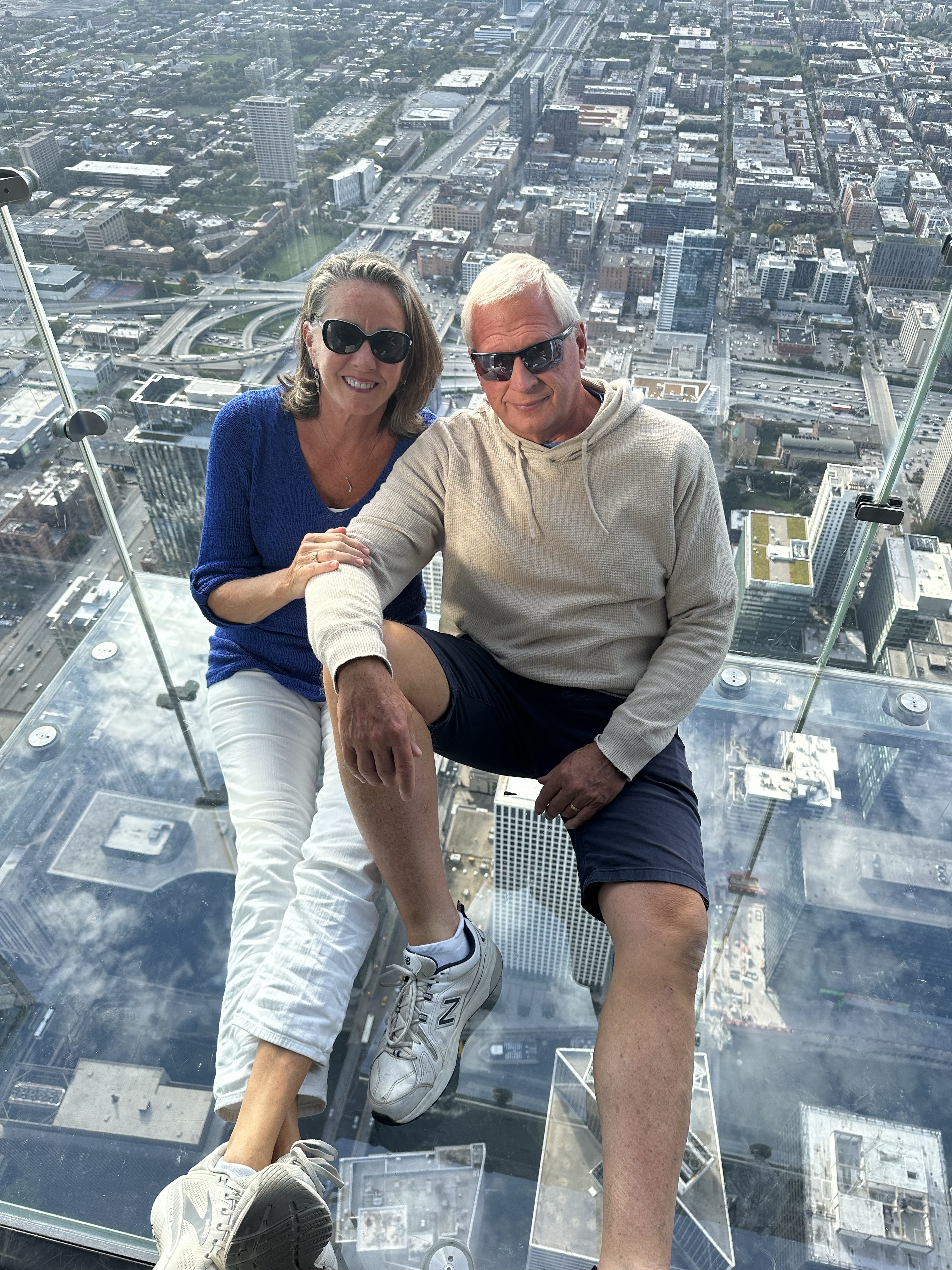
After an amazing lunch at Miller’s Pub, an icon in Chicago on S.Wabash Street, we were off to the Willis Tower (formerly Sears Tower) to have our turn on the Skydeck in “The Ledge.” Willis Tower is the tallest building in Chicago at 1454 feet and the third tallest in the Western Hemisphere. It was the tallest building in the world when completed in 1974 and held that title for 22 years when it was surpassed by the Petronius Towers in Malaysia. The Skydeck is on the 103rd floor with panoramic views of Chicago. The Ledge glass balconies extend out 4.3 feet from the Skydeck, 1353 feet in the air.

We finished our night with an amazing dinner at Rosebuds, an Italian restaurant highly recommended by a Chicago friend and colleague. Even though we were quite full, we topped off our night with the “mile high chocolate cake”, which was both huge and delicious! We had dessert for days!

We thoroughly enjoyed Chicago and as they say, if it weren’t for the winters, it would be the most beautiful city in the country. We were lucky to have very nice weather with warm days and cool nights. Alas, all good things much come to an end and it was time to move on. Wednesday we left Chicago and headed to a marina in Hammond about 15 miles which has little to offer except a casino and being close to the mouth of the Illinois River, where we will start our river journey south. We heard there was a Walmart about a mile away, but that’s about it. It’s a huge marina that had lots of loopers waiting for their scheduled time to go through the Brandon Road, Dresden Island and Marseilles locks – all newly refurbished and reopened.

We will be in flotilla #9, transiting on Saturday, 10/14. There are 16 boats in our flotilla and we will all gather at the Jolliet free wall on Friday, 10/13…..then on we go!

Chicago, Chicago!

Day 135 – 139; Oct 5 – 9: The weather was very favorable on Thursday, 10/5, so we were off to Chicago from Racine around 9:45 am for an approximate 5 hour run, arriving around 3:00 pm. Seas were very flat with winds around 5 knots to the North/North West and beautiful sunny skies.

Lake Michigan – completely flat! Just the way we like her!

It was an uneventful and peaceful ride where we saw lots of lakefront bluffs and homes, the huge dome of the Baha i House of Worship in Wilmette, IL and water cribs on the way into Chicago. We later learned that the water cribs protect offshore water intakes used to supply Chicago and her suburbs with drinking water from Lake Michigan. Water is collected and transported through tunnels located 200 feet beneath the lake ranging in diameter from 10 to 20 feet. The tunnels lead to Pumping Stations located onshore, then to water purification plants. Who knew! Out on the water, they looked like circus tents to me!

It was great to reunite with the Coda, Saga and Lil Sudden – the Seattle crews we affectionately dubbed the 3 musketeers….we are the 4th! We arrived looking forward to seeing them as well as all that Chicago had to offer. We arrived at the Chicago Yacht Club (CYC) leveraging our reciprocity from Annapolis Yacht Club (AYC) and enjoyed an amazing dinner at the CYC clubhouse the first night we were here. Located a short distance from the Navy Pier, restaurants and museums, we knew it would be a great location and jam packed few days. What we didn’t know was how bouncy it would be at CYC. When the winds come in from the south or south east, it can be pretty rough despite the sea wall. With some careful fender placement and strategically tied lines, we were fine but remained on alert.

Friday, 10/6 we were off to the Chicago Field Museum of Natural History where the largest and most impressive display is their dinosaurs in the main hall, but we also enjoyed learning about the first kings and origins of royalty, DNA, meteorites, biomechanics, ancient Egypt and much more.

Our evening was topped of by dinner at the neighboring Columbia Yacht Club where their clubhouse is most unique. Doesn’t this vessel pictured below and docked between 2 fabulous harbors in Chicago (Monroe and DuSable) look like a fine sailing vessel from years past? Well she is! Commissioned in 1947, she was the largest icebreaker in the world at the time and the heaviest vessel ever constructed in Canada. Albegweit was an ice breaking railway, vehicle and passenger ferry from 1947 – 1982. Retired from service and up for sale, she now serves as the clubhouse for the Columbia Yacht Club (CYC)! Chicago city ordinances barred CYC from constructing a clubhouse on the waterfront, so they purchased Abby and permanently moored her at their facility. It was a super unique solution so many years and a great meal for us!

Saturday, 10/7 we had a hang out/provisioning/laundry/catch up/email day that was very needed. Good to have a down day!!

Sunday, 10/8 was the Chicago Marathon and we sat in the cat bird seat just a few hundred yards from the start line. Streets were closed and there was a lot going on!

We sat tight for the morning and let all the activity happen around us then headed off to the Museum of Science and Industry in late morning. We spent the entire day there quickly realizing you need far more than a single day in this museum, especially if you spend as much time as we did in the U-505 exhibition.

We toured an actual German submarine (U-505) that was captured by an American Task Group off the coast of Africa in WWII. The German Uboats (subs) were wreaking havoc on the supply lines from the Americas to Europe; capturing a uBoat intact became a goal of Allied Naval commaders. It is quite the story how a US Task Group did just that and towed a captured enemy sub, in secret, to the Bahamas and then kept it a secret for 2 1/2 years since the sub contained German Code books, Enigma machines (used to communicate in code) and countless other military intelligence that would be used against the Germans in WWII. The Germans tried to scuttle the sub, but the American sailors who boarded the vessel managed to save it. The captured German sailors were interned in a POW camp in Louisiana and their survival (as well as the survival of the submarine) was kept secret for 2 1/2 years so the German commanders thought the U-505 was sunk, the crew lost and the secret codes at the bottom of the ocean. Believing this, they didn’t change the codes! Fascinating story.

At the end of the day, it was the commander of the US Task Force (a Chicago native that captured the U-505) who raised the funding to bring the U-505 (which was destined to be sunk as part of US Navy target practice) to Chicago and the Museum of Science, preserving this WWII history for all those who come to learn.

So much to see at this museum! In addition to the U-505 story and tour, we saw the largest train set ever (connecting Chicago to Seattle) as well as the Apollo 8 command module and a Lunar Landing Module trainer. We learned about farming and the technology behind a combine, glaciers and the effects global warming is having on them as proven in multi years of photos, a history of bicycles and so much more!

Topped off our day with Chicagos famous deep dish stuffed pizza at Giordano’s that was amazing…definitely 2 meals!

Monday, 10/9 we spent the day at the Chicago Institute of Art. Gary was skeptical but went along with a smile, hoping it was a little better than the art museum I dragged him to in Racine! We had no idea the museum was so huge! We enjoyed many aspects but especially the Monets, Van Goughs, Renoirs, Gauguins and Degas. They also had a huge collection of Georgia O’Keefe’s work. Of course there were floors and floors, acres and acres of sculptures, pottery, gems and other treasures. We were partial to the paintings over the hundreds of years (1500’s to modern time) and spent most of our time there.

Tomorrow – we go to the Federal Reserve Money Museum, then Willis (formerly Sears) Tower to stand in the sky boxes 1450 feet over Chicago at this highest point in the city……then dinner at Rosebud’s Italian restaurant!

Stock photos below…. Can’t wait!

Good Bye Milwaukee, WI – Hello Racine, WI!

Day 133 – 134: Oct 3 – 4. Spent one more day and night in Milwaukee enjoying the unseasonably warm weather in October. Karl (retired CIO Northwestern Mutual) and his wife Helen met us at the marina and after a short tour of the boat, we headed out to a very cool street of restaurants (East Brady Street) for empanadas. I can’t remember the last time I had empanadas, but they were authentic and fabulous. Really enjoyed catching up with Karl and meeting Helen. They also very graciously gave us a quick car tour of some of the sights in Milwaukee.

It was interesting to learn that much of what we think of today as Milwaukee’s lakefront wasn’t there when the first Europeans began to settle in this area in the early 1800s. As the city developed, land was developed nearly all the way to the ends of the tall bluffs that then lined the lakefront, leaving little space for public lands along the water. The lakefront we know today was the result of massive landfill projects over the past 100-plus years that were engineered to maximize both its industrial and recreation potential.

These landfill areas were created by literally dumping earth and stone into the lake until it built up into new, useable land. The earliest fill projects were mostly undertaken using dirt and mud dredged up from the lake or river bottoms and other loads of unneeded debris, including garbage and coal stove ash. These areas include pretty much all lands between the South Shore Marina and North Point. South of the straight cut, where the rivers enter the lake, are the huge docking terminals that were built on the outer edge of Jones Island in the early 1930s. This project was undertaken to maximize the shipping potential of the port and took advantage of the new south portion of the breakwater wall, which could protect large ships as they docked or sat moored at the island.

The lands just to the north of the straight cut have known the most varied uses of any part of the lakefront. One of the first major fill projects was untaken in the 1910s; the initial idea was to use this as expanded municipal docking space. However, by the time the project was finished, railroad shipping had taken away so much business from Great Lakes package freighters that the extra space was not needed. The area was eventually used as an airfield and later a flight school for seaplanes. During the Cold War, it was home to an anti-aircraft missile battery. Since 1970, it has been known as Henry Maier Festival Park, home to Summerfest and many of the city’s major ethnic festivals.

Karl drove us by beautiful stately homes on Oak Leaf Trail that at one point overlooked the water, but the land was filled in to create acres and acres of additional land that allowed the addition of a major thoroughfare as well as, what is today, parks and marinas for public enjoyment. The former lighthouse looks a bit out of place land locked miles from the water, but the addition of public lands was a priority for the socialist city mayor and government at the time. He was opposed to the rich barons of Milwaukee who owned those homes also owning the lake frontage and believed the lakefront should belong to the people. Fascinating!

As we considered what to do in Milwaukee, and with the Museum of Art and Brewery closed on Monday and Tuesday, we opted for the Harley Davidson Museum (see previous post) and the Milwaukee Brewers vs. Arizona Diamondbacks wildcard game. It was a short Uber ride back and forth to the stadium and great experience there: Really nice stadium with a roof that opens in good weather, pretty darn good traditional bratwurst and ice cold Oktoberfest and enthusiastic crowd, but sadly the Brewers fell apart in the later innings and lost…..then lost again last night (10/4) so they are out of it.

Wednesday morning (10/4) we left Milwaukee with a forecast of 2-3 foot seas and winds about 15 knots out of the South/South East. Not ideal, but we’d be taking the waves pretty much straight on the bow for the about 2.5 hour run to Racine. It was a little bouncy, certainly nothing Legacy can’t handle, but I did take the bar down and wrapped the bottles in beach towels and placed them on the floor (better safe than sorry)! It was a beautiful warm day (high 70’s) when we arrived in Racine at Reefpoint Marina – a huge marina with very nice accommodations including a smokehouse restaurant that smelled so good, we decided to eat dinner there. Yum!

We spent the afternoon at the Racine Art Museum (a bit of a snooze except for the pottery) and the Heritage Museum (much more interesting), then biked about 1.5 miles to what should have been a full service grocery store, but it’s shelves (in a bit of a seedy area) were pretty bare, so we left. Will re-provision in Chicago and we found the couple things we truly needed at the marina convenience store.

Racine has a rich history from its roots in fur trading to developing into an industrial city and a factory town almost from the beginning. The first industry in Racine County included the manufacture of fanning mills, machines that separate wheat grain from chaff. Racine flourished throughout the 19th and 20th centuries, eventually becoming the home to major corporations including the well-known SC Johnson family company with products like Windex and Pledge. Other surprising items invented in Racine include malted milk (Horlicks), the blender (Hamilton Beach), the blow dryer and the portable vacuum cleaner. Racine is also home to InSinkErator, manufacturers of the first garbage disposal and the Western Publishing factory where Little Golden Books were printed. It also has a fascinating history, well laid out in the Heritage Museum, of their support and role in the underground railway bringing slaves from the south to freedom in Canada through Racine.

Forecast for Thursday, 10/5 is super flat seas (barely a foot if at all) and winds very light (0 – 10 knots out of the north). Ideal conditions for our 5.5 hour trek to Chicago… that is ideal except for these pesky tiny flies/gnats that aren’t being blown away by the wind! Ugh!

Looking forward to reuniting with other Loopers in Chicago and doing some additional touring in Chicago. We are still on track to traverse the 3 locks on the Illinois River (Brandon Road, Dresden Island and Marseilles) on 10/14. The first of the AGLCA flotillas will move to the Joliet Wall today and lock through tomorrow. That will begin to clear the log jam of boats in the Chicago area. The plan makes for long days for the looper boats (it’s about a dawn to dusk trip) and then they need to keep moving the next day to allow the next flotillas to come through and take up their marina/wall space. There are over 20 flotillas in all. Looking forward to some time in Chicago then getting on with moving down the river system to the warm weather!