Day 356 – 360; 5/14 – 5/18: Do days at home and off the boat count as looping days if you have not yet crossed your wake? Some would say yes and some would say no. Well they say your loop, your rules…so we are going to say yes!
Tuesday, 5/14 – 5/16 were business trip days for Carol and a little bit of everything for Gary: offloading the boat, retrieving boxes from U-Haul, unpacking, restocking the house, haircut and even a little bit of golf! Friday, 5/17 was time for the same for Carol (except for the golf), as well as prep for our big day on 5/18 – crossing our wake in Annapolis!
5/18 (Saturday) we threw off lines around 10:15 am planning to arrive in Annapolis, where we started, around noon.
Last Leg!
The weather forecast was a little iffy all day (spitty with chances of rain). There was not much we could do about that, so we just decided to make the best of it. Mission BBQ would be there around 12:15 with a fantastic buffet lunch, the cooler was full of various beverages and we were home after an amazing year!
We were greeted at the dock by Todd and June as well as Liz and Jim, soon to be followed by a steady flow of friends and family who came by to welcome us home and celebrate “going gold.”
Turning into the Severn River and approaching Annapolis
It was a little spitty as we entered the Severn River and headed toward Ego Alley and AYC. As we arrived, however, the sun peaked out and the rain held off for the entire afternoon!
Coming into AYC; “Crossing our Wake”; the comment about my hair is because Liz cut it for me the day before!
Our guests came and went all afternoon with the last leaving around 4:00 pm. Within 15 minutes, the downpour started and it rained on and off all the rest of the night. We were truly blessed!
Hello Annapolis!Ego AlleyEgo AlleyMooring FieldWelcoming CommitteeHere we come!Legacy back where we startedAYCGoing GoldGreat friends celebrating with us!
And that’s a wrap! Full circle. 6571 Miles. 97 Locks. 5771 gallons of diesel fuel. New friends – too many to count!
Full Circle; Each month is a different color starting May 25, 2023 and ending May 18, 2024
Day 354 – 355: 5/12 – 5/13: The Saturday night forecast called for thunderstorms over night – our last night in Solomans Island. We added a couple extra fenders and checked the lines before retiring, noting that the other loopers at the dock were bouncing around quite a bit. At +95,000 pounds fully loaded with food, fuel, water and us (not to mention Carol’s clothes!), we were much less affected but still felt the waves at night. We awoke to the sound of thunder, lightning and hail….yup… slushy ice balls falling from the sky! It didn’t last long and was all clear by 8:45 am. We were lines off by 9:15 and headed to the South River – destination Burr Yacht Sales in Edgewater, MD. We waved goodbye to 2 other Flemings in town: 45 North and Sea Yinz. Always curious about the source or meaning of boat names, Sea Yinz is a play on Pittsburgh slang for ‘See y’all.’ Yinz is a Pittsburgh (originally Scottish) slang for ‘you all’ or ‘all you all.’
As we left Solomans, our on and off problem with the port transmission persisted – reverse works fine but when you shift it into forward, nothing happens, so we literally run on just the starboard engine for a few minutes, the port just idles in neutral. We’ve found if we travel every day, it’s pretty consistent about working correctly, right away. If we are stopped for a day or more, however, it gets finicky and forward decides to kick in when it wants to…sometimes it’s a minute, sometimes it’s 2-3 minutes and sometimes it’s 10 or more. Ugh. Glad we are close to home to get it looked at (again!).
It was about a 4 1/2 hour run mostly in cool and spitty weather, sometimes outright rain. We ran from the bridge but with the isinglass all in the down position; we usually open the center middle section for air flow. Carol had a call that was supposed to be 30 minutes but went for almost an hour…. Are you seeing the pattern here? It was great to see some familiar sights as we got closer to South River. We arrived around 1:45 and after tying up, saw a few passing showers from the protection of the salon. We used the afternoon to catchup on emails, bills, BOD stuff, etc. With Gary’s favorite German restaurant (Old Stein Inn) just around the corner and the opportunity to use one of Burr’s courtesy vans, we were off to dinner just after 6:30 to celebrate Mother’s Day.
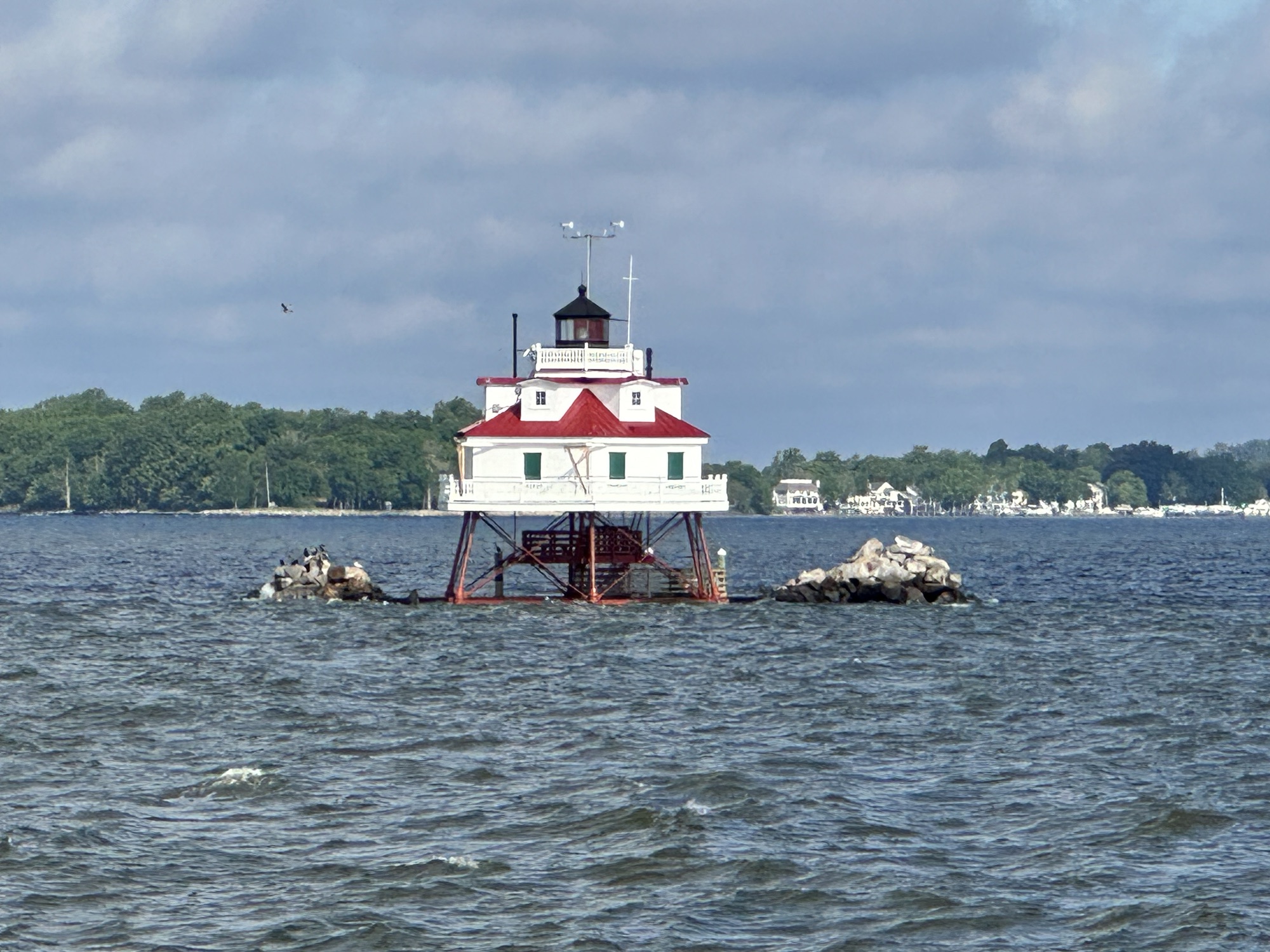
Bay BridgeThomas Point Light House
Now one might say: “Why Gary’s favorite restaurant for Mother’s Day?” Well it’s not that Carol doesn’t like it, although she’d not choose it for Mother’s Day, but it was so close and we were right there so we agreed she’d get to choose for Father’s Day. Cafe Mezzanote (Italian) here we come in June! Food was fabulous and we each had our usuals: Short Rib Saurbraten for Carol and Munchner Schweinhaxe (pork shank) for Gary, of course with amazing German beer. Too full for dessert, we waddled back to the car!
Monday 5/13 we were up and ready for the dock hand to help us with a pump out when they opened at 8:00 am, as discussed with him the night before…..but that didn’t happen. We waited about 30 minutes and after several attempts to reach him by phone, we gave up and left….Ugh! It was time to head home (yes we decided to sneak into our own pier and sleep in our own bed). We were now in familiar waters we’d travelled many times, passing the Thomas Point Light house, going under the Bay Bridge and entering the Magothy River just north of Annapolis.
We don’t consider arriving at home as crossing our wake, since we started the Great Loop from Annapolis at the Yacht Club and will return there on Saturday, 5/18. It just made sense to get home and start unpacking Legacy and for Gary to have 3 days to get some of our things out of storage while Carol will be gone on a business trip (Tuesday – Thursday).
We thought we’d travel a bit incognito and sneak home by not turning Nebo on, but it came on itself and lo and behold we were found out! Our phones and facebook started lighting up. People saw our unannounced path home so we thought we’d come clean and admit we are back in our “dirt home” but we aren’t done with the loop!
Final legComing back around Thomas Point LighthouseBay BridgeToot, toot to Todd and JuneHome coming into sightPier at homeHome sweet Home!
It was great entering the Magothy and all the familiar sites. We gave our traditional toot of the horn as we passed Todd and June’s house and just like we’ve done hundreds of times, backed Legacy in to her berth and got her secured. The rest of the afternoon was hauling stuff off, one meeting for Carol and getting settled back into our home….atleast for now! Carol leaves in the morning and Gary starts the arduous task of getting the boxes out of the attic or back from storage. The beach took a beating from some of the winter storms so we have lots of work to do!
Home Sweet Home!
Saturday, 5/18/24 we head to Annapolis and cross our wake – 1 week short of a year from our departure date of 5/25/23. What a year it’s been!
Day 348 -353: 5/6 – 5/11; Monday, 5/6 we left the quiet Alligator River Anchorage around 8:30 am and weaved our way back out through the crab pots on our way to Coinjock, NC. It was a bit of a spitty, rainy, overcast day, but the Albermarle Sound was relatively calm and an easy run. Carol had a 30 minute call that went an hour (again) so we had to hover a bit before we were ready to dock. We arrived around 1:00 and were one of just a few boats on the very long dock, but they tucked us up to the boat in front of us so tight we were afraid our anchor was going to go through their cockpit isinglass. Well it didn’t and boats filed in all afternoon filling the dock including Mack (Kevin (former AYC commodore) and Amanda who we met day -1 of our loop in Eagle Cove), Marydale who we met in Belhaven), a large green cabin cruiser we met in Sea Island but never got a boat card) and then the huge 110’ Freedom arrived with a crew of 6 women and the male captain. Freedom winters in Fort Lauderdale and summers in Newport. For a mere $100k PLUS expenses (fuel, food, booze, etc) you can charter her for a week! Those ladies worked hard scrubbing that boat for over an hour. Made me tired just watching them!
We were quickly reminded by some of the other boaters that this was the famous prime rib restaurant (one of the reasons they come here), but you have to reserve your piece in advance and there weren’t many servings left. Gary ran down to the restaurant and secured us one 32 ounce cut to share. 32 ounce you might say – that’s crazy!… well it was, but we were angling for leftovers for sandwiches to follow. 32 ounce amazingly tender prime rib plus 4 side dishes for the two of us to share for $59.00! You can’t beat that! Highly recommend and they serve it every night!
We stayed just one night in Coinjock – not much else there. The homes on the ICW were tired and most looked to be in disrepair. Coinjock got its name from its Native American heritage meaning “the place of the blueberry swamps” and has a population of about 500. We were told there is a picturesque little downtown, but we didn’t venture there. We did hear the roosters in the morning before we left for Norfolk.
110’ FreedomPacked in; some boats raftedBar outside; boats packed inAcross the way, a bit dilapidated but for saleThat’s what a 32 oz Prime rib looks like!
Tuesday, 5/7 took us to Norfolk, VA and marked our crossing into our 20th state on the trip. We left around 8:30 am, surprised to be one of the last boats off the dock. It was an about a 7 hour run where we enjoyed the open water of the Currituck Sound but then slowed our pace as we navigated the Chesapeake and Albermarle Canal including several bridges that only open on the hour or half hour. If you are coming up hard but just a few minutes too late, that bridge tender could care less! You will have to wait until the next opening! We also passed through our final lock of the trip (only a 2 foot drop) at the Great Bridge Lock in VA.
Narrow swing bridgeCrossed into VA!Time it perfectly to get through; not all didLast lock of the trip!Leaving the last lock
We arrived at the Norfolk Yacht and Country Club which is a very large facility offering indoor and outdoor pools, tennis, pickleball, huge gym, sailing program and multiple dining rooms. We were greeted by the harbor master with our temporary membership cards in hand! Our plan was to tour Norfolk on Wednesday, so we decided to eat in on the boat on Tuesday and get up and out early on Wednesday.
Passing through NorfolkA large working Navy townSite of AGLCA RendezvousNYCCKids racing in Optis Night time view from NYCC
There is so much to do in Norfolk, but we had heard such great things about touring the Battleship Wisconsin, we set our sights on that. We grabbed an Uber that dropped us at the Post Office very close to the Wisconsin so we could…… drum roll….cancel our mail forwarding orders! Yes we are getting close to home so it was time. We also needed to buy a stamp….. wow! 68 cents each! Chatting with the postmaster, back in 1978 when Carol graduated from High School, stamps were 15 cents and that was after the outlandish increases from 8 cents in 1971 to 10 cents in 1974 to 13 cents in 1975!
We then walked over to the Wisconsin and enjoyed touring her almost all day! We left for lunch and found another local hole in the wall with its walls covered in dollar bills…. This is the 4th on the trip! It was called Jack Browns Beer and Burger Joint, and that’s all they serve – Burgers and Beer. You have some options on what you want on your burger but don’t ask for lettuce and tomato, they don’t have that but you can order it as a double. Funny place, great burgers, we skipped the beer.
I asked ChatGPT to write a few paragraphs for us re: the history of the Battleship Wisconsin. What was provided wasn’t too bad but it was neither complete nor fully accurate, so I had to fix some of it. Goes to show the danger of using AI without human check for accuracy or what AI calls “hallucinations” with the software. BTW – if you aren’t playing with ChatGPT (it’s free), you should be. Your kids and grand kids are!
“The USS Wisconsin (BB-64), one of the famous Iowa-class battleships, holds a storied history entrenched in the annals of American naval warfare. Commissioned in April 1944, during the height of World War II, the Wisconsin swiftly joined the Pacific Theater, participating in numerous pivotal engagements. Its massive firepower and formidable presence made it a linchpin in the United States Navy’s strategy.
During World War II, the Wisconsin proved its mettle in battles like the Battle of Leyte Gulf, where it played a crucial role in defending the American fleet against Japanese kamikaze attacks. Its 16-inch guns pounded enemy positions during shore bombardments in the Pacific campaigns, providing vital support to ground forces. The ship’s resilience was evident when it survived a kamikaze strike during the Battle of Okinawa with minimal damage, a testament to its robust construction.
After World War II, the Wisconsin was briefly decommissioned before being reactivated for the Korean War in the early 1950s. Once again, it demonstrated its firepower and versatility, bombarding enemy targets along the Korean coastline. Its presence served as a deterrent to North Korean and Chinese forces, projecting American naval power in the region.
Despite technological advancements and shifts in naval doctrine, the Wisconsin remained relevant through the latter half of the 20th century. It underwent modernization programs to adapt to evolving threats, including the installation of missile systems and radar upgrades. She was reactivated in 1986 and participated in Operation Desert Storm in January and February of 1991. With the Cold War concluded and naval priorities changing, the venerable battleship was decommissioned for the final time in September of 1991, marking the end of an illustrious era.
Today, the USS Wisconsin stands as a proud symbol of American naval heritage. She now serves as a museum ship, allowing visitors to walk its decks and experience firsthand the legacy of one of the most iconic battleships in history. From the tumultuous waters of World War II to the tense standoff of the Korean War and Wisconsin firing the first cruise missions of the Gulf War, the Wisconsin’s service is infamous. One of the most remembered moments of the Gulf war was when hundreds of Iraqi soldiers surrendered by waving white flags to a Wisconsin controlled unmanned drone. Not quite sure how to handle it, the Captain of the Wisconsin asked for assistance from the army who had troops on the ground. You can’t exactly take prisoners with a drone commanded by a ship miles away!
To Norfolk, VALook how close we are to home!Night view of working NorfolkFlood gate that protects the cityBow of Wisconsin; originally part of the Kentucky – look it up!Captains quarters and private dining roomKitchen for Captain’s dedicated ChefIn case there was any doubt Wisconsin carried nuclear weapons…. Zoom in!Command Center; Captain was above in constant communicationNavigation on paperSteering from hereInside here!Captain sat up hereCaptain’s viewTomahawk missile launchers#1 spot held the nuke; only missile to not be fired in Dessert StormNuke guarded by a MarineAnother dollar bill covered restaurantAnchor chainHelio pad in aftShore Power!Enlisted sleeping accomodationsBarber shopCrew storage under bunkChaplain’s quarters
We were back to the boat in time for Carol to attend a Board Meeting then it was off to dinner at NYCC. A lovely club with beautiful facilities and friendly service.
Thursday, 5/9 took us from Norfolk, VA to Kilmarnock, VA and another Yacht Club where we had reciprocity- Indian Creek Yacht and Country Club. We left Norfolk around 8:40 am and arrived around 2:30. It was a lovely open water uneventful run where we chatted with our daughter and Carol took a couple more calls/meetings. ICYCC was also a very large club mostly centered on golf with the green of its first hole right on the water by the marina. ICYCC also offered tennis and pickleball as well as an outdoor pool (not yet open). We weren’t there in time for Gary to get a few holes in, so we pretty much caught up on email and BOD work and had dinner and a movie on board. The marina was small compared to the large size of the club grounds and we didn’t see anyone else on the boats there, although there was another Fleming there.
Crossing into MDGoodbye NorfolkLots of tankers anchored; delayed due to Key Bridge?
Friday, 5/10 we were up and out around 8:45 am on our way Solomans Island. Today would be the day we cross back into Maryland waters and cross the 6500 mile mark! It was about a 5 hour run with overcast weather and cool temperatures. Waves were 1-2’ which is not issue for us, but it was definitely sweatshirt weather. We arrived at Solomans Island Yacht Club around 2:00 just in time to get settled and allow Carol to take 2 meetings – one at 3:00 and one at 4:00. The latter was supposed to end at 5:00 but went til 6:00 so we caught the very end of docktails with Alan and Cheryl on Gypsy Girl. Food at SIYC was a little unusual. On this night, there were 2 crockpots – one with chili and one with chicken tortilla soup. For $10 you could get a bowl from either one and piece of cornbread, and there was no other menu to choose from. We decided to pass and go to the local Tiki Bar and Grill up the street other loopers had raved about. Food was okay. The next night at the SIYC was to be leg of lamb, but they were already oversubscribed…. You had to sign up a few days ago. So we knew we needed to make other plans for Saturday as well.
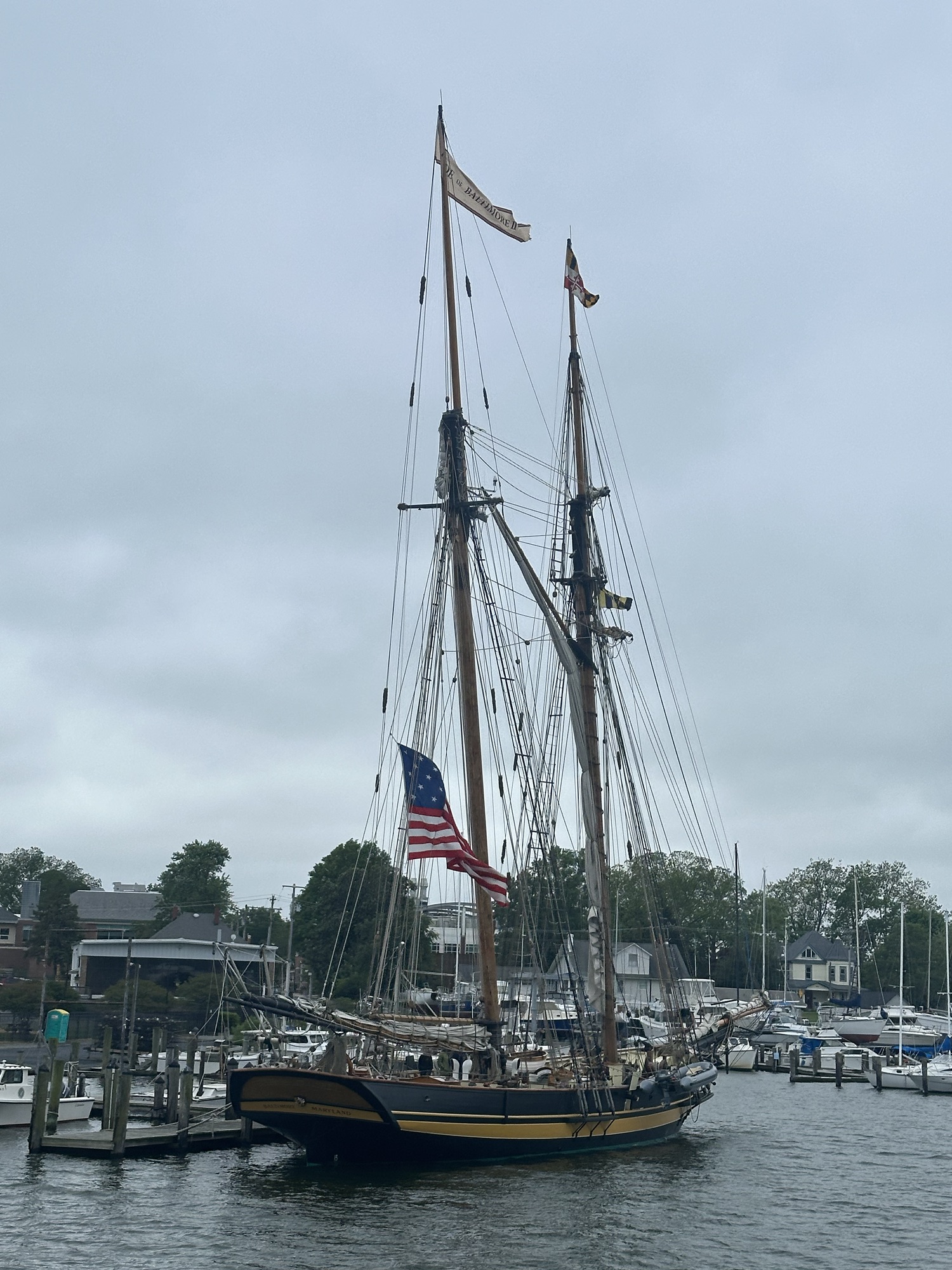
Pride of Baltimore in Solomans Island
Saturday, 5/11 we planned to tour the Calvert Marine Museum that was only about a mile away, so we were off on our bikes just before 10:00 am to get there when they opened. This was a well done and interesting museum with something for everyone – Fossils and dinosaurs with specimens from the local Calvert Cliffs; maritime history from carved out canoes to sailing vessels to steamships and pleasure boating and the history of floating theater; live otters, skates and rays, fish and other creatures; the Drum Point light house which was moved to the museum grounds; and history of the area including its oystering, fishing and slavery past.
I had no idea those egg cases we found as kidsWe actually skates!Drum Point lighthouse moved to the MuseumLight
We spent almost all morning there, leaving for lunch at Anglers nearby (never heard of a buffalo shrimp wrap before – very good!), and returning for the afternoon. Once we toured the entire area, we rode the additional mile to the grocery store to pick up a few things then returned to the boat around 4:00. 5 more looper boats arrived (Water Colors, Blue Odyssey, Cool Beans, Now or Never and Live the Dash), so we all chatted on the dock a bit and of course decided on docktails up at the club at 5:00. The local harbor hosts (Doug and Susan aboard Suz Inn) also joined us rounding out our party of 14.
Antique outboards and history of motorboatsSea OttersSeahorsesFossils and dinosaursTobacco Hogshead which would hold 1 acre of tobacco (800-1600 lbs)History of Floating TheaterDocktails!Calvert Cliffs – source of many fossils
It was back to the boat for dinner and plotting our final course into familiar waters. Sunday, 5/12 (Mothers Day) we made a slight change of plans. We decided we’d skip Herrington Harbor and head to Edgewater, MD and the Fleming dealership where we bought the boat – about a 4 hour run.
Day 341 – 347; 4/29 – 5/5: We’ve covered a lot of ground, or should we say water, in the last 7 days. Check out how far we went in the month of April below. That’s 3 states in April, 19 states and provinces overall on our trip!
With so much going on in our lives right now, and maybe just a little bit of “get-home-itis,” we decided to pick up the pace a little and are shooting for crossing our wake at AYC on Saturday, 5/18. That puts us back in our ‘dirt home’ on 5/19 having completed the Great Loop just 1 week short of a year!
It’s not that we are flying through ports and not stopping to smell the roses at all, but with the commitment we just made to a winter home in Savannah and summering in Annapolis, we will be traveling these waters again many more times and will be able to stop to really tour the towns on our way up and down the coast in the future. Loopers say this stretch of SC, NC and the Chesapeake Bay is one of their favorites, so we are feeling blessed that we will get to enjoy it over and over again!
We’ve laid out a plan where we travel 3-6 hours each day, arrive in port no later than 3:00 pm and enjoy our evening there, then do it again. That being said, we will stay in a couple ports for 2 days, but have our eyes on getting home. Many loopers leave their boats for weeks and even months at a time to go home for various and sundry reasons, but we’ve not done that.
So back to our journey….Monday, 4/29 brought us to North Myrtle Beach, SC – an area we know quite well because of the beach house. It was about a 5 hour run and Carol had a Board call in the middle of it. As we cruised up the ICW, we were twice contacted by folks who enjoy seeing the loopers go by. Bryan has a FB group called “Show us your boat” and videoed us as we went by, then contacted us on the radio as to where we could see the video. Here it is and check out the FB group for lots of cool boats on the ICW.
Then “Ripple Doug” and Lee on Ineffable called on the radio seeing us approaching on NEBO and said they’d be taking some “glamour shots” and a video from their deck as we went by. Both were kind enough to send them to us…. See below!
It was a fun day seeing the familiar landmarks of NMB by boat… except for the green head flies! While the bridge is enclosed with Isinglass on the front and sides with screen on the back, we need to keep the front isinglass open for air flow, which gave those little terrorists their entry point. We were a force to be reckoned with, however, and Gary’s swatting expertise along with the racquet shaped zapper in Carol’s hands produced a high body count. Hundreds of kills for the Z’s and zero bites for the Greenies!
We docked at Lightkeepers Marina right near the Myrtle Beach Yacht Club within walking distance to a restaurant called Clark’s. We went there for dinner; we’ve been there twice now and sadly, don’t recommend it. Steaks were over cooked (actually so badly had to send it back) and not very good quality for the price. A ribeye should not be tough and chewy.
Calabash Seafood and their junk yardGreg Norman’s where we’ve been via Boston WhalerLuLu’s!Some fake dude…. Why?Swing bridge at Sea Mountain HighwayCasino on way to Southport, NCGlen Dornoch Waterway Golf – A Gary favoriteFishing!That’s a lot of antennas Shrimp fleet
Tuesday, 4/30 we were up and out early (8:00 am) to thread the needle on 2 meetings for Carol; one at 9:30 underway and one at 1:00 just after we would arrive in Southport, NC. This was a Safe Harbor Marina and nice enough with a waterfront restaurant just off the pier. We were a distance from the town so didn’t really go check it out, although we heard great things. In chatting with another boater (not looping, they live aboard and go up and down the coast) they raved about Joseph’s Italian restaurant in the building that looked like condos at the entrance to the marina. They stop here just to go to Joseph’s. With that recommendation,we changed our dinner plans from eating in to eating there and it did not disappoint….in fact it was fabulous. So torn by all the great choices, we ordered a lasagna to go and had that for lunch on Wednesday. Definitely recommend Joseph’s!
Wednesday, 5/1 we were up and out by 8:45 am with slightly overcast skies and spitty rain. It was about a 6 hour run to Mile Hammock Bay where we planned to anchor for the night. It was also a pretty big milestone – we crossed the 6000 mile mark of our trip! Commemorating this milestone, we were joined by dolphins along the way. We arrived around 4:00 pm and enjoyed watching the guys fishing on the shore as we enjoyed dinner alfresco in the cockpit. We seared chicken breasts, then topped them with pesto, fresh mozzarella and a slice of tomato caprese style and finished them in the oven to melt the cheese. Yum! Will definitely make that again. What we didn’t know was that one of those fisherman was also taking pics of us and posted it in the Great Loop FB group the next day. It’s been a week of photos and videos on social media!
Caprese ChickenLegacy in Mile Hammock Bay
Thursday, 5/2 we were off to Beaufort, NC pronounced Bo-fert unlike its SC twin pronounced Beau-fert like beau-tiful. These towns really know who the locals are by how they pronounce their names. Beaufort is very close to Topsail (pronounced Top-sil) and Atlantic Beach where our good friends Dave and Maria Inch have a condo, so we looked forward to dinner with them. We were out around 9:45 to catch the 10:00 am opening of the Onslow Beach Drawbridge. It was a very narrow passage due to a construction barge taking up more than half of the space. Our timing was great dumb luck as we were later informed that the bridge would be shut down for a week starting 5/13! If we had stayed on our original plan of getting home mid June, we may have been stuck there a while. We transited with three other boats and then were immediately stopped by a Marine police boat and instructed we’d need to anchor and wait an hour before proceeding north. Camp Lejeune was conducting live fire practice, so of course, we dutifully complied as we could hear the rounds off in the distance.
We arrived at the Town Creek Marina around 3:15 and were glad to see they had a courtesy car, so we took advantage of that and provisioned at the local Piggly Wiggly…. Where do they come up with the names of Grocery stores? Around 5:00 the Inches came by and we enjoyed a short tour of Beaufort before heading to dinner at Moonrakers. The food and company were outstanding as we ate out on the deck overlooking the water. It was nice to catch up with them and hear all about the wonders of Grandparent-hood. Maybe someday! Hint-Hint!
Narrow passage with the construction bargeTold do not pass go!White sandy beach between the ICW and open oceanThat is one huge boat!Bo-fert!Fun dinner with friends!
Beaufort was the 3rd largest port in NC at the time of the American Revolution. The town escaped destruction during the Civil War and became a resort destination for much of the 20th century. The town’s tourism industry got a boost in 1996 when the remains of Blackbeard’s sunken flagship, Queen Anne’s Revenge, was discovered in 22 feet of water in the silted inlet just off of Beaufort. We look forward to returning to Beaufort and exploring all she has to offer.
Friday, 5/3 we were up and out in the morning again, leaving around 9:30 am headed to Oriental, NC and Whittaker Point Marina. It was about a 3 hour run of mostly winding river/channel of the ICW before it opened up as we headed into Oriental. We docked on the T-head that had to be the longest, turny walk on a pier we’ve ever seen – a bit of a strange pier design. Oh well…. It certainly made the decision easy if we were going to go ashore and use their gas grill for dinner or just use ours on the boat! Oddly, even though we shut down as many things as we could, we continue to pop the breaker on the power pedestal. Super nice people trying to help, but not sure what the issue was. Alas it was only for one night.
This was a marina that was full of boats, but no cars in the parking lot; Had a courtesy car which Carol gladly took to go get a badly needed pedicure. The closest nail salon was 20 minutes away. The AC barely worked and the seat belt wouldn’t stay buckled on the drivers side so she had to buckle it into the passengers buckle. The ride there was 80% farmland and 20% very tired homes and businesses. Not sure if it was a blessing or a curse for the towns again, but there was a Walmart next door to the nail salon. We never saw anyone else in the marina except for the dock hand and couple guys fishing off the pier. It was a quiet dinner and a movie on board, then up and out early the next morning.
Saturday, 5/4 we were out around 9:45 am and off to Belhaven, NC. Belhaven means “beautiful harbor.” It was a nice open water run on the Neuse River, then back on the ICW to more open water on the Pamlico River. It was another battle with the green heads (Z’s win again) and dockage at the Grand Manor Marina, formerly known as River Forest Marina. The winds were howling but we docked without issue with the winds keeping us off the pier. We were facing differently than two other loopers there (Marydale and Wanderlust, Too) who were getting quite the ride. Marydale’s large aft cabin would make it difficult to get on and off from the pier, never mind the wind and waves pitching it up and down by a foot or two. Wanderlust, Too’s Captain came by to say hello, but the first mate didn’t want to risk getting off the boat so we never met her. I wouldn’t have wanted to be them in that wind. Legacy is so much heavier than those two other boats, we rode it like a champ with no issues.
Grand Manor Marina is under new ownership and really trying to cater to loopers. They offer free golf carts to take into town (which we did) and found the town to be super cute and quaint with an Ace Hardware store, ice cream shop, a few restaurants and of course other shops with women’s apparel. There was a party going on at a newly opened business: Down East Preservation. We inquired what was going on at one of the shops and found out it was open to all with free food and beer – wanting to introduce the business and social club to the locals. Well Hells Bells, we went by! There was live entertainment, food and a keg. We never quite figured out what they did and who was in charge, but we had a beer and sat a while! Fun Fact: Did you know that the last leg of the Intracoastal Waterway was officially opened in Belhaven in 1928 with the completion of the Alligator Pungo Canal? A grand celebration at the River Forest Manor, co-located with the marina, marked the occasion.
Marydale was out before us, fighting the wind and waves to get out of their slip. It was tough. Wanderlust, Too was heading home for a month leaving the boat, which was still bouncing all over the place. That motion was definitely enough to introduce some seasickness, but we never found out if it did. We easily moved away from the dock when it was our time to leave, aided by the wind instead of having to fight it like Marydale.
Longest walk ever in a marina – Oriental at Whittaker Point MarinaPirate ship on way to BelhavenParty Crashing at BelhavenDowntown BelhavenUnusual configuration: Tug pullingTug pushingGood night Moon from Anchorage in Alligator River
Sunday, 5/5 we were off to an anchorage on Alligator River (we didn’t see any alligators) but it was on and off spitty rain for the day. We ran inside from the pilot house a couple times but were mostly on the bridge. It was about a 6 hour run partially on the aforementioned canal, although were were able to pretty much run at speed with good depth, and partially on the open water on the Alligator River. We arrived around 3:30 pm after picking our way through tons of crab pots which took both of our eyes on the water to navigate safely. We were the only ones in the anchorage and as the sun went down. It cooled off enough that we did’t even need to run the generator for the AC and opened the windows for the night. We did run the gennie to fire up the oven and make some enchiladas for dinner in honor or Cinco De Mayo.
Tomorrow we are off to Coinjock, NC and then Norfolk, VA inching our way home!
Day 336 – 340; Wed 4/24 – Sun 4/28: We were excited to see historic Charleston on Wednesday morning where we made reservations for horse drawn carriage tour at 9:30 am. It was a short Uber ride to the City Market area where we climbed aboard our tour guide Star’s carriage pulled by Bryan. Bryan is a 17 hand tall 2000 lb Morgan from the Amish Country of Ohio. Star explained to us how these working horses need to sweat as they work and that is aided by them getting 2 pints of Guinness in the morning and 2 more in the afternoon….that is one lucky horse! The tour was fabulous as we learned so much about Charleston and both its upbeat and dark history.
Bryan and our carriage tourStreets made form the ballast of shipsRainbow RowAntebellum MansionsPerfectly lined up to serve as range lights
As far back as the 1600s, English royalty figured out how convenient the rivers and creeks of this sprawling natural harbor would be. With protected inland waterways connected by a wide, deep natural inlet to the Atlantic Ocean, a thriving port seemed inevitable. So, they planned a “great port town” and named it after the country’s top politico, King Charles, and pretty much let matters unfold from there.
Charleston (originally called Charles Town) has become what the originator’s envisioned, even as it weathered wars, hurricanes, an earthquake, and periodic social upheavals. Charleston was founded in 1670 on the west bank of the Ashley River, the real estate having been granted to eight men by England’s Monarch as a pay-off for their loyalty and patronage. As the capital of what was called the Carolina Colony, Charleston became a beachhead for English expansion. Early colonists erected fortifications around the settlement to protect it from Spanish and French assaults, Native Americans, and pirate raiding parties (two buildings that once protected the “Walled City”, still stand).
The philosophy of early Charles Town was based on religious tolerance; it was believed that with this attitude, the settlement would increase in numbers and profitability. The city charter guaranteed religious freedom, bringing French Huguenots, Baptists (known then as Anabaptists), Congregationalists and Presbyterians. Early in the next century, 12 Scottish families withdrew to form the Scots Kirk, now the First Scots Presbyterian Church. A Jewish congregation formed in 1750, followed shortly by a Lutheran Church and Methodist assembly. The first Roman Catholic mass was held in Charleston in 1786. Because of its origins for religious diversity, Charleston became known as “The Holy City.” Economically, Charleston became the wealthiest city south of the well-to-do Philadelphia. English tax authorities rubbed their hands in anticipation.
Charleston eventually protested the British Tea Act of 1773. Gaining little satisfaction from England’s ruling elite, Charlestonians sent enthusiastic delegates to the Continental Congress a few years later eager to declare independence from Britian. During the Revolutionary War, the city vigorously resisted British attacks, even painting its church steeples black to blend in with the night sky, denying British ships useful navigation marks. The city’s independent spirit continued to the start of the Civil War. By 1860, Charleston lay divided concerning States Rights. The Ordinance of Secession was signed in December of that year making South Carolina a separate entity from the United States. On April 12, 1861, Confederate troops issued the first shots of the Civil War when they fired upon Fort Sumter, successfully driving out the federal forces. The Confederacy would hold the fort, and the city, for the next four years.
Through much of the 18th and 19th centuries, Carolina landowners thrived on cotton and rice cultivation under the slave-based plantation system. After the Civil War, however, the economy faltered. Charlestonians were too poor to remodel so the city simply adapted her old buildings. Then, in 1886 a major earthquake rocked Charleston damaging more than 2,000 buildings. More than 100 buildings were declared unsafe and pulled down and 110 people lost their lives. As a result of the earthquake, iron rods were run through the interiors of buildings and fastened to the exterior walls to protect them from future quakes. Today, these round and star-shaped bolts remain visible on many homes and commercial buildings.
The 20th century brought gradual economic growth and eventually, tourism. After World War II, the city began protecting Charleston’s historic buildings and helped create new attractions, many of which are still open to the public. Unfortunately, Hurricane Hugo struck in 1989 with its 135- mph winds headed directly for Charleston. Near midnight, a 12-to-17 foot wall of water swept over Fort Sumter in the harbor and the storm surge came ashore and three-quarters of the homes in the city’s historic district suffered damaged. A week after the storm, preservationists surveyed the city and found that just 25 of the 3,500 historically important buildings had been severely damaged, so Charleston rebuilt itself again and today thrives as a jewel of the New South.
Back to our visit – The weather was finicky so it was jackets on and off all day long. We returned from the tour and walked the shops of the 200 year old 4 block long City Market. Back in the day, the market provided a convenient place for area farms and plantations to sell beef and produce and acted as a place for locals to gather and socialize. Today the vendors sell souvenirs and other items, notably the famous Gullah sweet grass baskets. Over 20 years ago when we were here, we bought a basket, but Holy Cow ….have prices gone up! I’d say they are 4-5x more expensive now. We saw a lot of looking but not a lot of buying.
Hungry, we looked for something local and found the Sweetwater Cafe just a couple blocks away – delicious! Then we were off to the Old Slave Mart Museum. At one point in the history of slavery, 35-40% of enslaved people entered the US through Charleston. Here we learned of that dark period in Charleston’s history where families were broken up, young and old sold based on their different skills, capabilities, past behaviors and ability to bear children. The price of a human being ranged from a hundred dollars or less for the elderly, and infant or somewhat disabled up to $1500 for a prime field hand. Average price in 1860 was $800, which is about $30,000 today. At that time, there were 4 million slaves in the US, so $3.2B spent on slaves; equivalent of $120B today. Now these numbers are flawed since all slaves weren’t purchased in 1860 and many slaves were born into slavery, but you get the point on the economics. Just think about that in terms of generational wealth held or accumulated by whites, but denied to blacks for 8-10 generations. It is staggering to think about and an area of our history that we’ve learned so much about on this trip.
Door to no where; when open meant guests were invited; closed means do not disturb.Black dots/circles are the earth quake supportsCharleston hat man – a boogie man of sorts who collected naughty children at nightSt. Phillips Church built 1860Chandellier hanging from a tree on the street!Gas lightsTiny houseOld Exchange DungeonTavern at Rainbow Row – oldest liquor store in USTiny houses
We toured the Old Exchange and Provost Dungeon built in 1771; this building has served as a commercial exchange, custom house, post office, city hall , military headquarters and now a museum. It is the site of the debate and signing of the US Constitution by the SC leaders, but also a market place hosting slave auctions while the basement once served as a military prison. After our visit, we walked the city including Rainbow Row where for a mere $4.3M, you can purchase a 4000 sq ft historic home, but don’t attempt to change a thing about it, at least on the outside – that is strictly prohibited. Right around the corner from Rainbow Row, we walked the Battery and White Point Garden – a lovely waterfront park featuring historic cannons and statues bordered by antebellum mansions. It was very windy at the park, but as soon as we entered the grid of the streets it was calm and warm again. We headed back toward the marketplace in search of Henry’s on the Market for dinner since it looked to have a nice rooftop deck.
Pineapple fountain representing hospitalityNorth entrance waterfront parkBar covered in dollar bills!Battery and White Point GardenMore doors to nowhereYes that house is leaning… badly!Navy town!
Thursday morning, 4/25 we were out early to get rental car and get Tracy to the airport. The rest of the day was meetings and catching up on other things with a quiet dinner on boat. Friday morning was the same – a few chores in morning, but the afternoon brought an early happy hour at Tommmy Conlon’s Irish Bar with Todd and Maria on Sea No Evil and Mike and Deb on I Think I Can as well as Brian, Pam and son Brian on Take 5. Happy Hour rolled into dinner and we indulged in their Irish eats: Bangers and Mash, Irish Egg-rolls filled with corned beef and cabbage, Irish Nachos and Shepherds Pie. We enjoyed their live music for a while, but then we were off to check out a couple more places that Todd and Maria knew well….their sons live here, so we just followed their lead!
Happy Hour crewSt. Phillips at night
Saturday, 4/27 we drove to Savannah to meet with sellers of the home we are buying to finalize what they were taking versus leaving, having negotiated the house to be sold fully furnished and outfitted – we literally want to walk in with our toothbrushes on ‘day one’ and feel at home. We are confident that we will! The major items we will bring from our home is our dining room table that is also a pool table and art work; sellers are understandably taking all of theirs. It wasn’t too bad of a drive: 2.5 hours each way. We strategically planned our trip to get back to the boat at slack tide (that time between high tide and low tide where the water is not running either way so there is no current) and reposition the boat on the outside dock. That way, when we left in the morning we had no risk strong currents and more bumper boats! Why didn’t we think of that in Beaufort!
Sunday, 4/28 we were off to Georgetown, SC leaving around 9:30 am. We were treated by a trio of dolphins who swam with us in our bow. We still puzzle about what makes a Fleming such a dolphin magnet, so we posted this video of them with that question in the Fleming FB page. Got lots of likes, but no answer. Anyone know?
Dolphins in the bow (37 seconds)Last night CharlestonGood Bye CharlestonFort SumterDolphins in the bowLots of boathouses on the ICWCargo ship life boat… a la Captain PhillipsHilton Head to Beaufort, SCBeaufort to CharlestonCharleston to Georgetown
Georgetown was a long run – over 6 hours. We planned to anchor but as we explored the anchorage, decided it was too shallow. Fortunately, the Harbor Walk Marina had space for us so we pulled right in. It was great to see Mike and Deb on I think I Can as well as Brian and Linda on Mila Vera. We first met Brian and Linda in Annapolis the week before we started our loop. They aren’t looping (they have no desire to do the river system), but they are ‘arcing’ meaning they go all the way from Florida up to the Great Lakes and then back making an Arc. Brian is a former F14 pilot so they had timed their arc to be in Annapolis for Commissioning week and the Blue Angels air show when we met them. We puzzled as to the meaning of Mila Vera looking up the words in Spanish and Italian but couldn’t figure it out. We finally asked them – It’s the first syllable of each of their Mom’s first names. Mystery solved.
It was dinner on the boat – we were both beat and early to bed; Off to Myrtle Beach on Monday!
Day 334-335; 4/22 – 4/23: The rain overnight on Sunday, 4/21 provided some good sleeping weather in Beaufort…. Or maybe it was the fact that Tracy was up at 3:00 am the night before to catch her flight or maybe it was the multiple glasses of Chardonnay we shared after not seeing each other for almost a year? Regardless, we had a leisurely morning and Gary’s yummy omelette for breakfast then we headed downtown to check out downtown Beaufort (pronounced beau like beautiful, not beau like Bo).
On Monday, 4/22 we wandered through a few shops, but didn’t find anything we couldn’t live without. After a while, all the shops (except for the art galleries) look the same. We had hoped to have lunch or dinner at the highly recommended Old Bull Tavern, but it was closed. We opted instead for Panini’s on the Waterfront located in a former Bank building with its outdoor dining overlooking the waterfront park on the ICW. It was a late lunch followed by a 1 hour bus tour of Beaufort which proved to be the highlight for the day, providing such great history as well as the key sites in Beaufort.
Tracy arrivedDarth Vader in the marinaWaterfront parksTabby – “cement” made with sea shellsIf I didn’t know how to find the restrooms!Seccession HouseBeautiful Beaufort historic homesAngel Oak – the branches help support the weight of the treeNational Cemetary
Beaufort was founded in 1711 making it the second oldest city in South Carolina (SC) behind Charleston. On Port Royal island in the heart of the Sea Islands and SC Lowcountry, it once embodied the serene elegance of the antebellum South. BTW – I wasn’t sure what antebellum meant until I looked it up; in case you were wondering, it means “before the Civil War.” Period mansions still line picturesque streets, palmetto palm trees grow everywhere (SC’s state symbol) and the arts scene is quite lively.
Before the Civil War, shipbuilding, rice and then cotton brought prosperity on the back of the slave based economy. When the Civil War loomed, Beaufort was in the forefront of the Southern efforts to break away from the Union. Secession House, where the Ordinance of Secession was drawn up, still stands on Craven Street. When the Union marched into town and took over, they turned it into a hospital.
Beaufort didn’t see much war related destruction. In 1861, a Union armada was sent to capture the town (which fell easily) and remained in the hands of the North throughout the war. As the war wound down, Beaufort became a center of the emancipation efforts. Due in part to its early occupation, the city attracted escaping slaves. The Union declared the slaves emancipated and initiated efforts at education and preparation for full independence.
Interesting story of a local hero: Robert Smalls was born into slavery in Beaufort, South Carolina in 1839. His mother, Lydia Polite, was a slave owned by Henry McKee, who may have been Smalls’ father. Smalls was hired out by McKee on the Charleston waterfront as a young man. Owners often did that – hired out their slaves to work and collected the wages themselves. Working as a sail maker, rigger, and foreman, Smalls gained expertise in the Georgia and South Carolina waterways. During the Civil War, the Confederate Army conscripted Smalls into service aboard the CSS Planter.
On the night of May 13, 1862, Smalls and seven enslaved men who worked on board the Planter navigated the ship out of the heavily fortified Charleston harbor. After a stop at a nearby wharf to pick up their families, Smalls disguised himself as a white captain and maneuvered the ship past several Confederate forts to the Union fleet, at which point he hoisted a white sheet atop the Planter, signifying its surrender. Union officials boarded the ship, and Smalls turned the Planter over to the Union Navy.
Smalls was hailed across the nation for his daring escape and Congress passed a bill, signed by President Lincoln, that awarded Smalls and his fellow crewmen a monetary reward for the capture and turn over of the Planter. Smalls traveled to Washington to meet with President Lincoln, where he helped to persuade Lincoln to permit black men to serve in the Union army. Soon after the meeting, Secretary of War Edwin Stanton accepted 5,000 former slaves to fight for the Union.
After the war, Smalls returned to his native Beaufort. He bought his former master’s home, seized earlier by Union tax authorities. Smalls went on to lead a life of public service, notably as the first black captain of a U.S. vessel and as a Congressman representing South Carolina’s 5th and 7th congressional districts in the U.S. House of Representatives. It was at his suggestion to President Lincoln that black soldiers were allowed to be buried in the national cemetery in Beaufort.
About a dozen national cemeteries were established in 1862, more than a year after the war began. The National Cemetery in Beaufort was created by Abraham Lincoln’s National Cemetery Act in 1863. The original interments in the cemetery were men who died in nearby Union hospitals during the occupation of the area early in the Civil War, mainly in 1861 following the Battle of Port Royal. Battlefield casualties from around the area were also reinterred in the cemetery. Of the Civil War soldiers buried in Beaufort, there are 9,000 Union soldiers (3,607 unknown,) 2,800 POWs from the camp at Millen and 1,700 African-American Union soldiers. There are also 102 confederate soldiers. Because identification of remains was difficult at best, some Confederate soldiers were reburied in national cemeteries, unintentionally as Union soldiers.
US CT -designation for US Colored Troop all buried in same sectionWhite soldiers received a designation of their state
When first established, the national cemeteries were only for union soldiers while confederates were often buried in unmarked mass graves. Arranging Confederate burials became a state, local, or individual responsibility. As a result, many Confederates were buried in private family or city cemeteries. By 1870, almost 300,000 Union soldiers and sailors lay buried in 73 national cemeteries. Today, the nation has more than 175 national cemeteries, soldiers’ lots, government lots, and Confederate cemeteries.
Dinner took us over the Beaufort River on the Woods Memorial bridge that was used in the scene where Forrest Gump was running across the USA and crosses into Mississippi. It wasn’t really Mississippi… it was SC. Yup – they changed the sign and confused the tourists for weeks! We sat outside on the porch at Lady’s Island Dockside, even though it was a little cool.
Over 15 major Hollywood movies were filmed in and around Beaufort: The Great Santini, The Big Chill, The Prince of Tides, Daughter of the Dust, The War, Jungle Book and of course Forrest Gump. For more on this, visit explorebeaufortsc.com
Tuesday, 4/23 was not our favorite day. Up early to get to Charleston, we threw off lines around 7:00 am. The tidal swing in SC is substantial (7-9’) making the currents very strong. As we left the dock in the narrow fairway, we experienced a mechanical issue with the port transmission preventing us from using forward; we only had neutral and reverse. We fought the current with the one engine and both bow and stern thrusters but it wasn’t without some minor bumps and damage to a few other boats. Talk about raising your heart rate and blood pressure. Most damage was cosmetic and we returned to port to leave our contact informatin before heading to Charleston in a rather somber mood.
It was about a 7 hour run to Charleston and a few dolphins joined us along the way. That was a particular thrill for Tracy having heard us talk about it, but now able to experience it. We are still seeking the answer to the question: what is it about a Fleming that attracts the dolphins more than other boats? When we ran with 4 other boats, we’d have 7-10 dolphins on either side or in the bow and the other boats would have none or maybe 1 or 2. They even asked us to stop hogging the dolphins and called us the dolphin magnet!
Beaufort to CharlestonEnjoying the ride to CharlestonYachts in the Charleston HarborSunset from the pier in Charleston
It was a long travel day that started badly but ended with a wonderful dinner on the boat and a few adult beverages. Gary made an awesome chicken piccata over linguine and of course that pairs well with Chardonnay!
Tuesday, 4/23 would bring a day of touring Charleston, starting off with a horse drawn carriage tour at 9:30 am. We plan to make quite the day of it before Tracy departs on Wednesday morning!
Day 331 – 333; 4/19 – 4/21: From our last post you will recall we arrived at Wexford Yacht Club at Hilton Head Island on Thursday, 4/18 passing through a tiny lock to get to there. The lock was 19’ wide and we took up 17.5’ of it! Length wise we had a few feet to spare on both the bow and stern….but not much! Gary’s sister Diane arrived by car at the same time. At dinner that night, we battled dive bombing caterpillars finally retreating to the boat to cheer the Red Sox on to a victory over Pittsburgh!
Dang that’s close!We barely fit!Door closing in the sternBow has a few feet to spareOpening…time to go!
Friday, 4/19 we were ready for a boat ride since Diane had been on the boat, but never in motion. Today would be a very special yet solemn day as we planned to sprinkle Gary’s Mom’s ashes off the coast of Hilton Head, one of her favorite places. Jane passed away in 2012and this was one of her wishes that we would now be able to fulfill. We left WYC around 10:00 am and found the perfect spot in the Atlantic Ocean between Hilton Head and Tybee Island. Jane used to visit Diane when she was in the army and stationed in Fort Stewart; they would visit Hilton Head. Diane told her “This is a beautiful place for a wonderful mother. Rest in peace, Mom. We love you and miss you“ as we set her ashes into the ocean and watched them disperse.
Hilton Head LightTybee IslandReturned to the water she loved
It was a short and quiet ride back to Hilton Head where we anchored off of the 18th hole of the RBC Heritage PGA Golf Tournament. At anchor we enjoyed lunch and watching the players finish their rounds on day 2 of the tourney. It was exciting to hear the crowds roar at some great shots, notably one by Carol’s favorite Jordan Spieth. We stayed until around 4 pm and headed back to WYC. We hoped when we watched the rebroadcast, we’d be able to see ourselves off in the distance on TV! Sure enough, there we were… look closely for Legacy!
Legacy spotted on TV!Colin Morikawa on the 18th hole Watching from a distance18th hole grand stands18th hole RBC Heritage
It was a beautiful sunny day and so peaceful at anchor. Alas we headed back to WYC, through the lock and enjoyed dinner at their clubhouse before again returning to our beloved Red Sox to see them victorious over Pittsburgh!
Saturday, 4/20 we opted for the car and roadtripped to Bluffton, SC to check out the town. This town was also on our list as a potential winter home, post Great Loop. We walked the old town wandering in and out of the shops and checking out the public pier and beautiful parks. Bluffton was once a “planter” community with a public dock that enabled the shipment of rice, cotton and pine resin. The wealthy built summer homes on “The Bluff” to escape the hot, unhealthy conditions of the low-lying rice and cotton plantations. Bluffton’s high ground and cool river breezes from the May River provided relief and easy-access to other waterways. What is now known as the Calhoun Street Dock was once a rest stop for boat travelers between Savannah, Beaufort and Charleston.
The planter economy collapsed after the Civil War without the forced labor of enslaved people. Within one year of the capture of Fort Sumter, Bluffton became a safe haven for residents fleeing Union occupation. Bluffton was a headquarters for Confederate forces. Later, Union forces on Hilton Head Island ordered the Town’s destruction in 1863. Approximately 60 structures were in the Town before the attack. Only the Town’s two churches and fifteen residences remained standing after the attack. After the Civil War, Bluffton slowly returned as a center of commerce and tourism.
Preserving history and the town’s remaining buildings from the Antebellum/Reconstruction Era has resulted in a surge of tourism. While time marches on, the reasons why people come to Bluffton haven’t changed much since its early days. People relocate to Bluffton for its beauty, culture and high quality of life. The Historic District is still the hub of businesses, shopping and community gatherings. The May River is where people still go to fish, oyster and shrimp. It is a town known as the place to get the Lowcountry’s best seafood. Tourists and residents come to Bluffton to see oystermen harvest May River oysters the old-fashioned way, using their hands, gloves and small boats called bateaus. Oysters are brought to the historic Bluffton Oyster Company where employees, many who have worked there for generations, hand shuck the oysters. The Bluffton Oyster Company is the last hand-shucking factory in the state.
Since 1998, Bluffton has exploded from about 750 residents and a jurisdiction of one-square mile (i.e. the Historic District). In 2019, Bluffton is 54 square miles due to multiple annexations and has more than 20,000 residents. Bluffton is the fastest growing municipality in South Carolina. We enjoyed a visit to the Montage Palmetto Bluff in Bluffton – a 20,000 acre development with gorgeous resort village, marina, restaurants, golf course, homes and cottages as well as nature preserves and walking trails. The resort is ideal for large and small weddings with a sweet chapel and waterfront park. We enjoyed sitting on the bench and watching the kids play on the jungle gym and swings, the adults pay bocce and the wedding parties pose for photos.
We found a great place for lunch – Calhoun’s Town Tavern – and later returned to the boat late in the day to grill some steaks on board and enjoy the live entertainment playing at the WYC pool. Then, it was back to New England sports and watching both the Red Sox and the Bruins play that night; we felt Jane with us in spirit (she was a devoted Red Sox fan) as the Red Sox beat Pittsburgh again and the Bruins beat Toronto in the first round of the Stanley Cup Playoffs – one down and 15 to go for a Stanley Cup for the Bruins!
Church of the Cross BlufftonTown dock in Bluffton on May Riverhand painted rocks/slabs in parkTown parkPalmetto BluffWow that is high!Wedding Chapel Palmetto Bluff
Sunday, 4/21 we said good bye to Diane as she embarked on her 7 hour drive home. We left Wexford around 9:45 am for our 3.5 hour trek to Beaufort, SC. It was overcast, but a nice breeze with just a little chop in the water. We enjoyed 3 dolphins in the bow who stayed with us for some time. Check them out below and how close they are to the bow! We sent photos and video to Diane, who unfortunately didn’t get to experience that although we did get to see a single dolphin pass by us off of Hilton Head.
3 dolphins running with us in the bow (28 seconds)
We arrived in Beaufort around 1:15 and Tracy (Carol’s college roommate) pulled in around 1:30 after starting off in Maine with a flight at 5:50 am. Yikes that meant the alarm clock went off at 3:00 am! It was great to sit on the back deck in the sun for a couple hours (it’s still dang cold in Maine) until the skies opened up and it started to rain…. Really Hard! It was dinner on the boat (Gary made an awesome shrimp and pasta dish) and Looper midnight (with some sympathy for a traveler from Maine) came early so it was off to bed by 9 pm to get ready for some Beaufort sightseeing in the morning!
333 days on the loop. 18 US States plus Canada. Awesome to have Diane and now Tracy with us. We’ve come so far yet still several weeks before “crossing our wake.” Just a few more days marks 11 months on the loop and we are conflicted between wanting to get home and not wanting this grand adventure to end.
Day 324 – 330; 4/12 – 4/18: Friday 4/12 we arrived in Savannah, GA at Thunderbolt Marina after a fairly uneventful 4.5 hour trip. It was a bit cool with variable winds between 20 and 30 knots. It was a twisty-turny path to get there, arriving around 2:00 pm.
Consulting with the dockmaster, he thought it unwise for us to ride our bikes to the local grocery store just a few miles away. The streets were too narrow and busy, so he encouraged us to wait until tomorrow when we had the rental car. Deferring to his local knowledge, we walked to dinner at Tubby’s Tank House just a few hundred yards away on the bluff across from the shrimp docks in historic Thunderbolt. It was a great local spot with outdoor seating, good food and cold beer.
Saturday, 4/13 we were up and out early to get our rental car, provision and explore. We were particularly interested in this area and a community called “The Landings” as consideration for our winter home, post Great Loop, so we met with a local realtor to get the lay of the land. We spent some time just driving around the area afterward returning to the marina late in the afternoon to find a new neighbor docked in front of us — Blue Moon.
Blue Moon
Blue Moon is a 198’ Feadship built in Holland in 2005 and completely retrofitted in 2021. She accommodates 12 guests in 6 cabins across her 4 decks and carries a crew of 16. You can charter her for a mere $329,000 plus expenses for 1 week! WOW!! She is HUGE and made us feel tiny!
Back to the Landings – we loved everything we saw including the 6 golf courses, multiple pools, clubhouses/restaurants and 2 marinas. Our visit gave the realtor a great idea of what we were looking for and we agreed to return the next day to see a house he thought we’d be particularly interested in, being just a few hundred yards from one of the marinas. Unfortunately, we weren’t impressed with this one, but it again gave the realtor better intel on our desires.
After our visit to the Landings we were off to the City Market area of Savannah where we enjoyed an outdoor cafe with live entertainment and an afternoon snack followed by the Prohibition Museum. What a fascinating time in our American History.
Prohibition is the period from 1920 to 1933, when the 18th Amendment to the United States Constitution prohibited the manufacture, sale, transport, import, or export of alcoholic beverages. Protestants, Progressives, and women all spearheaded the drive to institute Prohibition as a response to social issues like domestic violence, child abandonment, and absenteeism – all whose presumed cause was alcohol.
Prohibition, while well-intentioned, had far-reaching consequences that significantly impacted American society. Initially, it led to a decrease in alcohol consumption and related issues such as public drunkenness and alcohol-related crimes. However, the unintended consequences soon became apparent. It crippled the American economy throwing hundreds of thousands into unemployment. This was followed by the illicit production and distribution of alcohol, giving rise to a flourishing underground industry run by bootleggers, speakeasies and the rise of organized crime.
Prohibition exacerbated social divides and fueled political tensions. The enforcement of prohibition laws disproportionately targeted marginalized communities, particularly immigrants and people of color, leading to widespread corruption within law enforcement agencies. The fervent debate over prohibition also polarized American society, pitting “drys” who supported the ban against “wets” who advocated for its repeal. Ultimately, the failure of prohibition to achieve its intended goals, coupled with its detrimental social and economic impacts, led to its repeal with the ratification of the 21st Amendment in 1933. The era of prohibition left a lasting legacy, highlighting the complexities of attempting to legislate morality and the importance of considering the unintended consequences of sweeping social reforms. When repealed under the leadership of President Roosevelt, it was billed as “a return to individual freedom.”
Historic district outdoor cafes
We ended our day with dinner at the Pirates House, the most historic spot in Georgia being the oldest house in Georgia. The Pirates House first opened in 1753 as an inn for seafarers and fast became a meeting point for pirates and sailors. Here, seaman drank and discoursed sailor fashion on their exotic high seas adventures from Singapore to Bombay and from London to Port Said. Stories still persist of a tunnel extending from the old rum cellar beneath the Captain’s room that lead to the river. Drunk and unconscious men were carried through the tunnels to ships in the harbor in need of crew. Indeed many a sailor drinking in carefree abandon awoke to find himself at sea on a strange ship now “under the employ” of the captain, able to return home years later! Oh the stories those walls could tell!
Again we returned to the marina to find a new neighbor – this one an 80’ Paddle Wheel boat named Anna Maria Princess tied about 3’ off of our transom. The captain assured us they walked her back to get that close to us and he didn’t attempt to bring her in under power that close! She’s powered by 2 diesel engines that turn the paddle wheel for her sole source of propulsion. You often see paddlewheels that are just for show with other more robust propulsion…not this one! She tops out at 4 knots! Her crew of three had already been on board for 21 days with at least 9 more to go before they arrived in Manteo, NC. The crew was great and gave us a little tour.
Monday 4/15, we left Thunderbolt and moved to Savannah Yacht Club (SYC) and headed back to the Landings to look at a few houses the realtor had lined up. One house really piqued our interest and we needed to sleep on it a bit – was this the place for us? We headed back to SYC where we looked forward to reconnecing with Leo, the former assistant club manager at AYC and now General Manager at SYC. SYC is a beautiful club on 24 acres of prime waterfront with a very large marina, large club house, 2 pools, sailing center, and tennis center complete with tennis and pickleball courts. The restaurant was closed on Monday and Tuesday so we’d have to wait until Wednesday to chat with Leo about this amazing club, the Savannah community and enjoy a meal.
Savannah Yacht Club
Michael and Darlene from Riversong had arrived back in town, so we all climbed into our rental car and headed downtown to the Savannah waterfront on River Street. Historic River Street is situated along the Savannah River where the colony of Georgia was founded in 1733 and the location of the original Port of Savannah. In the 1700s it was the main location for goods coming into the city and by the mid-1800s Savannah was the leading exporter of cotton in the world. The four and five story buildings along the waterfront were cotton warehouses.
Located between Bay Street and River Street is a series of iron and concrete walkways, known as Factors Walk, connecting the buildings to the bluff. The people who set the prices for cotton and many other exports were called Factors, which is how this area got its name. The first commercial house below the bluff opened in 1744.
The hand-laid cobblestones that pave the ramps leading from Bay Street down the bluff to River Street were originally used as ballast material on the many ships that sailed into Savannah’s harbor. The ships collected chert, quartz, granite, basalt and other rocks from their initial locations and deposited the stones upon unloading in Savannah. The stones originated in a number of exotic locales including Madeira Island, Spain, Canada, France and the British Isles. Savannah settlers found the stones to be an affordable and abundant building material and used them throughout the Historic District.
Stairs down to River Street
Tuesday 4/16 took us back to the Landings to see the house “one more time” before we would head back to Savannah for a ‘Hop On Hop Off’ trolley tour of the city, which was fabulous! We ended the day at one of the stops: the Six Pence Pub for an authentic Irish meal and a pint. Six Pence Pub was the pub in the movie “Something to Talk About” starring Julia Roberts. Grace (Julia Roberts) sees her husband Eddie (Dennis Quaid) out with another woman and confronts him – in the middle of the street in her nightgown. Let’s just say lots of tourists try to recreate the scene in photos!
Six Pence Pub
Our 2 days touring Savanna by trolley and on foot was fabulous! Savannah is known for its historic district adorned with cobblestone streets, picturesque squares, and impeccably preserved architecture. This charming district takes you back in time, with each square (there are 22 of the original 24 left) telling a story of the city’s rich history and Southern heritage. The largest and most popular is Forsyth Park created in 1840. Its 30 acres is home to the city’s most famous fountain installed in 1858 and modeled after the Place de la Concorde in Paris. Of course a popular rival is Chippewa Square where the famous park bench scenes from the movie Forrest Gump was filmed. In the opening shot of the film, a feather floats high above the trees, then sweeps down past the Independent Presbyterian Church and makes its way toward Chippewa Square, eventually landing at the base of a park bench. Tom Hanks, who plays the role of Forrest, sits on this park bench for about 80% of the film telling his life story to anyone who will listen. The bench that Hanks/Forrest sat on was actually a movie prop, so is not there, but the location of the bench for the movie in Chippewa Square is still a popular spot for photographs.
Forrest Gump Movie – bench scene in Chippewa SquareForsyth SquareChippewa SquareWaving Girl Statue – greets passing ships River StreetFounder of Girl Scouts home – Juliette Gordon LowDolphins Downspout
Our stay in Savannah was finally coming to an end. We fueled up and pumped out at SYC and threw off lines around 11:30 am. Carol had a couple more meetings while underway while Gary enjoyed a couple dolphin escorts. We arrived at Wexford Yacht Club in Hilton Head, SC around 2:30 where we got to do another small lock. Yup – you have to pass through a very small lock that raises you between 1 and 2 feet to get to the Wexford Yacht Club. We barely fit both length and width wise, but the dockmaster Mark skillfully locked us through and helped us secure the boat just minutes before Gary’s sister Diane arrived by car from Destin to spend a few days with us.
With the benefit of Diane’s car, we were off to dinner at Black Marlin Bayside Grill where the food was fabulous but the caterpillars falling out of the trees on our table, food and heads was a bit distracting. Carol kept her menu to partially wear as a hat partially use as a weapon! After dinner it was back to the boat to catch the Red Sox game (good guys won!) and plan our day on Friday.
Closing the door behind usThink Thin! We barely fit!Filling the lockOpening the gate
Hilton Head was hopping with the RBC Heritage PGA Golf Tournament in town. Not having tickets, we thought we’d anchor off of the 18th hole and watch a bit! But that’s for the next post.
Oh yah….. we are under contract on a house in Savannah, GA!
Day 324. 329; April 7 – 12: Sunday, 4/7 we said goodbye to Puffin and No Rush at Jekyll Island and departed for St. Simons and Sea Island. It would be short run (about 2 hours) so we took our time in the morning with a leisurely breakfast and lines off around 11:00 am. Had lunch underway, arriving around 1:00 pm having fought the current the whole way. We normally cruise at about 10 knots and the current slowed us down to just over 8.
We had a strange (and noisy) following of birds just about the whole way that we’ve not seen before; sort of like you see behind a shrimp boat. We saw just one dolphin on the way, although he/she only swam along with us for a few seconds. We do miss the playful pods of dolphins we enjoyed in FL, but did read that boaters are starting to see dolphins in the Chesapeake, so we look forward to that.
Noisy following….do they think we are a shrimp boat? We have no food for you!
The Village of St. Simons with its cute shops, restaurants, pier, parks and lighthouse was just a short 2 mile bike ride away, so off we went. There was a wonderful bike path the whole way making the trip a breeze. We poked around downtown and of course, found some ice cream! We decided on a quiet dinner on the boat to use some of fresh veggies we had gotten at the farmer market and watch some of the MASL playoff games. Even though our beloved Baltimore Blast are on the sidelines, we still like to watch.
Jekyll to St. SimonsBirds followingHorses on Jekyllthe pier on Jekyll we walked on the day beforeSt. Simons Light house in the distanceCoast Guard boatSt. Simons lightOn the pierViews from the pierInteresting “lift”storage for boats
Monday, 4/8 we picked up a rental car and tooled around St. Simons checking it out as a possibility for a winter home. We stopped in and spent some time with a local realtor who gave us the lay of the land of St. Simons and Sea Island. There are many gated communities on St. Simons we couldn’t wander into, but Sea Island is entirely a private island that we’d need to wait to see on Tuesday, when Carol’s friend Jon provided us with a pass. He also provided some restaurant recommendations, the first of which was Halyards on St. Simons that we went to on Monday. Tuesday, Jon treated us to dinner on Sea Island at Tavola – which was fabulous! We could definitely see ourselves on Sea Island and it was great to get some insights from him on his experiences there. Sea Island has great golf for Gary, ocean for Carol but limited places to keep Legacy. Jon reminded us that it does get down right cold in the winter, so to keep that in mind.
Wednesday, 4/10 it was time for us to move on and head further north. After picking up our free muffins from the coffee shop, a perk of staying at the Morning Star Marina, we threw off lines around 10:00 am for a planned 3.5 hour run to Tea Kettle Creek where we planned to anchor for the night. With heavy rain and wind forecasted overnight, we decided we’d skip the anchorage and press on all the way to Sunbury making it a 6.5 hour run, but we’d be much safer at the marina. It was a twisty, turny day through Georgia’s marsh land, creeks and rivers where we needed to be ever mindful of water depth.
We are thankful for the amazing electronics on Legacy and wonder how the first looper managed this back in 1906. We arrived around 4:45, just in time before the dock hands went home for the night. There were 2 or 3 other looper boats there, but with the rain coming in, no docktails. It was just as well since Carol had a BOD meeting at 6:30 pm. The winds picked up to about 35 knots and the rain was very heavy overnight and most of the morning.
Long twisty turny day; arrived safely in Sunbury before the winds and rain
The sun came out and dried things off a bit just after noon. The heavy rain gave Carol a chance to jump on a several hour zoom call with Jane and begin to hammer out a budget for FY 2024/2025 for A Little Compassion and the Nest Coffee House. With the rain finally stopping, Gary grabbed a bucket and brush to give Legacy a good scrub on the outside. Carol got off the boat and stretched her legs a bit before getting on another BOD call that would go from 4:30 – 6:15. Then it was off to dinner at the Sunbury Creek Crab Company right there at the marina. It was quite the rustic looking place with ‘rustic’ being a generous description, so our expectations were low. The service and food were actually exceptional with Gary commenting it was the best pecan pie he’s ever had….I guess that means it was better than Carol’s….Hmmmmm.
Marsh view in SunburyLegacy at Sunbury
Tom and Susan aboard Mona Lisa hailing out of Connecticut were also there, so we enjoyed chatting with them. We never did meet Chris and Lisa on Cool Beans who were tied up right behind us. Between the heavy rains and several meetings, we only saw each other through the rain drops. They were up and out earlier than us on Friday, 4/12 but we can see them on Nebo ahead of us also headed toward Savannah and Skidaway Island.
We left Sunbury around 9:30 am, a departure time coordinated with a rising tide. There are a few ‘skinny spots’ (that’s boater talk for shallow water) we needed to traverse on the way to Skidaway, so tide matters. The tidal swing here is a remarkable 6-7 feet! Check out the photo of Legacy above and note how tall the pilings are – that’s because those are floating docks that rise with the tide and need to ride up and down those pilings. It was a bit cool with winds between 20 and 30 knots on this leg of the trip to Thunderbolt Marina in Savannah. We arrived just after 2:00 pm and look forward to exploring this area, particularly a community called ‘The Landings.’
Read on for some St. Simons history if you are so inclined:
St. Simons has an interesting history as the second-largest and most developed of Georgia’s barrier islands; approximately twelve miles long and three miles wide (roughly the size of Manhattan Island in New York). The resort community of Sea Island is separated from St. Simons on the east by the Black Banks River.
The Georgia coast was considered “debatable land” by England and Spain, even though Spain had fully retreated from St. Simons by 1702. Thirty-one years later General James Edward Oglethorpe founded the English settlement of Savannah. In 1736 he established Fort Frederica, named after the heir to the British throne, Frederick Louis, Prince of Wales, on the west side of St. Simons Island to protect Savannah and the Carolinas from the Spanish threat.
Between 1736 and 1749 Fort Frederica was the hub of British military operations along the Georgia frontier. A town of the same name grew up around the fort and was of great importance to the new colony. When the British regimen disbanded in 1749, most of the townspeople relocated to the mainland. Fort Frederica went into decline and never fully recovered. Today the historic citadel’s tabby ruins are maintained by the National Park Service.
By the start of the American Revolution (1775-83), Fort Frederica was obsolete, and St. Simons was largely uninhabited as most of its residents joined the patriot army. The island played almost no role in the war.
Following the war, many of the townspeople, their businesses destroyed, turned to agriculture. The island was transformed into fourteen cotton plantations after acres of live oak trees were cleared for farmland and used for building American warships, including the famous USS Constitution, or “Old Ironsides.” Although rice was the predominant crop along the neighboring Altamaha River, St. Simons was known for its production of long-staple cotton, which soon came to be known as Sea Island cotton.
Between the 1780s and the outbreak of the Civil War (1861-65), St. Simons’ plantation culture flourished. One of the largest owners of land and enslaved laborers was Pierce Butler, owner of Hampton Point Plantation. By 1793 Butler owned more than 500 slaves who cultivated 800 acres of cotton on St. Simons and 300 acres of rice on Butler’s Island.
The outbreak of the Civil War in 1861 put a sudden end to St. Simons’ plantation era. After the Civil War the island never returned to its status as an agricultural community. The plantations lay dormant because there were no enslaved laborers to work the fields. Union General William T. Sherman issued Special Field Order No. 15 in January 1865 demanding that former plantations be divided and distributed to formerly enslaved workers. This was overturned by President Andrew Johnson less than a year later, and freedmen and women were forced to work as sharecroppers on the small farms previously occupied by the sprawling plantations.
By 1870 economic recovery began with the re-establishment of the timber industry. Lumber mills were set up on the former Hamilton Plantation. The lumber mills provided employment but also provided mail and passenger boats to the mainland. Such water traffic, together with the construction of a new light house in 1872 marked the beginning of St. Simons’ tourism industry. The keeper of the lighthouse created a small amusement park and the island became a summer retreat for families from the mainland.
The island’s resort industry was thriving by the 1880s. Beachfront structures, such as a new pier and grand hotel, were built on the southeastern end of the island, accessible by ferry. Around this time wealthy northerners began vacationing on the island.
The opening in 1924 of the Brunswick–St. Simons Highway, today known as the Torras Causeway, was a milestone in the development of resorts in the area. More than 5,000 automobiles took the short drive from Brunswick to St. Simons via the causeway on its opening day, paving the way for residential and resort development.
In 1926 Howard Coffin of Detroit, Michigan, bought large tracts of land on St. Simons, including the former Retreat Plantation, and constructed a golf course, yacht club, paved roads, and a residential subdivision. St. Simons remained a small community with only a few hundred permanent residents until the 1940s.
The outbreak of WWII (1941-45) brought more visitors and residents to St. Simons. Troops stationed at Jacksonville, Florida, Savannah and nearby Camp Stewart took weekend vacations on the island, and a new naval air base and radar school became home to even more officers and soldiers.
With a major shipyard for the production of Liberty ships in nearby Brunswick, the waters of St. Simons became active with German U-boats In April 1942, just off the coast, 2 US flagged oil tankers were torpedoed by the Germans, bringing the war very close to home for island residents.
Due in large part to the military’s improvement of the island’s infrastructure during the war, development on the island boomed in the 1950s and 1960s. More permanent homes and subdivisions were built, and the island was no longer just a summer resort but also a thriving community. The island continues to be a major vacation destination as its development boom continues.
Tuesday 4/2 we were off to Amelia Island/Fernandina Beach – our last stop in Florida before we cross over into Georgia. It’s almost 4 months now that we are circumnavigating FL, so time for a new color on our pin board. You may remember every month is a new color! April is white.
We left around 8:30 am for what should have been a very uneventful 4 hour run. For the most part it was uneventful, except for touching the bottom twice. The first was right in the middle of the channel! It’s always disconcerting when your boat touches bottom. Fortunately, the first was just a graze but it was strange; we sort of bounced off a ridge on the starboard side and it threw us a little to port – like bumping into a soft guard rail. Come to find out, many boats reported the same bump in the same spot, so the channel markers need to be moved.
The second bump was our own fault where we wandered out of the channel ever so slightly and just grazed the bottom. We were at near idle speed, so it was easy to back out of the shallow area back to safety. Legacy is constructed with a fiberglass keel reinforced with stainless steel that extends 12” below the propellers, so unlike may other boats, the props are protected. We’ve heard stories of lots of bent props and shafts, the worst being stories of pods that if you strike bottom, they literally fall off! Thankfully, we’ve not seen any damage yet.
We’ve said this before and repeat it again, if you’re doing the loop and say you haven’t touched bottom, you’re either lying or you will! You just don’t want to do it at speed!
As we pulled into Fernandina Harbor Marina, it was great to see Puffin tied up on the end of the pier. We walked the cute little town, poking into the shops and finding some ice cream. We especially enjoyed “Trailer Park Collectibles” – talk about an eclectic collection of stuff you’d find in an antique store, Good Will or at the dump! Good clean fun wandering through – just be careful what you touch! We enjoyed dinner at the Boathouse downtown with Tony and Shirley and their friends Dwight and Melinda who now live on Amelia Island, but were previously their neighbors in NC.
First time seeing a tug towing and one on the sideAlso one pushing from the rearHello Puffin!Downtown Amelia IslandBeautiful sunset before the storm
Wednesday, 4/3 brought heavy rain and gusty winds. Gary found a barber shop and Carol worked on budgets for the non profit her sister Jane runs; Carol is on the board of directors. Here’s a shameless plug if you’d like to support us…. It’s been a tough year on donations and grants! I know because I just did the finance report and budget. Check out or mission and impact here: https://alittlecompassion.org/
The rain made for a good day to catch up on email, paper work and other mundane stuff so we hung out and decided to have dinner on the boat. Tony and Shirley (with their pup Sophie) joined us for Carol’s homemade pesto and shrimp over pasta. They brought a salad and some amazing carrot cake! Yum all around! Sophie didn’t get any – not good for doggies.
Thursday, 4/4 brought more spitty rain but much more intense winds. It was a good time to get off the boat for a little while, so we borrowed Dwight’s truck with Tony and Shirley and headed to the local grocery store for provisions. The wind was pretty steady at 35/40 knots all day, generating 1-2 foot choppy seas that pushed us onto the pier. Our fenders stood up well, although other boats reported some of theirs had popped. It was howling! Legacy weighs in at over 100,000 lbs so doesn’t bounce around as much as the other lighter boats.
We were docked on the west side of the island on the ICW, so the winds were coming directly at us broadside (windward side.) We decided to take a bike ride 2 miles directly east across the island to the ocean side and the beach. This would be the leeward (protected from the wind) side. What a difference! There was a pretty steady breeze with people sun bathing, walking the beach and playing beach games like frisbee or volleyball. We found a beach bar and enjoyed a snack and a beer before heading back to the 35/40 knots winds. One island, two different worlds. This would go on most of the day and finally calmed a bit around 7:00 pm.
Windward sideLeeward sideAt the beachLighthouse….that was as close as we could getBoat office
Amelia Island – Windward side
Amelia Island (not Anna Marie Island like I say in the video) – Leeward side
During our downtown strolls, we came across a German Biergarten that looked to have a pretty interesting menu, great variety of beer and cute outdoor seating. 13 loopers headed there and took over 2 tables for dinner. A great time was had by all with crews from Legacy, Puffin, Finito, Never Home, No Rush, Journey…. And of course Dwight!
Biergarten crew missing Shirley, since she took the photoSunset post Biergarten
Friday, 4/5 it was time to head to Jekyll Island so Puffin, No Rush and Legacy left together around 9:35 with a plan to anchor at Cumberland Island for a couple hours and tour the ruins of the old Carnegie mansion and see if we could find some wild horses. 90% of the island is now a national park so it was a fun hike. Here’s a little history:
In the 1880s, Thomas M. Carnegie, brother of steel magnate Andrew Carnegie, and his wife Lucy bought land on Cumberland Island for a winter retreat, eventually owning 90% of the island. In 1884, they began building a mansion, though Carnegie never lived to see its completion. Lucy and their nine children continued to live on the island, naming their mansion Dungeness. Dungeness was designed as a 59-room castle. They also built pools, a golf course, and 40 smaller buildings to house the 200 servants who worked at the mansion. The last time Dungeness was used was for the 1929 wedding of a Carnegie daughter. After the Crash and the Great Depression, the family left the island and kept the mansion vacant. It burned in a 1959 fire, believed to have been started by a poacher who had been shot in the leg by a caretaker weeks before. Today, the ruins of the mansion remain on the southern end of the island. That is where we hiked. Today, Cumberland Island has just under 40 habitable dwellings which are used by owners and guests. Fun fact: John F Kennedy Jr. and Carolyn Bessette were married on Sept. 21, 1996, during a small private ceremony at the First African Baptist Church on Cumberland Island, filling the 8 pews with family and friends, with no press!
Anchored off of Cumberland IslandTrails in national parkRuins of Carnegie Mansion and groundsOld swimming poolWild horses
Back on the boats, it was time for lunch underway and we heard over the radio of 2 boats hard aground a few miles ahead of us. They attempted to pass a dredge and swung too wide, especially on an outgoing tide. That’s a bad day! As we approached, Puffin (who draws 4 feet) was in the lead. The dredge operator told them where to pass and they should be okay. As Tony proceeded exactly as instructed, he reported scraping the bottom. Not a hard hit, but a scrape he was able to push through. That was good news for Puffin, but bad news for Legacy who was next in line to pass. Because we draw 5 feet, and we knew Puffin scraped, going through was a no go. At first, the dredge suggested we wait for the tide to rise and as we backed away and he saw 4 or 5 other large boats behind us, he offered to pull up his anchor and move closer to shore to give us deeper passage. That took about 10 minutes and then it was our turn to thread the needle between the grounded boats and the dredge with a huge boom. The dredge instructed us to stay close to him, but about 10-15’ away and we’d be fine. Get beyond the boom and cut to the starboard away from the shoal. With wind on the port side, it pushed us to starboard far closer than 10-15 feet he suggested….. okay maybe it was only about 4 feet from the boom, but there was no unwanted touching involved, although we did invade his personal (safe) space quite a bit! All good, we made it through and had plenty of water (about 14’ lowest), as did No Rush and the other boats.
2 boats aground on left, dredge on right and Puffin threading the needlePuffin goes bumpLegacy clears – rear view mirror shotNo Rush threading the needleLine where fresh water meets salt (river meets ocean)Is it cocktail time?Another beautiful sunset
We arrived around 4:30 pm at Jekyll Ilsand and once all were secure, enjoyed a safe arrival drink on Legacy as we waited for our name to be called at the Riverhouse restaurant right there at the marina. It was several hours later, after waiting for the tide and the tow boat, that the two grounded boats arrived looking quite tired from the day. They pretty much kept to themselves and the rest of us gave them their space to do as they needed to do from a bit of a harrowing day. They left early the next morning, so we didn’t get any more insight from their grounding but we really didn’t need it…. We could see exactly what happened.
Saturday, 4/6 we got out our bikes and rode with Tony & Shirley (Puffin) and Trish & Jamie (No Rush.) We left around 11:00 am and rode the trails on Jekyll Island all day, stopping for pizza around 2:00 and returning around 4:00.
A little history on Jekyll Island: Christophe du Bignon and his family arrived on Jekyll Island from France in 1792 as refugees from the violence of the French Revolution against the elite. Du Bignon developed a prosperous plantation based on African slavery. After he died in 1825, his son Henri Charles Du Bignon inherited the property. Under the new ownership of Henri Charles, the plantation continued to prosper. Interestingly, on November 28, 1858, fifty years after the importation of slaves to the United States was prohibited, the ship the Wanderer landed on Jekyll Island with 465 slaves. This was the next-to-last ship to bring slaves to American soil from Africa.
By 1860, the plantations on Jekyll had declined in productivity, as the markets had changed and the soil became exhausted. By 1862 when Union Army troops arrived, the Du Bignon plantation was completely deserted. After the American Civil War ended, the Du Bignon family returned to the island. Henri Charles divided the island among his four children.
In 1875 John Eugene Du Bignon, a nephew, became owner of property on the island. He inherited the southern third of the island from his father and intended to build a house.
Du Bignon purchased the rest of the island from his siblings, with the help of his brother-in-law Newton Finney and an investor. Their plan to market the island as a winter retreat for the wealthy came to fruition on February 17, 1886. They decided to construct a clubhouse which was completed in January 1888. Fifty-three members purchased shares for $600 each; a limit of 100 members was imposed to preserve the club’s exclusivity.
From 1888 to 1942 the club opened every January for the winter season, accommodating some of the world’s wealthiest people – the Vanderbilts, Rockefellers, Goodyears, Pulitzers, Morgans and Cranes, for example. Members and their families enjoyed activities such as biking, hunting, horseback riding, tennis and frequenting the north beaches. Some of the wealthiest members built their own “cottages”, mansion-sized residences that are mostly still standing in the 21st century. The government ordered the island evacuated when the Germans torpedoed a tanker nearby in 1942, placing the island under protection of the coast guard. The club closed at the end of the 1942 season and the owners paid for a staff to keep up the buildings and property until 1947, when the island was sold to the state of Georgia. For a while, the state operated a resort in the club but it closed in 1971. The club house still stands as a hotel and resort while the “cottages” have become private homes or museums. The state of Georgia owns all of the land and instead of purchasing a parcel of property and it’s building (fee simple ownership), the state of Georgia leases the land to owners for a fee known as leasehold ownership…… fascinating!
Card for Kaylee floating away….. so sad!Sophie rides alongJekyll Island Clubhouse, now hotelOne of the “cottages”Ruins of cottageMiles of beachesLunch
It was a long day on our regular, non electrically assisted bikes. Tony and Shirley had been telling us how much they love their Tern folding electric bikes. Come to find out, Trish and Jamie have the same bikes. They were kind enough to let us try them and wow – what a difference. Well at least one of us is sold and wants one! With just 2.5 months left on the Loop, is it worth it? Well one of us says yes! The loop isn’t the end of needing bikes, and if it were a little easier, we’d likely use them more and go further…. Right?
Having such a late (and large) lunch, we decided on a later dinner…. Later being 7:15/7:30 which is creeping right up on looper midnight of 9:00! Dinner was fish tacos on Legacy with yummy apps and dessert provided by our bicycling buddies. It as a fun time by all!
Sunday, 4/7 we would part ways with Puffin and No Rush as they pressed on to Sunbury Harbor – a 10 hour run and Legacy had plans to stop in St. Simons/Sea Island GA for a couple days. Puffin will cross their wake in NC, and will likely be ahead of us the rest of the way. We will see them again, however, when they come to Annapolis to go to the boat show. No Rush is heading up the coast, hopefully as far as Maine and we will plan to see them as they pass through Annapolis on the way.